Germany blames Russia for drone attack on Leipzig airport

Daftar Isi
Leipzig Drone Incident Pushes Germany to Escalate Confrontation With Moscow
Earthguardiansonline.com – Berlin formally attributed last month’s drone discovery at one of Europe’s busiest cargo hubs to Russian intelligence, triggering a cascade of diplomatic and security measures that mark a sharp hardening in German policy toward Moscow. Interior Minister Alexander Dobrindt elevated the national threat assessment from “general” to “high” on Tuesday, framing the episode not as an isolated curiosity but as part of a sustained campaign of pressure against European infrastructure.
“We are not at war, but we are a daily target of hybrid attacks,” Dobrindt told reporters.
A Coordinated Package of Retaliatory Steps
The government’s response extended well beyond rhetoric. Foreign Minister Johann Wadephul ordered the immediate closure of two Russian diplomatic and cultural presences: the consulate in Bonn and the Russian House cultural center in Berlin. Entry requirements for Russian nationals traveling to Germany were simultaneously tightened, narrowing the channels through which Moscow’s personnel can move freely within the country.
At the European level, Commission President Ursula von der Leyen indicated that EU foreign ministers would unveil a “clear response” to Russia later in the week, a package expected to include “additional sanctions.” The timing underscores how a single airport incident has been folded into a broader transatlantic strategy of cost-imposition on Moscow.
What Happened at Leipzig/Halle
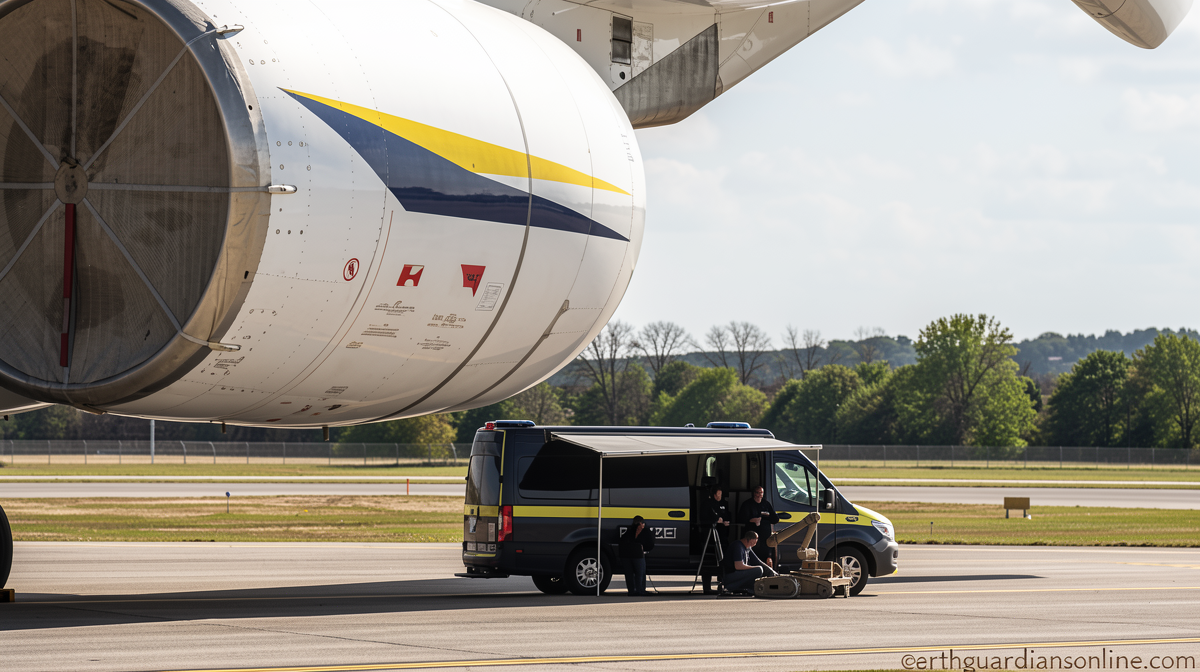
On August 5, a drone loaded with military-grade explosives was located inside a secured zone of Leipzig/Halle Airport, close to the south runway where cargo operations concentrate. German authorities dispatched a bomb-disposal robot to the site; the device’s detonator was carefully extracted. Photographs released afterward showed the robot positioned near a Ukrainian cargo aircraft parked on the apron.
A US defense official stationed in Europe confirmed that the aircraft’s payload was consistent with military ordnance and that the drone was assessed as belonging to a Russian intelligence service. The same day, a second airborne object struck a cargo plane in the vicinity, inflicting minor damage. That aircraft completed its flight and landed safely in Hannover.
German media subsequently reported that a third drone had been recovered from a field roughly a week after the initial discovery, fueling speculation that the operation was designed to deploy multiple devices simultaneously. The Federal Prosecutor’s Office, which is leading the investigation, declined to elaborate, citing the ongoing nature of the inquiry.
Moscow Dismisses the Accusation
The Kremlin pushed back swiftly. Foreign Ministry spokeswoman Maria Zakharova characterized the German measures as manufactured justification for long-standing grievances.
“The Russian House has long haunted them,” Zakharova stated. “That’s why they were looking for something to latch onto. Moscow will respond to all anti-Russian decisions.”
Her remarks signaled that Russia intends to treat the closure of its cultural and consular facilities as actionable provocations rather than routine diplomatic friction.
NATO Reaffirms Collective Posture
Alliance Secretary General Mark Rutte endorsed Germany’s steps and used the occasion to restate NATO’s commitment to Ukraine as “unwavering.” He added that the alliance would “continue to strengthen our ability to deter and defend all Allies against any threat – including malign actions like those seen in Leipzig.” The language positions the Leipzig episode within the broader deterrence architecture rather than as a bilateral dispute.
Why Leipzig/Halle Matters to Ukraine
The airport’s significance extends far beyond German logistics. Since Russia’s full-scale invasion of Ukraine began in February 2022, Antonov Airlines — Ukraine’s principal cargo carrier — has operated from Leipzig/Halle after its home base at Hostomel, northwest of Kyiv, was destroyed in the opening days of the war. The airport thus functions as a critical node for delivering military and humanitarian supplies to Kyiv. A drone found adjacent to one of those Ukrainian aircraft carries implications that reach well beyond German airspace.
Dobrindt himself framed the event as a qualitative shift. At the time of discovery he noted that while drone sightings and hybrid-context threats were familiar, an explosives-armed drone physically present at an operating airport constituted “a new threat scenario.”
A Pattern Across the Continent
Western intelligence agencies have repeatedly linked a series of apparently disconnected incidents across Europe to Russian operations: arson at warehouses, high-profile cyber intrusions, GPS jamming episodes that disrupted commercial flights, and sabotage targeting undersea communication cables, logistics depots, and railway lines. Each event in isolation might be dismissed; taken together, they outline a sustained effort to degrade European readiness and cohesion without crossing the threshold of open armed conflict.
Washington has warned that the calculus could shift. Recent US intelligence assessments, shared with three sources familiar with the reporting, indicate that President Vladimir Putin may seek to test NATO’s resolve by launching a limited strike against an allied country within the coming years. The Kremlin was reached for comment on that assessment.
For European publics, the Leipzig episode crystallizes an uncomfortable arithmetic: the distance between a drone found on a cargo apron and a conventional military confrontation is shorter than it was five years ago, and the institutional machinery now exists on both sides to ensure that neither side underestimates the other’s next move.
Related Reading
Frequently Asked Questions
What is Germany blames Russia for drone attack?
Germany blames Russia for drone attack is the main topic of this guide. The article explains the context, practical details, and next steps readers should understand.
Why does Germany blames Russia for drone attack matter?
Germany blames Russia for drone attack matters because readers are looking for a useful answer, not just a short summary. Good content should match search intent and help them decide what to do next.