When Lake Mead hits new lows, its waters unveil mysteries. Last time, it revealed a murder case that is still unsolved

Daftar Isi
Record-Low Waters at Lake Mead Surface New Bones and an Unsolved Decades-Old Murder
Earthguardiansonline.com – A jagged jawbone, still studded with yellowed teeth, was pulled from a pile of rocks at the waterline on August 16, 2026, just days after the reservoir registered a historic low of 1,040.5 feet above sea level. Within hours, several additional curved, slender bones surfaced nearby, according to photographs shared with local broadcast station KLAS. The Clark County Coroner’s Office has taken custody of the fragments and is working to determine who the person was and how they died. Park authorities are examining the scene but have indicated they do not believe the individual was killed.
The find is the latest in a long sequence of revelations that Lake Mead’s shrinking shoreline has produced along the Nevada-Arizona border. Hundreds of miles of previously submerged terrain have been exposed this month as the reservoir slid to another all-time low, and the pattern of discovery stretches back to the previous record drought of 2022.
What the Receding Waters Have Already Uncovered
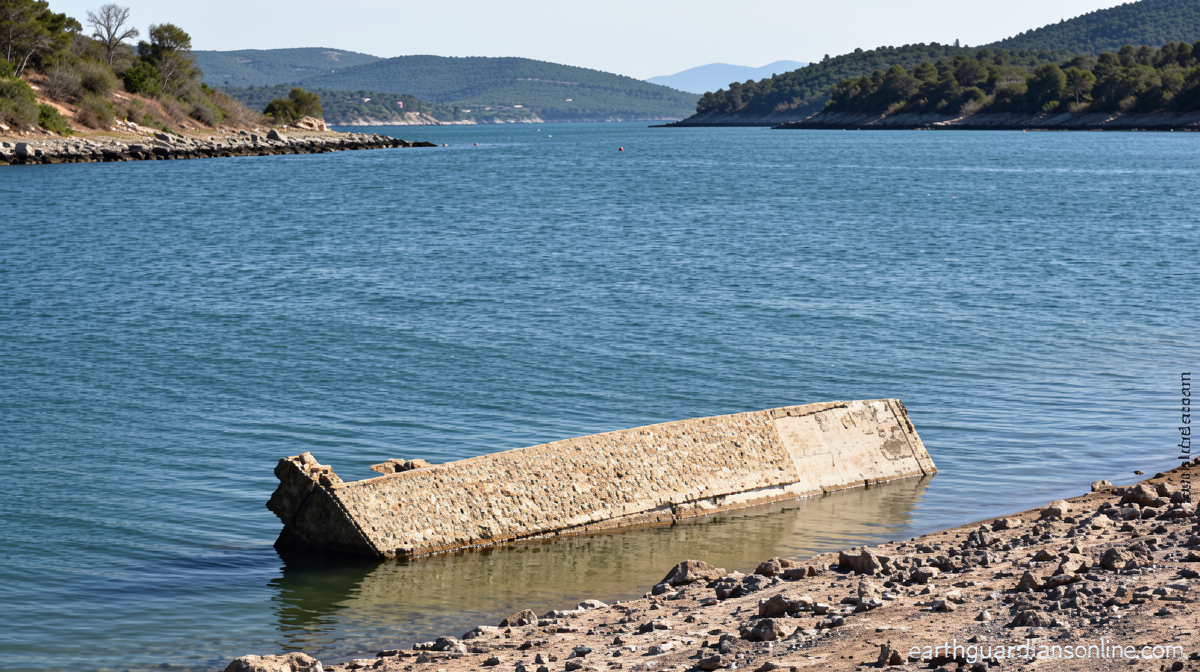
When the lake last bottomed out in 2022, the sudden exposure of its basin laid bare a catalogue of forgotten objects. The skeletal frame of a World War II-era vessel, unseen for decades, caught sunlight for the first time in years. An abandoned houseboat sat stranded on dry sand. Dozens of small craft—skiffs, speedboats, watercraft long abandoned by their owners—emerged from the mud. These curiosities, while striking, were merely the opening act.
The far more disturbing discovery came on a bright morning in May of that year at Hemenway Harbor, one of the reservoir’s most frequented recreational beaches. A visitor walking the shore stumbled upon a heavily corroded metal barrel. Through a gaping hole in the deteriorated steel, she could see the decomposed remains of a man sealed inside. His bones were still encased in battered jeans, Velcro-closure sneakers, and a silver Timex wristwatch.
The Hemenway Harbor Doe: A Cold Case That Will Not Close
Las Vegas police quickly classified the man as a homicide victim from the 1970s or early 1980s. Lieutenant Jason Johansson of the Las Vegas Police Department homicide unit told CNN at the time that the victim had clearly sustained a gunshot wound, a conclusion officers reached simply by looking through the hole in the barrel on May 1, 2022. No coroner’s confirmation was needed to recognize that a murder investigation was underway.
Former homicide lieutenant Ray Spencer, who oversaw the unit when the body was recovered, described the deliberate measures taken to conceal the victim.
“The person (who disposed of the body) took a lot of steps to make sure that the victim had not been recovered,” Spencer said.
The barrel had been punctured in several places and dumped well offshore, Spencer explained. Whoever discarded the remains almost certainly never anticipated that the reservoir’s shoreline would one day retreat hundreds of feet, exposing the very spot where they had hidden their crime.
The victim had been dressed in a 2X-sized striped short-sleeved button-down shirt, jeans, and Trax-brand Velcro sneakers. The cool, freshwater environment preserved the clothing well enough for investigators to date the death to the mid-1970s through the early 1980s—an era when organized crime still held a firm grip on Las Vegas and the city was cementing its reputation as a dazzling destination for ambition and excess.
Despite years of forensic effort, including DNA analysis and traditional investigative work, the identity of the Hemenway Harbor Doe remains unknown. Three additional sets of remains discovered in the same 2022 shoreline exposure have since been identified through genetic testing and records research. The homicide victim, however, has resisted every attempt to name him. Locals and true-crime communities continue to generate theories about his fate, but no official identification has been announced.
The Water Crisis Behind Every Discovery
The mechanism that keeps turning up these secrets is not mysterious. Lake Mead reached its peak elevation in 1983 at 1,225 feet above sea level. Since then, the water surface has dropped nearly 200 feet. The decline is driven by a combination of climate-change-fueled mega-drought and sustained over-allocation of Colorado River water, a crisis that has pushed the river system and its dependent reservoirs into unprecedented stress.
“If you were to go back 40 years ago, where the victim was found was probably about half a mile to a mile offshore,” Spencer said.
That single observation captures the scale of what has changed. A spot that was open water in the late 1970s or early 1980s is now dry, walkable ground. Every foot of retreat exposes new terrain—new artifacts, new bones, new questions.
The August 2026 jawbone and associated fragments represent the latest chapter in that ongoing exposure. The Clark County Coroner’s Office has not yet released a preliminary cause of death or demographic profile for the new remains. Park officials continue their scene investigation. Meanwhile, the Hemenway Harbor case from four years ago remains open, its victim still nameless, still waiting for someone to connect a face to a set of bones that spent decades sealed in a punctured drum beneath a lake that no longer covers them.
Related Reading
Frequently Asked Questions
What is When Lake Mead hits new lows?
When Lake Mead hits new lows is the main topic of this guide. The article explains the context, practical details, and next steps readers should understand.
Why does When Lake Mead hits new lows matter?
When Lake Mead hits new lows matters because readers are looking for a useful answer, not just a short summary. Good content should match search intent and help them decide what to do next.