Kevin Warsh has a plan for the Fed. Scott Bessent is getting in the way

Daftar Isi
Two Trump Appointees, Two Opposite Philosophies: The Fed-Treasury Clash Over Bond Markets
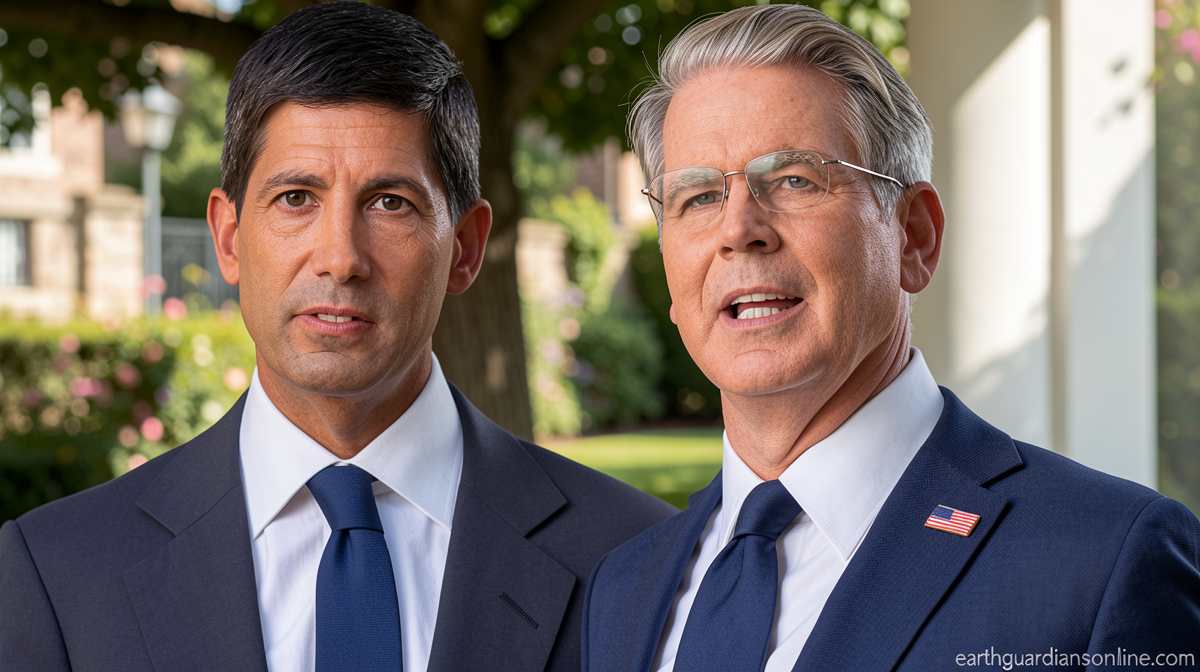
Earthguardiansonline.com – The White House installed two powerful figures in charge of America’s monetary and fiscal levers, and they are now pulling in fundamentally different directions. Federal Reserve Chair Kevin Warsh, selected by President Donald Trump to lead the central bank, has launched what amounts to a live experiment in market communication. Treasury Secretary Scott Bessent, Trump’s chief economic voice, has stepped into the bond market with a program that directly undermines the conditions Warsh needs his experiment to succeed.
Warsh’s Gamble: Letting the Market Speak for Itself
For roughly two decades, the Federal Reserve has operated under a regime of escalating transparency. Press conferences after every policy meeting, dot plots projecting individual policymakers’ rate expectations, and even televised interviews on programs like CBS’s “60 Minutes” have become standard fare. Wall Street built its entire trading architecture around decoding these signals.
Warsh has dismantled that architecture. He has ceased providing the incremental hints that traders once relied on to anticipate the next policy move. His stated rationale is elegant in theory: if the Fed stops telegraphing its interpretation of incoming data, bond markets will react purely to the economic numbers themselves. Those unfiltered market reactions, in turn, would serve as a cleaner compass for Fed officials deciding whether to tighten or ease policy.
The practical difficulty is enormous. Decades of conditioning have made traders compulsive readers of Fed subtext. Asking them to ignore the central bank’s own commentary on its data releases is, by most accounts, close to impossible.
Bessent’s Intervention: Fogging the Windshield
Into this already fragile setup walked Bessent last week with a surprise announcement: the Treasury would at least double its pace of bond buybacks. The department framed the move as a routine liquidity measure, a technical adjustment to keep markets functioning smoothly. Analysts, however, read the signal differently. With the 30-year Treasury yield having recently surged to its highest reading since 2007 — the eve of the Great Financial Crisis — the timing and scale of the buyback program looked less like plumbing maintenance and more like an active effort to cap yields.
The effect was immediate. US Treasury rates fell after the announcement, precisely the outcome Bessent has long sought. But the price of that relief was the destruction of the very signal Warsh needs. If the Treasury is actively purchasing bonds to suppress prices, the resulting yield levels no longer reflect organic market sentiment. They reflect policy intervention.
“It’s not a clean signal of what the market wants if Treasury is intervening,” said Eric Rosengren, former president of the Federal Reserve Bank of Boston.
Rosengren went further, dismissing the liquidity rationale outright.
“There is no chaos in the Treasury market. The liquidity argument doesn’t hold. It looks a lot more like window-dressing before the midterms.”
Druckenmiller’s Rebuke and the AI Controversy
Stanley Druckenmiller, the legendary macro investor who mentored Bessent early in his career, published an op-ed in The Wall Street Journal under the headline “Let the bond market speak.” In it, he labeled the buyback expansion “artificial yield suppression.” The commentary drew a secondary controversy when critics noted that Druckenmiller had used artificial intelligence to draft the piece, a detail that complicated the force of his argument.
The Inflation Backdrop Makes the Conflict Sharper
Warsh has repeatedly emphasized that inflation has remained above the Fed’s 2 percent target for five and a half years. During the summer, Fed officials debated whether to raise short-term rates in response. At minimum, they agreed to hold rates steady. Bessent, meanwhile, appears committed to the opposite impulse: engineering lower long-term rates through direct market participation.
If the Treasury succeeds in pushing down long-duration yields, the ripple effects would lower mortgage payments, reduce corporate borrowing costs, and cut the federal government’s own interest expense. Each of those channels, however, carries the potential to rekindle price pressures — precisely the problem Warsh is trying to solve.
“The Fed and Treasury are working at cross purposes, which is not productive,” Rosengren observed.
A Transparency Reversal Few Have Attempted
The historical context makes Warsh’s communication pivot even more audacious. Under Alan Greenspan, who chaired the Fed through the late 1990s and into the early 2000s, the central bank offered minimal detail about its reasoning. The modern era of transparency began in the mid-2000s and accelerated after the financial crisis, when Congress and markets demanded accountability.
Reversing that trajectory is not a simple policy toggle. Benson Durham, a former Fed official and founder of the independent research firm DASM LLC, cautioned that the transition would be turbulent.
“Taking back transparency will be really difficult to pull off smoothly. It’s hard to put the genie back in the bottle.”
Durham also highlighted the asymmetry between the two Trump appointees’ communication styles.
“You have a Fed chair who doesn’t say enough and a US Treasury secretary who says too much.”
The Referee Analogy and Its Limits
At the July policy meeting, Warsh defended his approach with a sports metaphor, arguing that elevated Treasury yields were evidence markets were finally focusing on real data rather than Fed commentary.
“Market participants are learning to play the ball, not the referee,” Warsh said.
Economists and market watchers have pushed back on the analogy. A referee does not take shots, does not own the ball, and does not set the score. The Fed, by contrast, is an active participant in financial markets: it sets the federal funds rate directly, influences longer-term yields through balance-sheet operations, and shapes expectations through every public statement. The comparison collapses under scrutiny.
Tim Mahedy, a former San Francisco Fed official now serving as CEO of research firm Access/Macro, captured the broader tension with a wry observation about the relationship between the two men.
“If timing is everything in love, the bromance between Bessent and Warsh may be coming to an end.”
For investors navigating the coming months, the practical implication is stark. The two most powerful voices in American economic policy are now generating contradictory signals. Bond traders who once parsed Fed transcripts for hidden meaning now face a second, louder voice from Treasury that actively distorts the very data they were supposed to read. Until the conflict resolves — or until one philosophy clearly prevails — market volatility around every data release and every policy announcement is likely to remain elevated, and the question of who truly guides whom will stay unanswered.
Related Reading
Frequently Asked Questions
What is Kevin Warsh has a plan?
Kevin Warsh has a plan is the main topic of this guide. The article explains the context, practical details, and next steps readers should understand.
Why does Kevin Warsh has a plan matter?
Kevin Warsh has a plan matters because readers are looking for a useful answer, not just a short summary. Good content should match search intent and help them decide what to do next.