Japanese artist Yayoi Kusama, who filled the world with polka dots, dead at 97

Daftar Isi
The Dot That Outlived Its Maker: Yayoi Kusama’s Final Chapter
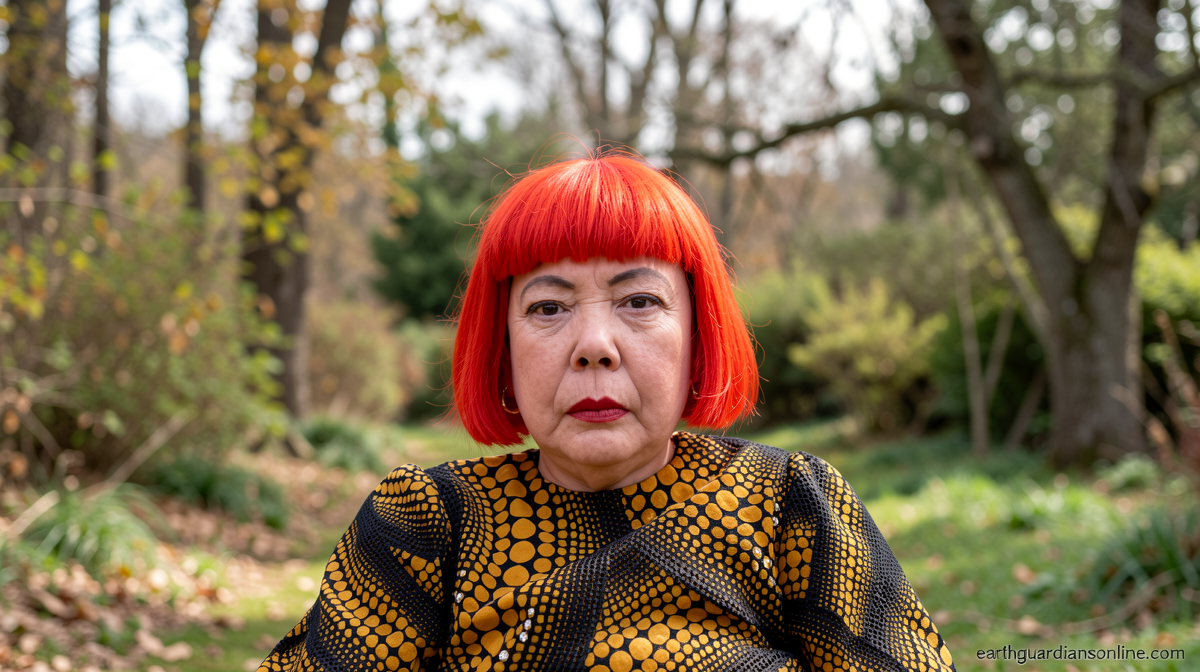
Earthguardiansonline.com – The woman whose repeating circles became synonymous with contemporary art itself has died. Yayoi Kusama, the Japanese-born painter, sculptor, and performance artist whose work now commands tens of millions of dollars at auction, passed away at the age of 97. A statement published on her official website on Thursday confirmed the news, noting that she died at a hospital in Tokyo on August 14. The announcement carried the weight of a global farewell: millions of visitors had queued for her immersive installations, collectors had bid fiercely for her canvases, and museums from Manhattan to Milan had built entire wings around her output. Yet the trajectory from a traumatized child in a wartime sewing factory to the most commercially dominant living artist of her generation remains one of the most improbable arcs in twentieth-century culture.
A Childhood Flooded with Patterns
Kusama was born in 1929 into a household marked by dysfunction and abuse. During the Second World War, much of her adolescence was spent inside a military factory, stitching parachutes for Japan’s imperial army. It was during these years that her hallucinations intensified — vivid, inescapable visions in which polka-dots proliferated across her field of sight, dissolving the boundaries between objects and space. Those involuntary patterns would become the visual signature of an entire career.
She enrolled briefly at an art school in Kyoto to study nihonga, the modernist Japanese painting tradition, but showed little sustained interest in its conventions. From the earliest works she produced, her preoccupations were abstraction, obsessive repetition, and the dot motifs that would later crystallize into the celebrated “Infinity Nets” series. Formal training in Japanese aesthetics was, for Kusama, a brief interlude rather than a foundation.
Crossing the Pacific, Subverting New York
A correspondence with American painter Georgia O’Keeffe, combined with a growing disillusionment with postwar Japanese life, prompted the 27-year-old Kusama to leave Japan in the late 1950s. She first landed in Seattle before relocating to New York, arriving just as the pop art movement was taking shape. What followed was a sustained assault on the city’s dominant abstract-impressionist vocabulary: Kusama replaced gestural brushwork with storms of dots, floral forms, and phallic protrusions, generating a vast body of work spanning painting, sculpture, film, literature, and performance.
In keeping with the countercultural ferment of the 1960s, she staged “happenings” in which nude participants were transformed into living, dotted canvases. She also made headlines in 1968 by sending an open letter to President Richard Nixon, offering to have sex with him on the condition that he end the Vietnam War.
“Let’s forget ourselves, dearest Richard,” she wrote, “and become one with the Absolute, all together in the alltogether (sic).”
Nixon did not respond. The war would continue until the Fall of Saigon in 1975. Still, the episode underscored a consistent thread in Kusama’s practice: beneath the exuberant color and playful geometry lay a willingness to confront gender equality, gay rights, and anti-war politics head-on.
The Outsider Within the Establishment
Despite friendships with figures as prominent as Andy Warhol and Donald Judd, Kusama was never fully absorbed into the Western art establishment. The Guggenheim Museum’s senior curator of Asian art, Alexandra Munroe, captured the dynamic in a profile written for Kusama’s ninetieth birthday in 2018:
“Besides being a foreign woman of color from a chastened Asian power, the psychological content of (Kusama’s) work set her identity apart from the Western mainstream that wrote the first histories of the 1960s avant-garde.”
The irony was not lost on the art world: institutions routinely drew on, and at times directly copied, her visual language while withholding full institutional recognition from the artist herself.
Exile, Hospital, and the Long Reemergence
In the early 1970s Kusama returned to Japan and effectively vanished from public view. Within a few years she voluntarily checked into a psychiatric facility, where she would reside for decades. Compulsively prolific and rarely inclined to draft compositions before beginning, she continued to produce paintings, sculptures, and installations from the hospital and a small adjacent studio. For more than a decade she existed in what amounted to creative wilderness, unknown to most of the international market.
The late 1980s brought a seismic revaluation. Viewed through a contemporary critical lens, her earlier work acquired new urgency and recognition. Long-forgotten canvases resurfaced at Western exhibitions, culminating in a high-profile career retrospective at New York’s Center for International Contemporary Arts in 1989. In 1993, the belated institutional embrace seemed to solidify when she was invited to represent Japan at the Venice Biennale — the very event she had, twenty-seven years earlier in 1966, essentially gatecrashed by unofficially displaying 1,500 mirrored plastic balls on the lawn outside the Italian Pavilion. Officials intervened to stop her attempts to sell the globes for two dollars apiece.
The Commercial and Cultural Aftermath
From that point forward, Kusama’s market presence accelerated dramatically. Her “Infinity Mirror Rooms” — large-scale installations that envelop visitors in endlessly repeating reflections of color and light — drew millions of gallery attendees worldwide. Pumpkin sculptures and polka-dot paintings generated millions of dollars in auction revenue, making her, by the time of her death, one of the most commercially successful figures in contemporary art. The global recognition she achieved in later life was rendered all the more remarkable by the obstacles she had navigated to reach it: childhood trauma, decades of mental illness, years of relative obscurity, and the persistent marginalization of a foreign woman working within a Western-dominated field. The dots that once flooded her vision as involuntary hallucination had, by the end, become the most recognizable visual motif in the global art market — a pattern that outlived its maker and will continue to repeat, indefinitely, in galleries and auction houses long after the woman who set it in motion has gone.
Related Reading
Frequently Asked Questions
What is Japanese artist Yayoi Kusama who filled?
Japanese artist Yayoi Kusama who filled is the main topic of this guide. The article explains the context, practical details, and next steps readers should understand.
Why does Japanese artist Yayoi Kusama who filled matter?
Japanese artist Yayoi Kusama who filled matters because readers are looking for a useful answer, not just a short summary. Good content should match search intent and help them decide what to do next.