A power struggle in Iran could decide when Trump’s war ends

Daftar Isi
Iran’s Fractured Leadership Faces a Make-or-Break Decision on War and Peace
Earthguardiansonline.com – With Supreme Leader Mojtaba Khamenei still concealed from public view and six months of sustained combat between the Islamic Republic and a US-Israeli coalition behind it, Tehran is locked in a bitter internal contest over whether to seal a negotiated settlement or press its advantage on the battlefield. The question echoes one posed more than four decades ago, when the young revolution’s leadership chose to extend a war that had already cost hundreds of thousands of lives rather than accept a partial victory.
The Ghost of 1982
In the spring of 1982, after months of grinding setbacks against Saddam Hussein’s Iraqi army, tens of thousands of young Iranian soldiers surged forward in a surprise assault that reversed the momentum of the conflict. The then-supreme leader, Ayatollah Ruhollah Khomeini, saw beyond the immediate tactical gain. His ambition was to overthrow the Iraqi dictator — who was receiving growing backing from Washington — and to send a message to every future adversary that war against Iran would carry an unbearable price. That single decision transformed what might have been a short campaign into a six-year war of attrition, one of the most lethal conflicts in the region’s modern history. The episode remains a defining reference point for how Iran’s revolutionary establishment understands war, endurance, and the politics of victory.
Today, the same ideological gravity pulls Tehran’s leadership in opposite directions. The revolutionaries who commanded that 1982 offensive still occupy the most powerful seats in the capital. To them, the present US-Israeli war is an imposed conflict whose outcome will hinge not on raw military superiority but on which side simply refuses to blink first. Across the aisle, a more pragmatic faction senses an opening to lock in whatever gains have been extracted from months of stalled negotiations.
The Pragmatists: Closing the Window
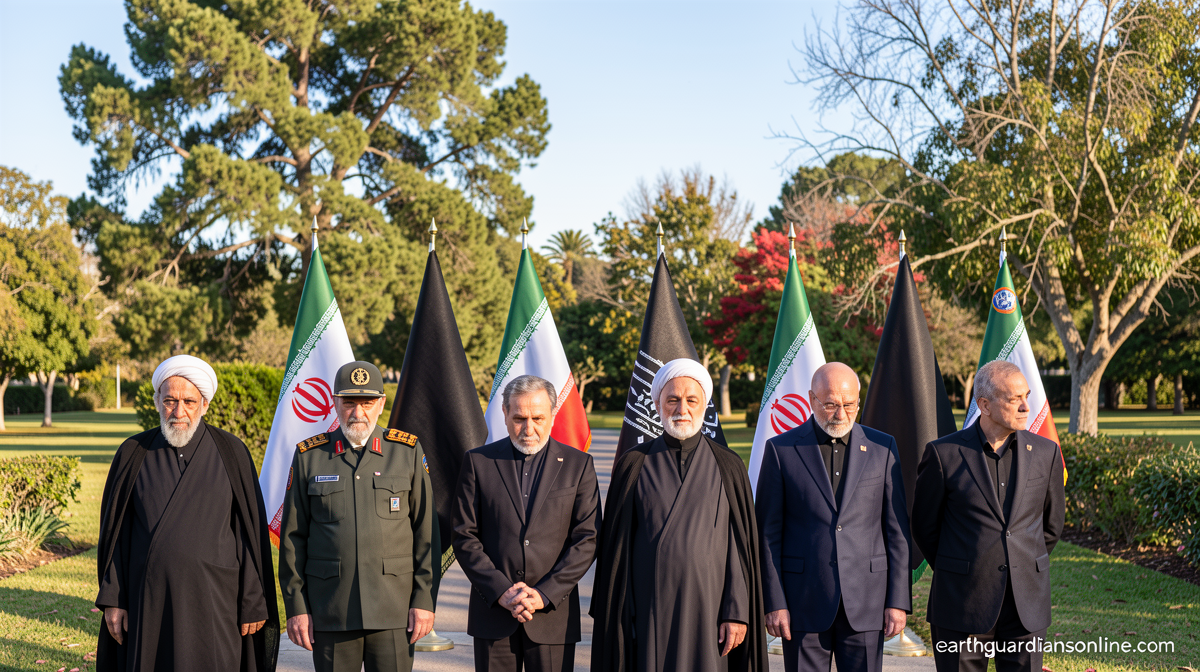
President Masoud Pezeshkian, Parliament Speaker Mohammad Bagher Ghalibaf, and Foreign Minister Abbas Araghchi form the core of a technocratic camp that argues the time for a conclusive agreement is running out. Their case rests on a war-ravaged economy, the grinding pressure of a US naval blockade, and visible damage to national infrastructure. They contend that the Islamic Republic’s domestic crises — currency collapse, energy shortages, public discontent — can only be alleviated by ending the 47-year confrontation with Washington and breaking the country’s global isolation.
“The war must end at some point,” Pezeshkian said this month. “It would be better to end it today, while we are in a position of strength and dignity, and the entire world acknowledges our victory.”
For this faction, the June ceasefire agreement — bearing both Pezeshkian’s and Trump’s signatures — represents a fragile but genuine opportunity to convert military endurance into diplomatic leverage before the window narrows further.
The Hardliners: Endurance as Strategy
Opposing them stands a conservative bloc whose worldview is built on half a century of suspicion toward Washington. They regard the United States as an actor committed to dismantling the Islamic Republic, and they point to Trump’s own war as vindication of warnings their moderate rivals dismissed for decades. They further accuse sitting officials of being “Western-oriented,” of inflating domestic problems to manufacture public appetite for a deal, and of deliberately mismanaging the economic crisis to exhaust the population into accepting terms.
“They see the US as a deeply untrustworthy actor… and (have) been burnt so many times by Trump himself that they think that this is exactly what will happen again,” Sanam Vakil, director of the Middle East and North Africa program at London’s Chatham House think tank, told CNN. “In their minds, by not losing (the war), they’ve won, and they’re not just trying to win out with a better deal from Washington, but they’re looking for internal longevity in their competition with their opponents.”
This camp treats the Islamic Republic’s sheer endurance as its greatest strategic asset. They cite the 2015 nuclear agreement signed under the Obama administration — later torn up by Trump — and two separate US military strikes launched while negotiations were still underway, as proof that Washington cannot be trusted to honor any arrangement. For them, a policy of sustained confrontation is not merely preferable; it is the only rational posture.
Accusations, Fuel Shortages, and the Question of a Coup
The rivalry has sharpened into open accusation. Hardline lawmakers allege the government has engineered fuel shortages to make an agreement feel unavoidable to the public. Others go further, suggesting moderates are staging a coup to force through terms. The divisions run so deep that some conservatives openly question whether the economic collapse is genuine or manufactured.
“Economically, are we really in a dead end, or are you just projecting a dead end?” asked hardline lawmaker Mohammad-Manan Raisi. “It has all been blamed on the war, while it is not all related to the war.”
Pezeshkian himself is a particular target. Hardliners portray him as a weak president who assumed office almost by accident after his predecessor died in a helicopter crash. His signature on the June ceasefire, they argue, has further isolated him and empowered their campaign to pin the shattered economy and the failed Washington negotiations squarely on his shoulders.
What Stakes the Outcome
With the ultimate arbiter — Supreme Leader Khamenei — absent from public decision-making, the balance between these two camps will determine whether Iran walks toward a negotiated settlement or into a prolonged second phase of confrontation. The historical parallel is inescapable: in 1982, the choice to press on rather than consolidate cost hundreds of thousands of lives and reshaped the region’s balance of power for decades. The question now is whether Tehran’s leadership will repeat that calculus, or whether the exhaustion of six months of war, a strangled economy, and a divided public will finally tip the scales toward the negotiating table.
Related Reading
Frequently Asked Questions
What is A power struggle in Iran could?
A power struggle in Iran could is the main topic of this guide. The article explains the context, practical details, and next steps readers should understand.
Why does A power struggle in Iran could matter?
A power struggle in Iran could matters because readers are looking for a useful answer, not just a short summary. Good content should match search intent and help them decide what to do next.