Kennedy Center removes outdoor ‘Blue’ sculpture

Daftar Isi
Stick-Figure Sculpture Vanishes from Kennedy Center Grounds Amid Ongoing Institutional Overhaul
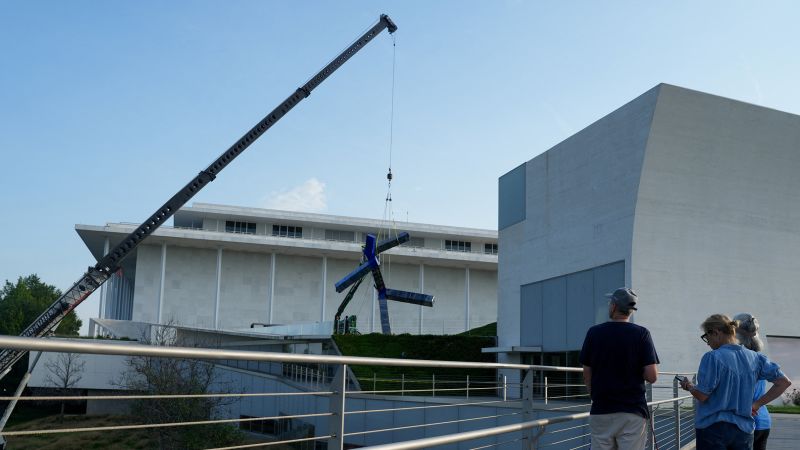
Earthguardiansonline.com – On the morning of Wednesday, September 2, 2026, heavy cranes descended on the Washington, D.C. waterfront to dismantle a seven-year-old public artwork that had stood as one of the Kennedy Center’s most recognizable outdoor landmarks. The sculpture, a towering stick figure captured in the act of kicking, was hauled away piece by piece while the National Park Service shut down a nearby roadway for several hours to manage the operation. Its departure marks the latest chapter in a prolonged effort by President Donald Trump to remake the performing-arts institution into something closer to a personal showcase.
The Sculpture and Its Artist
Titled “Blue,” the work was created by American sculptor Joel Shapiro and installed on the Kennedy Center’s exterior grounds in 2019. Shapiro’s practice centers on simplified, elongated human forms rendered in steel, often frozen in dynamic gestures that evoke movement, play, and physical comedy. “Blue” depicted its stick-figure subject mid-kick, a pose that gave passersby a recurring visual joke against the backdrop of the center’s modernist architecture. For nearly seven years the piece served as an informal greeting to visitors arriving from the Potomac side, a lighthearted counterpoint to the institution’s more formal programming.
Official Explanation: Routine Deinstallation
A Kennedy Center spokesperson framed the removal as a standard curatorial decision. In a written statement, the venue described the action as a “deinstallation,” a term the spokesperson characterized as “common practice” in the world of public art management.
“We are deeply grateful to Joel Shapiro for the years Blue has spent animating our campus and we are honored to have been stewards of his vibrant work and a part of his enduring legacy.”
The language of stewardship and gratitude, however, sits in tension with what at least one former insider claims happened behind the scenes.
A Curator’s Account and Its Denial
Josef Palermo, who previously served as a curator at the institution, stated that in September 2025 he received instructions to strip every piece of outdoor sculpture from the grounds, “Blue” included. His explanation was straightforward: the president wanted “all new art for the reopening,” meaning the center’s planned post-renovation relaunch would feature an entirely refreshed visual environment. A person familiar with the situation pushed back on Palermo’s version of events, suggesting the decision was not a single top-down order but a more layered institutional process. The White House was contacted for comment and had not responded as of publication.
Trump’s Footprint at the Kennedy Center
The sculpture’s removal does not occur in isolation. Since returning to the White House in early 2025, Trump has pursued an unusually direct role in the Kennedy Center’s governance. He personally selected members of the center’s board of trustees and subsequently was elected to chair that board, a position that places him at the apex of decisions ranging from programming to capital projects. The board later voted to affix his name to the building itself, a move that triggered legal challenges from opponents who questioned whether a sitting president could lend his name to a federally funded cultural institution without breaching norms of separation between government and artistic programming.
Those challenges have not ended. Earlier this year, Trump announced that the Kennedy Center would shut its doors for roughly two years of major renovations. The closure was originally scheduled to begin on July 4, but a federal judge intervened, ruling that the renovation plans had been authorized unlawfully. Rather than retreat, the administration and the board have continued pressing forward, contesting the ruling at every available level. Last month, attorneys representing the center went so far as to threaten demolition of the existing structure if the renovation work could not proceed, a statement that drew sharp criticism from preservation advocates and members of Congress alike. The board has also reaffirmed its intention to add Trump’s name to the building once again, signaling that the naming dispute remains unresolved.
Advocacy Groups React
The activist organization Hands Off the Arts, which monitors government interference in cultural institutions, took to social media within hours of the cranes appearing. In an Instagram post, the group labeled “Blue” a “beloved figure” and called its removal “buffoonery.”
“Wednesday, September 2, 2026 will forever be known as the day the United States government tore down a piece of public art at the behest of a petulant crybaby. But it won’t be the last.”
The organization’s language, pointedly aimed at the president, framed the event not as a curatorial choice but as an act of political will imposed on a public space. That framing resonates with a broader anxiety among arts advocates: when a single individual controls both the executive branch and the board of a major cultural institution, the line between institutional autonomy and personal preference becomes difficult to draw.
Why It Matters
Public sculpture occupies a unique position in American civic life. Unlike gallery works that can be rotated seasonally, outdoor installations become woven into the daily visual fabric of a neighborhood. Their removal, particularly when timed to coincide with a political figure’s stated aesthetic preferences, raises questions about who decides what a public institution looks like and whether that decision can be insulated from partisan influence. The Kennedy Center, funded in part by federal appropriations and situated on land managed by the National Park Service, operates at the intersection of private governance and public trust. Each decision about its physical environment therefore carries implications beyond the institution’s own walls, touching on norms of artistic independence, taxpayer-funded cultural stewardship, and the appropriate distance between a sitting president and the institutions he nominally oversees.
As the renovation legal battles continue and the board presses its agenda, the empty space where “Blue” once stood may prove to be less a blank canvas than a contested one.
Related Reading
Frequently Asked Questions
What is Kennedy Center removes outdoor Blue sculpture?
Kennedy Center removes outdoor Blue sculpture is the main topic of this guide. The article explains the context, practical details, and next steps readers should understand.
Why does Kennedy Center removes outdoor Blue sculpture matter?
Kennedy Center removes outdoor Blue sculpture matters because readers are looking for a useful answer, not just a short summary. Good content should match search intent and help them decide what to do next.