It’s always Shark Week in Putin’s world. That doesn’t bode well for Trump’s Ukraine peace hopes

Daftar Isi
Putin’s Predator Metaphor Signals No Retreat on Ukraine as SCO Summit Unfolds in Bishkek
Earthguardiansonline.com – The week in Bishkek carried the weight of multiple simultaneous crises. Iran and the United States had just exchanged another volley of retaliatory strikes. Russian drones and ballistic missiles continued to rain across Ukrainian cities. Germany had publicly accused Moscow of responsibility for a drone that struck Leipzig airport the previous month. Into that volatile atmosphere walked Vladimir Putin, arriving for the Shanghai Cooperation Organization summit alongside Chinese leader Xi Jinping, Indian Prime Minister Narendra Modi, and Iranian President Masoud Pezeshkian.
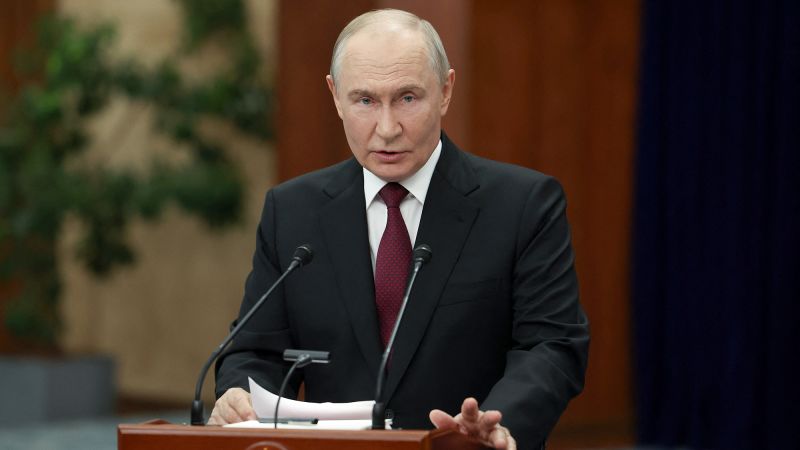
Yet the Russian president struck a tone of unshaken confidence. At a press conference late Tuesday, he seized upon a marine-biology analogy he had floated days earlier — killer whales consuming polar bears — and expanded it into a full-throated declaration of strategic intent. The comparison was not subtle, nor was it meant to be.
The Orca and the Shark
When Kremlin pool reporter Pavel Zarubin pressed him on the earlier remark about orcas devouring polar bears, Putin framed the statement as a “spontaneous” analogy for Russia’s ongoing confrontation with Western powers. He then elaborated with characteristic theatricality:
“I would say that the orca is, without doubt, a formidable predator, yet it is also a highly intelligent creature, a cunning one.”
He cast the collective West in the role of sharks — a label, he noted, inherited from Soviet-era rhetoric that “remains current to this day.”
“The collective West, for its part, was assigned a specific definition in the Soviet era, which remains current to this day – the sharks of imperialism.”
Taxonomically, orcas and sharks occupy very different branches of the animal kingdom. Putin did not appear to care. He pressed the metaphor further, warning that any attempt to drag Russia down the food chain would meet a brutal response:
“The thrust of my remarks was that if anyone attempts to drag us down the food chain and devour us, to consume us, they would be well advised to expect their teeth to be broken.”
“And Russia stands ready to do precisely that, despite the insatiable appetites and ever-sharpening teeth of these sharks.”
The domestic audience at home would have heard a familiar refrain: the state will not yield, no matter the cost. For international counterparts watching from Washington, Brussels, or Berlin, the message was equally unambiguous — Moscow intends to press its military advantage in Ukraine regardless of battlefield fluctuations or the economic toll that deep-strike campaigns impose on ordinary Russians.
Ukraine’s Sky Under Siege
The rhetorical posturing arrived amid a grim operational reality. Ukrainian children were returning to classrooms as the new school year opened, only to find themselves sheltering underground amid continuous Russian bombardment. Russian forces had been saturating Ukrainian cities with drone swarms and missile salvos, stretching Kyiv’s air-defense network to its limits.
Ukrainian President Volodymyr Zelensky warned on Tuesday that Russian airspace “will effectively be closing” because of the presence of Ukrainian drones operating inside it. Putin’s response was to pretend the remark had never been made. He dismissed the escalatory language outright:
“Such comments… amount to nothing less than a call for state-sponsored terrorism. And I would point out that they are asking us to resume negotiations and requesting face-to-face meetings. One does not negotiate with terrorists.”
He extended the same dismissive treatment to Germany’s Leipzig accusation, implying Berlin had staged a deliberate provocation by planting evidence at the scene.
“There is only one explanation offered: the need to counter an ‘aggressive Russia,'” Putin said. “But where is the proof? Well, now some ‘proof’ has been planted.”
A Narrow Door Toward Washington
Despite the bluster aimed at Ukraine and Europe, Putin adopted a noticeably softer register when the conversation turned to the Trump administration. He was asked about the recent Moscow visit by CIA Director John Ratcliffe. Without disclosing specifics, he characterized the intelligence-level contacts as constructive and continuous.
“Contacts are always there, even during the most difficult times of the Cold War, and they are even more so now,” he said. “We favor negotiations, any negotiations, being filled first and foremost with concrete content. And if someone makes or can make a concrete contribution to this process, we’re all for it.”
He then named his preferred channels for any future bargain with President Donald Trump: special envoy Steve Witkoff and Jared Kushner, the president’s son-in-law. The pairing is unconventional by diplomatic standards, but Putin framed their proximity to Trump as an asset rather than a liability.
“These are people close to President Trump. In my opinion, they are sincere people and strive to bring concrete substance to our work. And the president trusts them, which is very important, and without this it is generally impossible to conduct any negotiations,” the Russian leader said. “Both Mr. Kushner and Witkoff are always welcome guests to us, and we are happy to work with them.”
The distinction between the two registers — predator rhetoric aimed at Kyiv and Berlin, conciliatory language aimed at Washington — underscores a calculation that has defined Moscow’s approach since 2022: keep the war grinding forward militarily while leaving a narrow, personal channel open to the White House. Whether that channel can carry the weight of a genuine settlement, or whether it will remain a pressure valve for rhetoric rather than substance, remains the central question for anyone watching the next round of talks. Putin’s orca-and-shark speech suggests he expects the answer to be decided on the battlefield, not in a conference room.
Related Reading
Frequently Asked Questions
What is It s always Shark Week in Putin?
It s always Shark Week in Putin is the main topic of this guide. The article explains the context, practical details, and next steps readers should understand.
Why does It s always Shark Week in Putin matter?
It s always Shark Week in Putin matters because readers are looking for a useful answer, not just a short summary. Good content should match search intent and help them decide what to do next.