Swedish polls close in election deciding fate of far-right

Daftar Isi
Sweden’s Election Tests the Political Mainstreaming of the Far Right
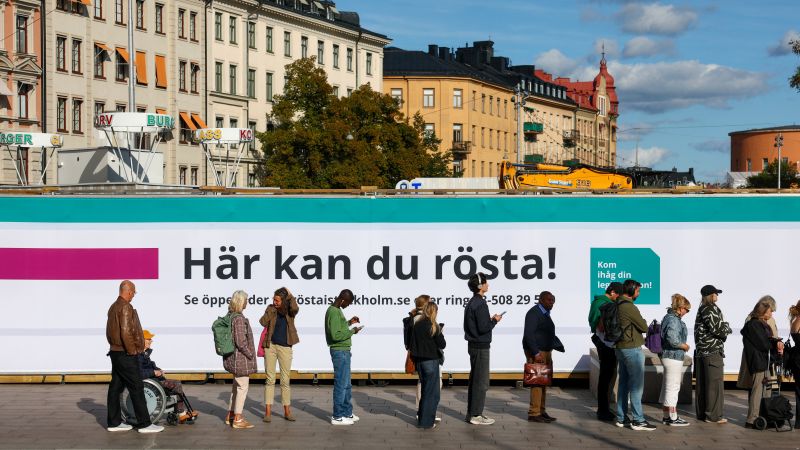
Earthguardiansonline.com – Sweden’s parliamentary election has become a defining test of whether the Sweden Democrats, a party once treated as politically untouchable because of its origins on the neo-Nazi fringe, will take a formal place in government. Voters cast ballots Sunday amid an exceptionally close contest between the governing right-wing alliance and the center-left opposition.
With votes counted from 1,054 of the country’s 6,312 electoral districts, Sweden’s public broadcaster projected a one-seat advantage for the governing right-wing bloc: 175 seats compared with 174 for the center-left. Earlier exit polling had suggested a different outcome, putting the opposition parties collectively at 51.3% and the governing bloc at 46.8%.
The shifting projections underscore the narrowness of an election whose consequences reach beyond the selection of a prime minister. At its center is the question of whether the Sweden Democrats will move from providing parliamentary support to receiving cabinet posts in a new administration.
Kristersson seeks a renewed mandate
Prime Minister Ulf Kristersson’s center-right minority government has relied on Sweden Democrat support in parliament since 2022. Before the election, the Sweden Democrats were polling at roughly 19%, making them a pivotal force in any right-wing path to a parliamentary majority.
Kristersson has said his partners intend to form a shared majority government after the September 13 vote, with him at its head. He has also pledged to deepen cooperation with the Sweden Democrats and offer the party ministerial positions if the governing bloc prevails.
“We have agreed to campaign on a platform of building a common, majority government and that I will lead that government,” Kristersson said during the campaign in late August.
The prime minister has argued that the existing arrangement helped produce economic growth, ease energy and food prices, reduce gang violence and shootings, and bring asylum applications down to historically low levels. He has presented those results as evidence that continued cooperation can deliver stability at a time when household finances and public safety remain central concerns for voters.
Immigration policy has reshaped the campaign
Sweden’s political debate has changed substantially over the past decade, particularly on immigration, citizenship, integration and border enforcement. Policies once viewed by many voters as sharply at odds with Sweden’s liberal identity now command wider support across the political spectrum.
During the past four years, the government has ended permanent residency for refugees, made welfare eligibility more restrictive and increased expulsions of people without legal permission to remain in the country. Asylum figures have fallen to their lowest point in 40 years.
Kristersson has said the next phase should focus more closely on integration. The Sweden Democrats want still tougher measures and frame the issue in cultural as well as legal terms.
“In Sweden it is Swedish culture, the Swedish language, Swedish laws, Swedish norms, Swedish morals and Swedish traditions that apply,” said Mattias Karlsson, a Sweden Democrat lawmaker and close ally of party leader Jimmie Akesson. “If you can’t accept that, you have to find somewhere else to live.”
That approach has alarmed critics who fear a cabinet role for the party could further weaken the country’s commitment to pluralism and liberal values. Birgitta Ohlsson, a Center Party lawmaker and Sweden’s European Affairs minister from 2010 to 2014, warned that the party’s influence had already been felt despite its position outside the government.
“If the Sweden Democrats enter government, that would have an enormously negative impact on the liberal ideals of our country,” Ohlsson said. “We’ve already seen the effects while they’ve been outside government, and it would be ten times worse.”
A contest between competing visions of Sweden
The center-left bloc is backing Social Democrats leader Magdalena Andersson for prime minister. Polling throughout the campaign pointed to a small but shrinking advantage for her side, turning the vote into a contest in which even a handful of seats could determine Sweden’s direction.
Immigration has dominated public debate, but it is not the only issue uniting or dividing the blocs. Both sides have promised stronger welfare systems, sustained backing for Ukraine, increased defense spending and efforts to lessen the cost-of-living pressures confronting many families.
This overlap on major policy areas means the election is less a simple argument over government spending than a broader debate about national identity, the limits of political cooperation and the place of a far-right party in Sweden’s democratic establishment.
Akesson’s party has sought to distance itself from its past. In 2025, the Sweden Democrats apologized for earlier neo-Nazi and antisemitic positions. Supporters see the party’s evolution as proof that it has become a legitimate participant in ordinary democratic politics. Opponents argue that its influence has already shifted the boundaries of acceptable policy and rhetoric.
“The election is a referendum on the Sweden Democrats; whether we continue to go down a far-right path,” author and political commentator Jan Guillou said.
The outcome also fits into a wider European pattern. Far-right parties already share power in Finland, Italy, Croatia and the Czech Republic, while their growing strength continues to challenge established political forces in France and Germany. Sweden, long regarded as one of Europe’s more open societies, is now part of that broader transformation.
Some observers believe a Sweden Democrat role in government would not represent a sudden rupture, but rather the formal acknowledgment of a process already underway since 2022. Historian Lars Tragardh has said the party’s acceptance is likely to continue.
“I think you’ll see a continued normalization of the Sweden Democrats,” Tragardh said.
Whether that normalization proceeds from parliamentary influence to ministerial authority is the central issue hanging over Sweden’s election night. A one-seat margin, if it holds, could decide not only who governs but also how far the country’s political center is prepared to move.
Related Reading
Frequently Asked Questions
What is Swedish polls close in election deciding?
Swedish polls close in election deciding is the main topic of this guide. The article explains the context, practical details, and next steps readers should understand.
Why does Swedish polls close in election deciding matter?
Swedish polls close in election deciding matters because readers are looking for a useful answer, not just a short summary. Good content should match search intent and help them decide what to do next.