Major anti-government protests sweep across Italy

Daftar Isi
Italy Sees Nationwide Protests Over Costs, Services and Government Policies
Earthguardiansonline.com – Large demonstrations unfolded across Italy on Friday, bringing farmers, students, dockworkers, employees and other residents into the streets in more than 50 cities. The nationwide mobilization focused on pressure from rising household expenses, frustration with public services and opposition to policies pursued by Prime Minister Giorgia Meloni’s right-wing government.
In Turin, farmers made a striking display of discontent by dumping manure on city streets. Major crowds also gathered in Milan, Rome and Naples, where protesters expressed anger over the cost of living and concerns about the condition of healthcare and education.
The action was organized by the anti-capitalist trade union Unione Sindacale di Base, known as USB. Its call for demonstrations extended across both public and private employment sectors, reflecting how the protests brought together groups with distinct immediate concerns but a shared sense that economic and social pressures are worsening.
Transport Action Scaled Back After Warnings
Transport employees had initially been expected to participate in picket lines. Those plans were dropped after Transport Minister Matteo Salvini warned that the sector could face sanctions. USB nevertheless encouraged taxi drivers to continue with strike action, despite receiving a comparable warning.
The different response among transport workers illustrated the tension surrounding industrial action. For workers considering a strike, participation can be a way to highlight unresolved workplace or policy disputes, but it can also carry legal, professional and financial risks when authorities signal possible penalties.
In Milan, demonstrators carried signs calling for the removal of the government. One placard read:
“Let’s oust the Meloni government—rebellion is just.”
In Naples, some participants burned photographs of Meloni. The protests drew people of different ages, with younger and older Italians appearing together at rallies in the country’s largest cities.
Mostly Peaceful Marches Amid Security Measures
Italy’s Interior Ministry said preventive arrests were carried out before the marches in an effort to limit violence. Although there were several isolated confrontations, the demonstrations were generally peaceful as they continued through the afternoon.
In Rome, a small group of young people attempted to ignite a dumpster. Other protesters quickly put out the fire, seeking to prevent disorder from overtaking the wider demonstration. Their response reflected an apparent desire among many participants to avoid the violent scenes that have affected comparable protests in France.
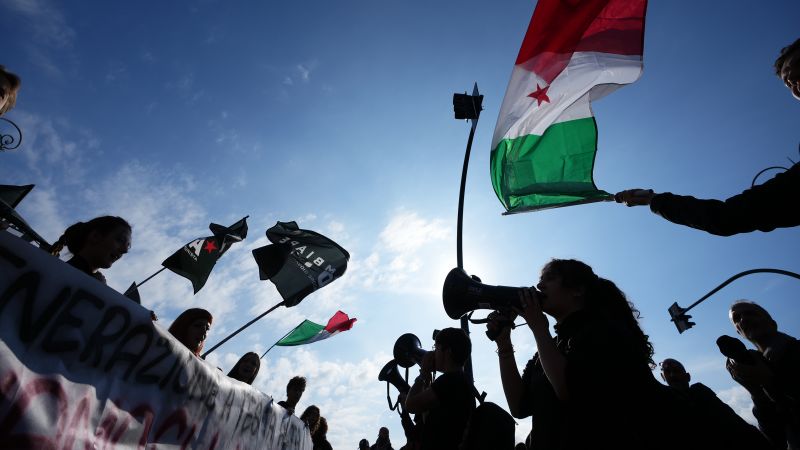
Opposition to war was also a visible feature of Friday’s marches. Palestinian flags appeared in many crowds, while banners criticized government spending on the military. The presence of these messages showed that the protest movement was not limited to domestic economic issues, even though high prices and weakened public services remained central themes.
Local Demands Took Different Forms
While the day of action covered much of the country, its focus shifted from city to city. In Genoa, dockworkers protested what they described as the militarization of the port. They sought to stop Italian-made weapons shipments from being exported to conflict areas, including Israel.
Elsewhere, students in Bologna pressed the government to reconsider its approach to education. Their participation put attention on concerns over investment and policy in schools and universities, linking the local debate to broader dissatisfaction with the quality and accessibility of public services.
This range of demands helps explain why the demonstrations attracted such varied groups. A farmer confronting economic pressure, a student worried about education policy and a port worker opposed to arms exports may not share identical priorities. Yet the nationwide protests created a common platform for criticism of the government’s direction and for demands that public needs receive greater attention.
Part of a Wider European Wave
Italy’s protests came as unrest over living costs, housing and public investment continued in several European countries. In France, demonstrations began in late September when teachers and students protested poor working conditions and insufficient investment in education. The movement later broadened as concern over everyday expenses became more prominent.
Housing shortages and affordability pressures have also prompted protests in Spain and Portugal. Activists there have set up encampments in central squares in the two countries’ capitals, using prominent public spaces to draw attention to the depth of the housing crisis.
In Albania, thousands have joined repeated anti-government demonstrations centered on allegations of corruption and calls for Prime Minister Edi Rama to resign. Serbia has also experienced powerful youth-led protests, which helped remove long-serving leader Aleksandar Vučić last weekend.
The events across Europe differ in their national politics and specific demands, but they share a broader pattern: people are turning to public demonstrations when they feel governments have not adequately addressed economic strain, housing insecurity, underfunded services or concerns about political accountability.
For Italy, Friday’s turnout underscored the challenge facing Meloni’s government. The protests did not present a single unified program, but they made clear that discontent reaches beyond one industry or region. Whether the demonstrations develop into sustained action will depend on how unions, students, workers and local groups organize in the coming weeks, as well as on whether government policies ease the pressures that brought so many people into the streets.
Related Reading
Frequently Asked Questions
What is Major anti government protests sweep across?
Major anti government protests sweep across is the main topic of this guide. The article explains the context, practical details, and next steps readers should understand.
Why does Major anti government protests sweep across matter?
Major anti government protests sweep across matters because readers are looking for a useful answer, not just a short summary. Good content should match search intent and help them decide what to do next.