There’s still one beautiful Southern European country with delicious food, great wine and no tourist crowds

Daftar Isi
North Macedonia Offers a Quieter Route Through Southern Europe
Earthguardiansonline.com – For travelers looking beyond Southern Europe’s busiest summer corridors, North Macedonia remains a striking and comparatively uncrowded option. Set immediately north of Greece, this landlocked Balkan country combines steep mountain landscapes, centuries of religious heritage, lakeside towns and deeply rooted local traditions.
Its scenery changes dramatically with the seasons. Hillsides can appear intensely green in warmer months, while higher ridges and rocky summits are covered in snow during winter. Mountains are not simply a backdrop here; they shape daily life, travel routes and the identities of communities across the country.
“When I enter my car, whichever direction I want to drive, I have a mountain in front of me and a mountain behind me,” said Frosina Pandurska-Dramikjanin, a Skopje resident who works in rural development and community empowerment. “I think this is the best way to describe my country.”
A Small Country With a Layered Past
North Macedonia declared independence from Yugoslavia in 1991 and was previously known simply as Macedonia. Its history reflects successive Byzantine, Ottoman and Yugoslav periods, leaving a visible mix of cultural influences. Across the country, regional traditions remain important, often paired with the kind of direct, generous hospitality visitors tend to remember.
Home to around 2 million people, North Macedonia is slightly larger than Vermont. Despite its location near heavily visited destinations such as Greece and Albania, it has avoided the overwhelming volumes of visitors seen in many Southern European holiday centers.
That relative calm is part of its appeal, but it is also something people working in tourism hope to protect. The country has room to welcome more visitors, yet many local tourism advocates are wary of growth that could undermine residents’ quality of life or reduce distinctive traditions to commodities.
Aleksandar Bogoevski, who owns Sustainable Adventure Travels, sees an opportunity in the many travelers who pass through the country without stopping. His agency directs part of its profits toward infrastructure in the communities it works with, reflecting a model built around local benefit as well as visitor experience.
“Approximately one million passengers are transiting Macedonia during the summertime. They don’t stop,” Bogoevski said. “I think there is so many other things that can be seen.”
Monasteries, Mountain Roads and Autumn Landscapes
Some of North Macedonia’s most memorable sights appear beside narrow country roads that follow valleys and wind through the mountains. These routes connect villages, parks and historic monasteries, including religious sites that have survived for more than a millennium.
Many monasteries feature elaborate interior details: carved woodwork, mother-of-pearl inlay, gilded chandeliers and old frescoes. Bigorski Monastery is among the best known. Located near Mavrovo National Park, it includes an affordable guesthouse that can be particularly useful for hikers and other travelers exploring the surrounding terrain.
Autumn gives this area another reason to slow down. On an October drive near Mavrovo, forests can turn vivid shades of ruby and topaz, producing a dramatic contrast against the mountains.
Another major religious landmark is Sveti Naum, which has stood on the shore of Lake Ohrid since 905. Its long history and setting on one of the region’s best-known lakes make it an important stop for travelers interested in both heritage and landscape.
Lake Ohrid and the Country’s Natural Centerpiece
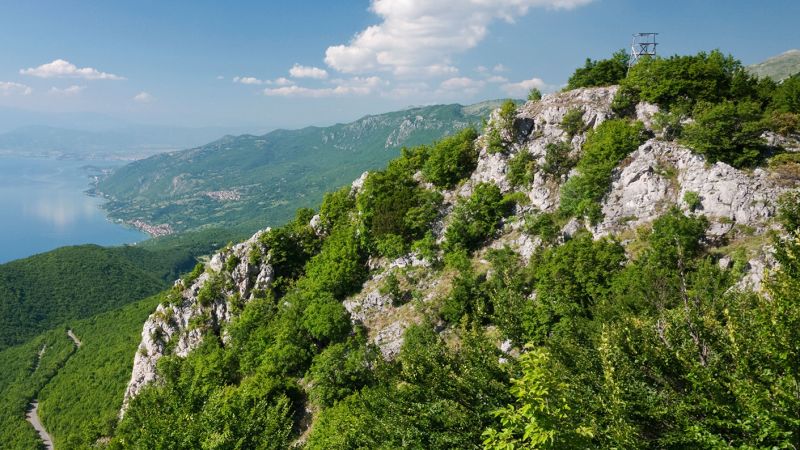
Lake Ohrid, near the Albanian border and south of Mavrovo, is one of North Macedonia’s signature destinations. Ringed by mountains and recognized as a UNESCO World Heritage site, the lake attracts visitors from around the Balkans during the warmer months.
Its appeal reaches beyond traditional sightseeing. The spring-fed lake supports roughly 1,200 plant and animal species, making it significant for ecotourism as well as recreation. In the historic town of Ohrid, on the northeastern shore, visitors can browse freshwater pearls along the bazaar street. Elsewhere on the shoreline, beach bars offer spritz cocktails and a more relaxed summer atmosphere.
Galicica National Park follows Lake Ohrid’s eastern edge, while Lake Prespa lies southeast of the park. Together, the lakes and surrounding protected landscapes offer a concentrated view of the country’s natural character: high terrain, clear water and communities shaped by their proximity to both.
Living Traditions in the Šar Mountains
More than 100 miles north of Lake Ohrid, the Šar Mountain range runs along North Macedonia’s northwestern border with Kosovo. It offers demanding options for hikers and mountaineers, with routes that reward effort with broad mountain views and access to rural areas far from the country’s urban centers.
Some villages in these mountains still maintain transhumance, an old shepherding practice based on seasonal movement. Shepherds take flocks down toward villages in winter and lead them to higher pastures in summer. The practice is increasingly rare, yet it remains part of the living culture in parts of North Macedonia.
Pandurska-Dramikjanin believes thoughtful tourism can help support traditions such as this one, provided visitors arrive with genuine interest and respect. The challenge is avoiding a form of tourism that treats local life as a spectacle rather than something deserving protection.
“In other countries, I have seen very, very bad examples of how mass tourism killed the local culture,” Pandurska-Dramikjanin said. “We want to keep tourists that will really appreciate our nature and our culture.”
That perspective offers a useful guide for anyone planning a visit. North Macedonia’s strongest attractions are not limited to a single landmark or resort district. Its appeal lies in the connection between mountain roads, monasteries, lakes, food, wine, hiking and small communities whose traditions remain central to everyday life.
For visitors willing to take their time, the country presents an alternative to the better-known routes of Southern Europe: a place where the journey between destinations can be as rewarding as the destinations themselves.
Related Reading
Frequently Asked Questions
What is There s still one beautiful Southern?
There s still one beautiful Southern is the main topic of this guide. The article explains the context, practical details, and next steps readers should understand.
Why does There s still one beautiful Southern matter?
There s still one beautiful Southern matters because readers are looking for a useful answer, not just a short summary. Good content should match search intent and help them decide what to do next.