How reliant is Ukraine on US support – and could Kyiv carry on without it?

Daftar Isi
Ukraine’s War Effort Faces a New Test as US Support Comes Under Strain
Earthguardiansonline.com – Ukraine is confronting renewed uncertainty over the durability of support from Washington as Russian missile attacks continue and diplomatic efforts show little sign of producing a settlement. The pressure comes after a turbulent period between US President Donald Trump and Ukrainian President Volodymyr Zelensky, marked by public criticism, disagreements over military assistance and questions over how Kyiv can sustain its defense.
Trump accused Zelensky of not doing enough to negotiate an end to Russia’s war, while Ukrainian officials raised alarm over delays affecting vital military supplies. The US president also dispatched an envoy to Norway and Russia in an effort to move peace discussions forward. That initiative resulted only in a plan for renewed trilateral talks, leaving the central military and political disputes unresolved.
The immediate concern for Kyiv is not simply the amount of foreign assistance available, but the kinds of capabilities that remain dependent on the United States. European governments have taken on a larger financial role, and Ukraine has rapidly expanded domestic weapons production. Yet some of the country’s most important defensive systems, intelligence resources and communications technologies remain difficult or impossible to replace quickly.
Europe has increased its role
Washington stopped approving new aid packages for Ukraine’s war effort at the start of 2025. Before that shift, the United States had provided at least $131.5 billion in overall assistance since Russia launched its full-scale invasion in 2022. That total still makes America the largest individual national donor over the course of the war.
European support, measured collectively, has now surpassed US contributions. European Union countries and institutions have supplied at least $228.5 billion since 2022, Kiel Institute for the World Economy figures show. Germany, Denmark, the Netherlands and Sweden have been among the leading EU providers of military assistance, while the United Kingdom and Norway have also made substantial contributions outside the bloc.
Much of this support has helped Ukraine avoid the abrupt collapse that many feared when new US packages stopped. European governments have increasingly financed weapons purchases, ammunition deliveries, training and other military requirements. Ukraine’s own defense sector has also expanded at speed, reflecting the need to produce more equipment closer to the battlefield.
Still, European funding does not entirely remove US influence. NATO allies frequently buy American-made weapons before transferring them to Ukraine, and those transfers require authorization from the Pentagon. That approval process gives the Trump administration an additional means of shaping what reaches Ukrainian forces.
Patriot shortages expose a critical vulnerability
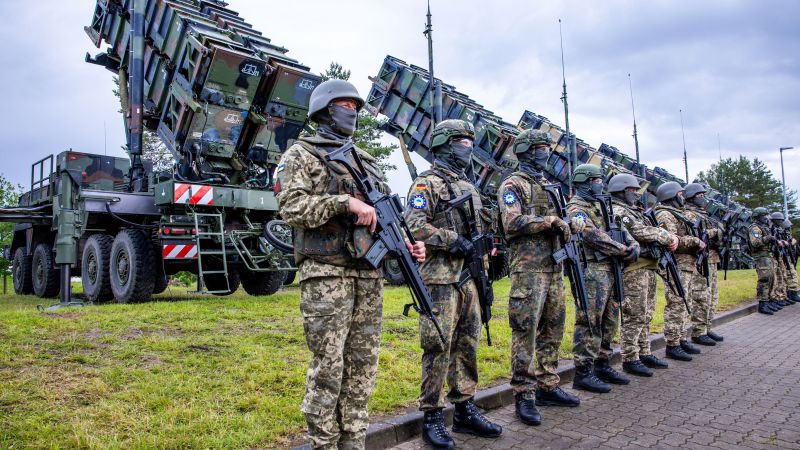
The clearest illustration of Ukraine’s dependence is its shortage of Patriot interceptors. These US-made missiles are among the limited number of systems capable of destroying ballistic missiles before they strike populated areas or key infrastructure.
Zelensky said Friday that deliveries of interceptors already agreed upon had yet to arrive.
“The delivery of interceptors to protect us against Russian ballistic missiles is still delayed. We are waiting for interceptors that were already agreed on, but they are still not coming.”
Ukraine ran out of Patriot interceptors last week, sharply increasing the danger posed by Russian missile attacks. During an overnight strike on Kyiv that continued into Thursday, no ballistic missiles were intercepted. The failure offered a stark indication that Patriot supplies were either exhausted or dangerously limited.
For civilians, the issue is immediate. Air defenses do not eliminate the threat of Russian attacks, but they can reduce casualties and damage when interceptors are available. A shortage leaves cities more exposed, especially when ballistic missiles are involved and reaction times are extremely short.
Zelensky identified two priorities in remarks made hours after the attack: maintaining pressure on Russian President Vladimir Putin and providing Ukraine with stronger missiles.
“Not to lift sanctions from Putin … (and) to give us better missiles.”
American defense companies benefit from orders placed by European allies for US equipment, which may limit the likelihood of a prolonged halt in such purchases. Even so, delays can have serious battlefield consequences when Ukraine’s air-defense reserves are already thin.
Intelligence and technology remain harder to replace
Financial assistance is only one part of Ukraine’s relationship with the United States. Kyiv also depends heavily on American intelligence and technological systems. Patriot interceptors are one example, but Ukraine also lacks alternatives for capabilities such as Starshield, the military version of Elon Musk’s Starlink satellite internet, and advanced missile-warning technology.
European states have considerable military resources, but decades of reliance on US protection have left gaps in certain high-end systems. Max Bergmann, director of the Russia program at the Center for Strategic and International Studies, said Europe had not developed comparable tools because it was encouraged to depend on Washington.
“That is something Europeans don’t have, and they don’t have it because we (the US) have told them for the last 30 years not to develop it … because they can rely on us.”
Bergmann warned that the consequences of diminishing US reliability could be severe for Ukraine, particularly for civilians and the broader economy. He nevertheless questioned whether such pressure would force Kyiv to abandon its resistance.
“This could be really devastating for Ukraine in the sense that it could cause tremendous economic damage, tremendous loss of civilian life, civilians leaving,” he said. “But I doubt it’s going to actually break Ukraine’s will to fight.”
Zelensky has also said that Ukraine has, on several occasions, received no US intelligence warning of approaching ballistic strikes. Without those alerts, Russian missiles can arrive before air raid sirens give residents time to reach shelters.
Ukraine has shown that it can adapt, draw more heavily on European partners and expand its own industrial capacity. But the country’s ability to continue fighting without America is not a simple question of replacing dollars with euros. It involves replacing intelligence, missile defenses, communications networks and the political certainty that support will still be available when Russia intensifies its attacks.
Related Reading
Frequently Asked Questions
What is How reliant is Ukraine on US support?
How reliant is Ukraine on US support is the main topic of this guide. The article explains the context, practical details, and next steps readers should understand.
Why does How reliant is Ukraine on US support matter?
How reliant is Ukraine on US support matters because readers are looking for a useful answer, not just a short summary. Good content should match search intent and help them decide what to do next.