
Rebels jeered Putin’s troops out of a key African town. Now his regional grip is slipping away
Rebels jeered Putin’s troops out of a key African town. Now his regional grip is slipping away
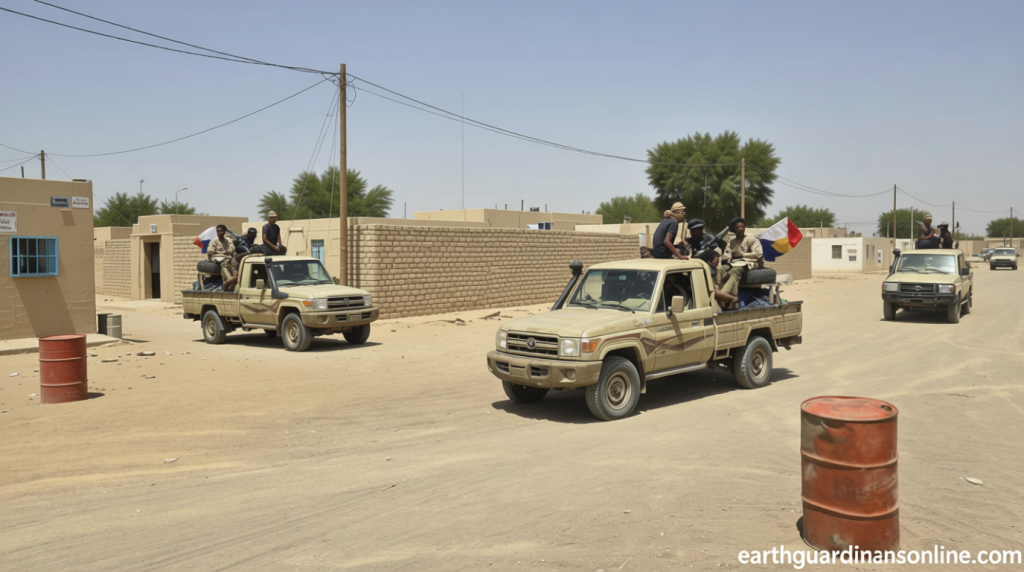
Rebels jeered Putin s troops out – On April 26, the Tuareg separatist group Azawad Liberation Front (FLA) announced on social media that it had finalized a deal with Russian forces to expel them from Kidal, a strategic town in northern Mali. This move marks a critical turning point in Moscow’s influence over the Sahel region, where its military presence was once seen as a cornerstone of security partnerships. The FLA’s declaration, claiming Kidal as “now free,” was met with a wave of videos circulating online that depicted Tuareg fighters jeering at a convoy of Russian vehicles fleeing the area. These images have become symbolic of the waning confidence in Russian military capabilities and the growing resistance to its geopolitical ambitions in Africa.
The Fall of Kidal
Kidal, situated approximately 1,000 miles northeast of Mali’s capital, Bamako, was captured by the Malian army and Russian mercenaries in 2023. This victory had initially signaled Moscow’s dominance in the region, as the town became a hub for its Africa Corps—a military initiative under the Russian Defense Ministry. However, the recent events have exposed the vulnerabilities of this strategy. The coordinated attacks on April 25, attributed to al Qaeda-linked militants, triggered a swift collapse of Russian defenses, leading to the town’s eventual surrender. Analysts describe this as a decisive blow to Moscow’s reputation as a reliable security provider, echoing past setbacks in Syria, Venezuela, and Iran.
The attacks were not only a military maneuver but also a psychological strike against Russia’s ambitions. By uniting with northern rebels, the militants orchestrated a series of complex assaults that overwhelmed several military bases in the region. This rare alliance between Tuareg separatists and jihadist groups has accelerated the chaos in Mali, challenging the stability that Russian forces had previously helped maintain. As the Africa Corps negotiated its exit, the rebels seized the opportunity to assert their independence, leaving Moscow’s influence in question.
Russia’s Strategic Shift in the Sahel
Since the late 2020s, the Sahel region has become a focal point of Russia’s global expansion. Once a bastion of Western influence, this vast area—spanning over 3,000 miles across Africa, from Senegal to Sudan—has seen a decline in the presence of French forces and United Nations peacekeepers. The vacuum was quickly filled by the Wagner Group, a private military company that had been operating in countries like Libya, Mozambique, and the Central African Republic (CAR) since 2018. However, the recent transition from Wagner to the Africa Corps has not fully resolved the region’s instability.
The Africa Corps, which now oversees Russian operations in Africa, has been deployed to address growing security concerns in the Sahel. Its mission was to reinforce alliances with local regimes, such as Mali’s military junta, which came to power after two coups in 2020 and 2021. The junta, seeking to distance itself from Western oversight, turned to Moscow for support. Yet, the fall of Kidal has revealed the limitations of this reliance. With the town no longer under Russian control, the junta’s authority is increasingly threatened by both rebel forces and militant groups.
The loss of Kidal also underscores the shift in power dynamics within Mali. The Malian Defense Minister, Sadio Camara—a Russian-trained officer and architect of the country’s pivot toward Moscow—was assassinated in a suicide vehicle bombing near Bamako. His death, claimed by the al Qaeda-linked group Jama’at Nusrat al-Islam al-Muslimin (JNIM), has further destabilized the regime. JNIM’s growing influence now threatens to escalate tensions, as the group calls for a complete blockade of Bamako and urges Malians to embrace Sharia law as a solution to the country’s crises.
Economic and Political Implications
While Russia’s military interventions in the Sahel have been framed as strategic victories, they are also driven by economic interests. In the Central African Republic, for example, CNN investigations revealed that companies tied to Yevgeny Prigozhin, the deceased leader of the Wagner Group, had secured mining concessions for gold and diamonds. These resources, vital to Russia’s energy and industrial sectors, have been a key incentive for the Kremlin to maintain its military footprint across Africa. However, the economic benefits come at a cost: the region’s security remains precarious, and the local governments are often left to manage the fallout of these alliances.
President Vladimir Putin’s emphasis on military cooperation has been a cornerstone of his foreign policy in Africa. At the 2023 Russia–Africa Summit in St. Petersburg, he announced agreements with over 40 nations, positioning Russia as a dominant player in the continent’s security landscape. Yet, the Africa Corps’ current challenges in Mali highlight the fragility of this vision. The summit’s rhetoric of partnership and protection has been tested by the realities on the ground, where the rebels’ successes have undermined Moscow’s ability to project power effectively.
Mali’s recent turmoil has drawn attention to the broader implications of Russia’s growing influence. The country, a former French colony, has long struggled with insurgency, but the withdrawal of Russian forces from Kidal has intensified the crisis. The junta’s promises to “neutralize” threats through Moscow’s support now appear increasingly hollow, as the rebels continue to gain ground. This situation mirrors the challenges faced by other African nations, where Russian involvement has sometimes been seen as a trade-off for resources and political favor. The question remains: can Russia sustain its role as a security partner in the Sahel, or is its dominance in the region beginning to erode?
As Western powers retreat from Africa, Russia has emerged as a key contender in the continent’s security race. However, its approach is often transactional, prioritizing resource extraction over long-term stability. The Africa Corps’ retreat from Kidal serves as a warning that this model may not be foolproof. The Sahel, already a hotbed of violence, is now a battleground for the future of Russian influence—and the resilience of its alliances. With the rebels’ victory in Kidal and the assassination of Camara, the region’s leaders may need to reassess their partnership with Moscow, even as the Kremlin continues to expand its reach across the globe.
