
Major US bridges could be vulnerable to ship collisions, including one just downstream from Key Bridge
Major US Bridges Face Ship Collision Risks, Including One Near Key Bridge
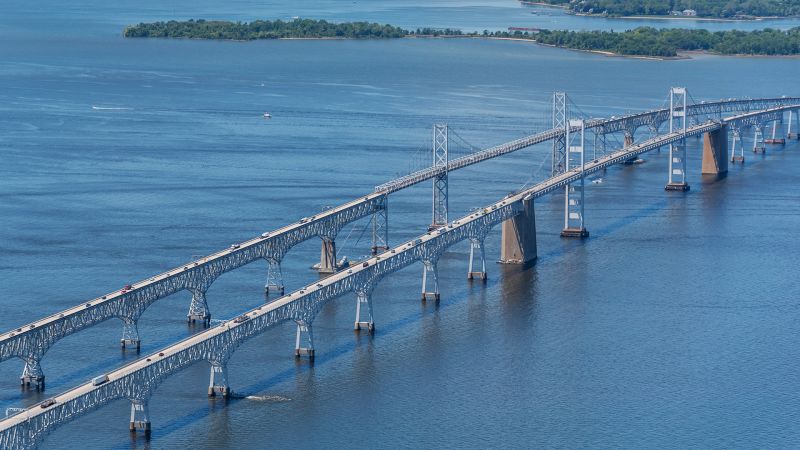
Major US bridges could be vulnerable – The recent catastrophic collapse of the Francis Scott Key Bridge has sparked widespread concern about the vulnerability of other critical infrastructure in the United States. This incident, which occurred last week, disrupted one of the nation’s most important shipping corridors, underscoring the fragility of structures that facilitate the movement of goods across major ports. While the Key Bridge’s failure is a stark reminder of the risks, experts warn that several other bridges along the same route—particularly the Chesapeake Bay Bridge—could also suffer similar fates if struck by large vessels.
The Shipping Corridor and Structural Risks
Thousands of container ships traverse the shipping route daily, with many passing under the Key Bridge’s aging span as they travel from the Atlantic to Baltimore’s bustling port. However, the bridge’s destruction has drawn attention to a less-discussed but equally concerning structure: the Chesapeake Bay Bridge, located 20 miles downstream near Annapolis. According to structural engineers who analyzed its design for CNN, this bridge may be susceptible to a similar fate if a ship collides with it. The four-mile-long bridge, like others in the network, features concrete piers positioned in the shipping channel, which experts say could be compromised by a direct impact.
“The Chesapeake Bay Bridge lacks adequate safety measures,” remarked Adel ElSafty, an engineering professor at the University of North Florida. “It’s time for a thorough reassessment of its design, especially after the Key Bridge disaster.” ElSafty’s assessment aligns with broader concerns about the resilience of bridges across the country. While many structures have robust defenses, such as reinforced fender systems or larger concrete barriers, the Bay Bridge appears to fall short in these critical areas.
Fracture Critical Members and Design Flaws
Fracture critical members, a common feature in many US bridges, are a key factor in their susceptibility to collapse. These structural components, if damaged, can lead to a complete failure of the bridge. The Key Bridge’s collapse was triggered by a ship striking one of its vertical piers, which experts believe could have caused the structure to fall even without such features. Matthew Yarnold, an Auburn University engineering professor, noted that the presence of fracture critical members in the Key Bridge likely accelerated its demise but did not eliminate the risk entirely.
Documents and photographs reveal that the Key Bridge was equipped with concrete and timber fenders before the incident. These fenders, designed to absorb impact, were part of its protective measures. However, structural engineers are questioning whether timber fenders are sufficient to withstand collisions with massive container ships. The Dali, the vessel responsible for the Key Bridge’s collapse, is a prime example of the size and force such ships can exert. “Fenders made of timber might not do much to stop a ship like the Dali,” said one expert, highlighting the need for more durable materials.
Discrepancies in Safety Claims
Despite the growing awareness of bridge vulnerabilities, some officials remain confident in their designs. A Louisiana Department of Transportation spokesperson claimed that a major bridge in New Orleans was “triple protected” due to its construction, a statement that one structural engineer dismissed as “nonsense.” This divide in perspectives reflects the broader debate about how seriously the country is taking the risks associated with maritime collisions.
“We can’t just assume these structures are safe because of old designs,” said Abieyuwa Aghayere, a structural engineering professor at Drexel University. “The collapse of the Key Bridge shows we need to adapt and innovate. If a ship can bring down one bridge, it could do the same to others unless we take action.” Aghayere’s comments echo the calls for a renewed focus on safety assessments and investment in protective systems.
Current Upgrades and Future Plans
Following the Key Bridge incident, officials in several states are accelerating efforts to strengthen bridge defenses. In Delaware and Pennsylvania, tens of millions of dollars have been allocated to install new concrete structures and rock islands that act as barriers against ship impacts. These upgrades are part of a broader initiative to safeguard the Port of Philadelphia, a major hub for freight transportation.
Meanwhile, the Maryland Transportation Authority announced on Tuesday that it is considering additional protections for the Chesapeake Bay Bridge. This decision comes after a thorough review of the bridge’s design, which highlighted potential weaknesses. “We’re looking at every possible measure to prevent another disaster,” said a Maryland official, emphasizing the urgency of the situation.
Economic and Social Consequences
The Key Bridge collapse has had far-reaching economic and social repercussions. It has not only halted operations at America’s 15th largest port but also caused billions in projected damages. The loss of six lives has further intensified the emotional toll on communities and stakeholders. “This isn’t just a structural failure—it’s a crisis for the entire supply chain,” said a transportation analyst. “Every bridge is a link in a chain that supports our economy, and one failure can ripple through industries nationwide.”
Experts are now urging a comprehensive evaluation of all bridges along key shipping routes. While some structures, like the Chesapeake Bay Bridge, may require immediate upgrades, others are already undergoing assessments. The focus is on identifying the most vulnerable points and implementing cost-effective solutions. “We need to prioritize the bridges that serve the busiest ports,” said ElSafty. “Investing in their safety is an investment in our national infrastructure.”
Global Implications and Lessons Learned
The incident has prompted a reexamination of bridge safety standards on a national level. In the wake of the disaster, transportation agencies across the country are revisiting design protocols and risk management strategies. “This collapse should be a wake-up call for all of us,” said Yarnold. “We’ve been relying on old assumptions for too long.”
As the US continues to expand its maritime trade, the demand for larger container ships is increasing. These vessels, while essential for economic growth, pose a growing threat to existing bridges. “The scale of these ships is outpacing our infrastructure’s ability to handle them,” noted Aghayere. “We need to modernize our systems before it’s too late.”
With the ongoing assessment of bridge vulnerabilities, the question remains: how many more structures could be at risk? While some engineers argue that protective systems can mitigate the damage, others believe that no defense is foolproof. “Even with the best fenders and barriers, a direct hit could still be catastrophic,” said ElSafty. “We must be prepared for the worst and act swiftly.”
As the nation grapples with the aftermath of the Key Bridge collapse, the focus is shifting from reaction to prevention. The lessons learned from this incident are being applied to other bridges, with the hope of avoiding similar tragedies in the future. “We shouldn’t be sitting ducks,” said Aghayere. “If we can’t design a system to stop a ship from hitting a pier, then we should consider tearing down the bridge altogether.”
The challenge ahead is clear: to balance the need for efficient shipping routes with the safety of the infrastructure that supports them. With billions in potential damages and the lives of countless workers at stake, the urgency for action has never been greater. As engineers and officials work to strengthen defenses, the broader question of how prepared the country truly is for the next major incident looms large.
