
In a city of high-rises, ‘cardboard grannies’ collect waste for cash
In a City of High-Rises, ‘Cardboard Grannies’ Collect Waste for Cash
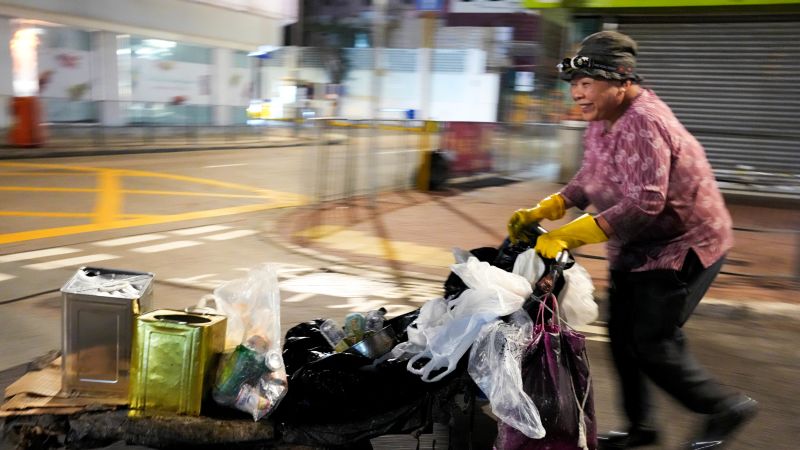
In a city of high rises – Amid the towering skyline of Hong Kong, a unique sight unfolds as the sun sets: elderly women, known colloquially as “cardboard grannies,” navigate the streets in search of discarded cardboard. Their trolleys, loaded with flattened waste, become a symbol of resilience in a city where wealth is abundant but resources for the elderly remain scarce. These workers, often in their 70s or older, trade grueling hours for modest earnings, balancing survival with a sense of purpose.
The Irregular Work of Survival
Their days begin at 2 a.m., when the city is still cloaked in darkness, and end at 11 a.m., as dawn breaks. Wu Sau-jing, 71, is one such individual who has dedicated three decades to this routine. “I maintain a livelihood and it’s also my hobby. If you don’t like it, it can be quite exhausting,” she tells CNN, reflecting on her decades-long commitment. Despite the physical toll, the work has become a part of her identity, echoing the habits of a lifelong smoker or gambler.
A City’s Waste Problem
Hong Kong’s waste production is staggering, with residents generating approximately 1.51 kilograms of trash per day. This far exceeds the waste output of neighboring Asian cities like Tokyo (0.88 kg) and Seoul (0.95 kg). Yet, only 30% to 40% of the city’s waste is recycled, a statistic that highlights the inefficiency of its systems. For the cardboard grannies, this means a constant battle against the urban environment, where discarded materials are often left in the streets, waiting to be claimed.
Economic Realities
Their earnings, though meager, are critical for daily sustenance. Lai, a woman in her 70s, recounts earning about HK$100 ($12) daily, barely covering the cost of a single meal. The government provides a small monthly allowance to elderly citizens, but many, like Lai, opt to supplement their income through this labor-intensive trade. The report from Oxfam Hong Kong in 2024 estimates that 580,000 elderly residents are living in poverty, underscoring the financial strain that drives them to work.
Yet, the income has dwindled. Recyclers once paid HK$0.6 ($0.078) per kilogram, aligning with the government’s minimum guidelines. Now, that rate has been cut in half, leaving workers like Lai with less than before. “Sometimes I get nothing when strangers or officials discard my items, thinking they’re just road blockage,” she explains. This misidentification adds to the unpredictability of their work, where a good day might yield $12, but a bad day could leave them with nothing at all.
Men in the Trade
While most of these workers are women, a few men, like Cheung, 80, also participate. Cheung has no fixed schedule, often collecting whatever cardboard he finds during his daily walks. Once his trolley is full, he makes a 30-minute journey to the nearest recycling center, navigating steep roads and narrow alleys with the same determination as his female counterparts. His role is rare, but his persistence mirrors that of the grannies, who endure the city’s challenges with unwavering resolve.
Challenges in the Streets
For Chan Ngai-kan, 95, the unpredictability of her work has become a source of frustration. One afternoon, after pushing her trolley through multiple districts, she discovered that her usual recycling outlet no longer accepted cardboard. Forced to dispose of her haul at a nearby rubbish station, she left empty-handed. “My children are in Canada and I have no money,” she says, her voice heavy with disappointment. Such incidents are not uncommon, and they underscore the vulnerability of these workers, who lack formal employment and face the risk of losing their earnings at any moment.
A System in Need of Change
Their struggle is emblematic of a broader issue: Hong Kong’s economic structure leaves many elderly residents with limited options. While the city thrives as a global financial hub, its high living costs force the elderly into informal labor. The disparity is stark, with recycling companies offering rates that barely cover basic needs. “It’s like smoking and gambling,” Wu quips, highlighting the addictive nature of the work. For her, it’s not just about survival—it’s a way to stay connected to the city’s rhythm and its discarded treasures.
The Cost of Urban Living
With only 30% to 40% of waste being recycled, the city’s recycling infrastructure struggles to keep pace with its consumption. Cardboard grannies play a vital, if underappreciated, role in this system, ensuring that materials are reused before they end up in landfills. Their efforts are a testament to the resourcefulness of Hong Kong’s elderly, who adapt to a world that often overlooks their needs. Yet, their existence raises questions about the fairness of a system that leaves them reliant on informal work to survive.
A Story of Resilience
Despite the hardships, these workers persist. Their trolleys, filled with cardboard, represent more than just a means of earning a living—they symbolize a connection to the city’s pulse. In a place where skyscrapers dominate the skyline, these grannies are the quiet backbone of recycling, navigating the streets with a resilience that is both inspiring and humbling. Their stories are a reminder that even in a city of wealth, there are those who work tirelessly to make ends meet, often unnoticed by the bustling crowds around them.
More Than Just a Job
For many, collecting cardboard is not just a job—it’s a lifeline. The physical demands are immense, requiring hours of exertion in harsh weather conditions. Yet, the work also offers a sense of independence and dignity. As Wu puts it, “It’s a hobby you can’t get rid of. I’ll do it until the day I can’t do it anymore.” Her words capture the essence of their dedication, blending necessity with a personal commitment that transcends financial gain.
Their presence in Hong Kong is a poignant reflection of the city’s economic pressures and its aging population. While the government provides minimal support, the elderly often take matters into their own hands, turning the streets into a second workplace. As the city continues to grow, the story of these cardboard grannies remains a powerful narrative of perseverance, highlighting the challenges faced by those who live on the margins of prosperity. Their work, though small, is a crucial part of the city’s environmental and economic fabric, a testament to the human spirit in the face of adversity.
