
Russia slams key Ukrainian cities in one of deadliest offensives in months
Russia slams key Ukrainian cities in one of deadliest offensives in months
Russia slams key Ukrainian cities in one – Early Tuesday, Russian forces launched a devastating assault on Ukraine, targeting the capital Kyiv and the central city of Dnipro in a widespread offensive that caused severe damage. This attack marked one of the most intense strikes in recent months, with at least 23 casualties reported, including seven in Kyiv and 16 in Dnipro, according to Ukrainian officials. Over 100 people were injured, while thousands of residents fled to underground shelters in Kyiv, setting a new record for nighttime evacuations. The assault underscores the escalating violence between Russia and Ukraine, as both sides continue to trade blows in a war that has seen prolonged stalemates on the ground.
Massive casualties and infrastructure destruction
The attack, which spanned multiple hours, targeted critical civilian infrastructure, including medical facilities and residential buildings. Ukrainian authorities confirmed that five hospitals and several commercial complexes were damaged or destroyed, leading to fires and debris falling onto a kindergarten. The scale of destruction mirrored previous large-scale operations, with reports of charred vehicles buried in rubble and residents navigating a landscape littered with the remnants of bombed-out homes. In one video clip, an elderly couple was seen salvaging what remained of their flat, its window facade completely shattered. The trauma of the assault was vividly captured by Mykhailo Sartynski, who described the explosions as so powerful they “blew open the entrance” of his house and left him “terrified for my wife.”
“It was so powerful that everything came flying at us,” said Mykhailo Sartynski. “I was terrified for my wife… Everything was on fire.”
Residents like Karina Kasamara also recounted the chaos, noting how the initial blast “shattered the windows, balconies, and everything.” She described the dog running into the hallway as the attack began, a moment she called “the start of all hell.” The attack’s intensity has led some to question whether Russia’s goal is to push Ukraine toward a state of despair. “(Russian President Vladimir Putin) is trying to erase Ukraine into a graveyard,” Kasamara said. “It seems to me that’s where it’s all heading.”
International condemnation and Ukrainian response
United Nations Secretary-General António Guterres swiftly condemned the strikes, with his spokesperson Stephane Dujarric stating, “Once again, we emphasize that attacks against civilians and civilian infrastructures are prohibited under international humanitarian law and must end immediately.” The UN’s criticism highlights the global concern over the war’s civilian toll, even as the conflict continues to dominate headlines. Meanwhile, Ukrainian President Volodymyr Zelensky urged citizens to remain vigilant, warning that “another large-scale attack may occur tonight.” He attributed the increased threat to Russia’s strategic focus on weakening Ukraine’s defenses, citing a limited supply of air defense systems.
“According to our intelligence, another large-scale attack may occur tonight,” said Ukrainian President Volodymyr Zelensky in his nightly video address. “Please, I strongly urge you to pay attention to air raid alerts.”
Zelensky’s remarks came as Russia accused Ukraine of escalating its own attacks, particularly on Russian oil assets. Over the past four months, Ukrainian forces have struck 15 refineries, reducing Russia’s main refining capacity by 40%, according to Zelensky. These strikes, which have disrupted fuel supplies, have been cited by Moscow as justification for its recent offensive. The Russian military reported firing more than 600 drones and numerous missiles, including advanced hypersonic weapons, during the attack. The combination of aerial bombardment and ground artillery has created a new phase of the conflict, with civilians bearing the brunt of the fighting.
Stalemate on the ground and rising tensions
Despite the violence in the air, the war on the ground has entered a relative stalemate. After over four years of combat, Russia’s full-scale invasion has shifted into a war of attrition, where both sides face heavy losses but have yet to achieve a decisive breakthrough. Kyiv, for instance, has begun reclaiming territory that Moscow previously seized, though the gains remain incremental. The Institute for the Study of War (ISW), a US-based conflict monitor, noted that Ukrainian forces had largely stalled a recent Russian offensive, signaling a more defensive posture on the front lines.
This ground stalemate has forced Russia to intensify its aerial attacks, aiming to cripple Ukraine’s ability to sustain its military efforts. The timing of the assault, which occurred during a period of heightened tension, suggests Moscow may be preparing for a larger campaign. Zelensky’s warnings about limited air defenses reflect the challenges Ukraine faces in countering the scale of the Russian bombardment. “Ukrainian forces are not able to shoot down a significant proportion of the missiles” being launched, he said, adding that the population must remain on high alert.
Aftermath and lingering dangers
By Tuesday morning, the city center of Kyiv echoed with the sounds of ongoing explosions, though the air defense systems appeared less active. CNN producers in the capital reported hearing thunderous blasts but not the rapid response of counter-air measures that had been expected. The mayor of Kyiv, Vitali Klitschko, described the assault as a “massive enemy attack,” emphasizing its impact on daily life. Emergency crews worked tirelessly to rescue survivors from the rubble of a multi-story building in the Podilsky district, where a “double tap” strike left several people trapped beneath the debris.
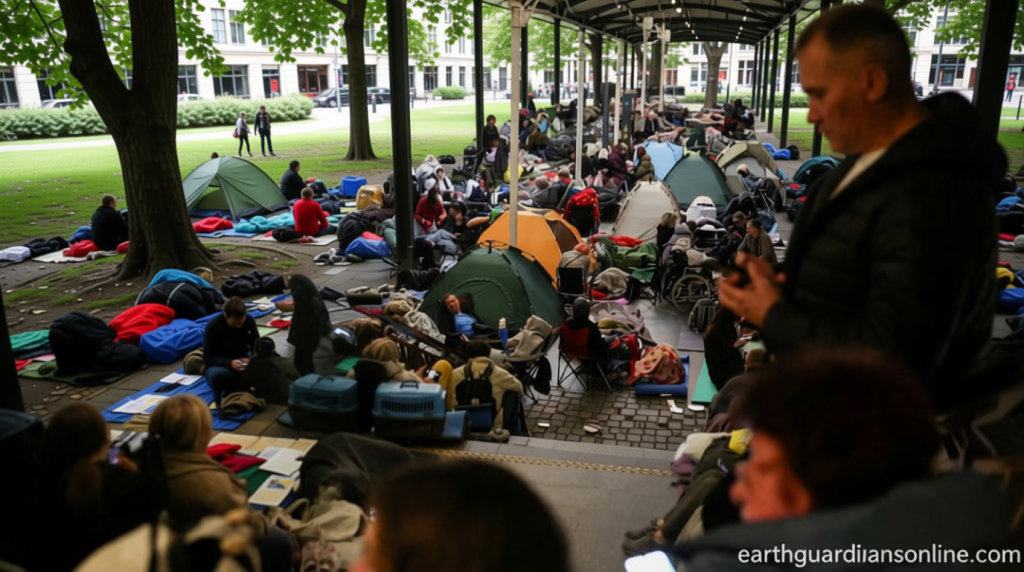
The aftermath of the attack revealed the extent of its reach. In Kyiv, more than 41,000 residents had sought refuge in the metro, a figure that surpassed previous records for nighttime evacuations. The underground stations, already a symbol of resilience, became makeshift shelters for families fleeing the violence. Residents described the lingering smoke and the difficulty of recovering belongings from the wreckage. “The dark smoke curled through the neighborhood like a serpent,” one witness said, capturing the surreal nature of the attack. The continued bombardment has forced civilians into a state of constant readiness, with many unable to sleep through the night.
As the situation unfolds, the conflict’s human cost grows more evident. The attacks on Kyiv and Dnipro have not only killed and wounded but also disrupted essential services and displaced thousands. While the exact number of casualties may still be rising, the scale of the assault has already drawn international attention. The UN’s condemnation and Zelensky’s appeals for vigilance highlight the global scrutiny on Russia’s actions. Yet, as the war drags on, the question remains: how long can Ukraine sustain the pressure while Russia targets its cities with increasing ferocity?
