
‘Unparalleled discovery’: Gold Roman ring unearthed by amateur metal detectorist
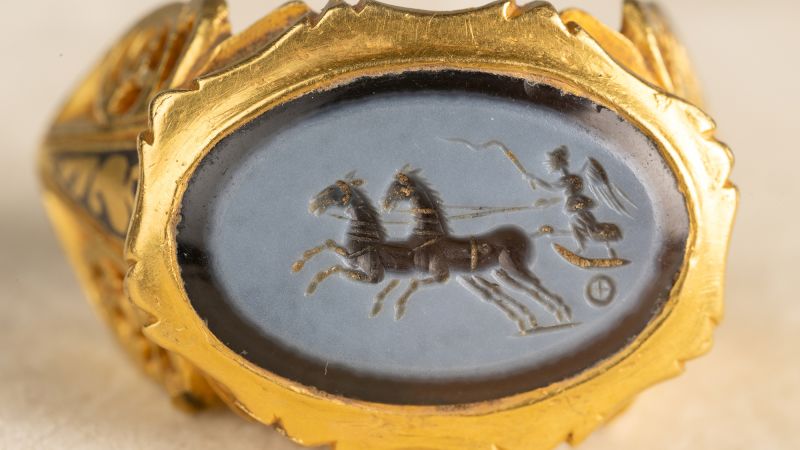
Gold Roman Ring Unearthed by Amateur Metal Detectorist
Unparalleled discovery – In a rural field in Somerset, southwest England, a 68-year-old trucker and former soldier stumbled upon a remarkable artifact that has redefined the understanding of Roman-era artifacts in the region. Kevin Minto, who had previously uncovered a hoard of Roman coins in the same area, returned to the site in 2018 as part of a group of military veterans engaged in historical exploration. His latest find—a gold ring dating back to the Roman period—has been hailed as an “extraordinary” and “unparalleled” discovery, according to the South West Heritage Trust, which has since acquired the item for public display.
A Jewel of Roman History
The ring, weighing 48 grams (1.7 ounces), is notable for its unusual size and intricate craftsmanship. At its center lies a gemstone depicting Victoria, the Roman goddess of victory, seated on a chariot pulled by two horses. This depiction, combined with the ring’s golden sheen, has captivated historians and archaeologists alike. The trust’s senior curator, Amal Khreisheh, emphasized the artifact’s significance, stating it could provide new insights into the lives of Roman inhabitants in South Somerset during a period of political upheaval.
“For any detectorist, finding a hoard is a dream come true,” said Minto, reflecting on the thrill of his initial discovery of Roman coins. The ring, however, has taken the experience to a new level, offering a glimpse into the cultural and economic practices of the time.
Minto’s journey with metal detecting began a year before the ring’s discovery, when he unearthed a collection of Roman coins. This find, which he described as “a bit unbelievable,” led him to revisit the field multiple times, ultimately uncovering a lead-lined coffin and, later, the golden ring. The process of acquiring the artifact was not only a matter of historical interest but also a legal obligation under British treasure laws. Once reported, the item underwent an inquest to determine its ownership and significance for public heritage.
Preserving the Past for the Future
The South West Heritage Trust, which funded the acquisition of the ring with £78,010 (approximately $105,000), will now showcase the artifact at The Museum of Somerset. The museum’s collection includes the coins Minto originally discovered, and both items are currently being displayed to local schoolchildren as part of an educational initiative. “The ring is such a stunning object that the children really enjoyed being able to hold it and examine the coins closely,” Khreisheh noted, highlighting the program’s goal of engaging young audiences with local history.
“The find sheds light on how South Somerset’s Roman inhabitants navigated a period of unrest from 286 to 296 AD,” Khreisheh explained. “It is likely the ring was buried shortly after, in 297, as part of a hoard that included coins, lead, and pottery. The owner may have been someone of considerable wealth, perhaps involved in the region’s administration or owning a prosperous farming estate.”
The ring’s acquisition followed a legal process where the finder and landowner split the reward. Minto, who shared his share with a fellow treasure hunter, used the proceeds to pay off his mortgage. “It took some time for the discovery to sink in,” he admitted, expressing the emotional weight of unearthing such a rare item. His initial excitement over the coins was surpassed by the realization of the ring’s historical value, which he described as a unique piece of Britain’s past.
The Road to Public Ownership
Under British law, metal detectorists must report any finds exceeding a certain value to their local finds liaison officer. This ensures that artifacts of historical importance are properly documented and evaluated for public benefit. The trust’s involvement in acquiring the ring and coins was part of a broader effort to preserve and share the region’s Roman legacy. The Fosse Way, a major Roman road that traversed Somerset, played a crucial role in facilitating trade and connecting the area to the rest of the empire. Khreisheh speculated that the ring’s presence in this region underscores its economic and cultural significance.
The discovery has sparked renewed interest in Somerset’s Roman history. Historians are particularly intrigued by the combination of the ring, coins, and lead-lined coffin, which suggests a deliberate effort to store valuable items during a time of uncertainty. Minto’s find adds to a growing body of evidence that the area was a hub of activity, with communities engaged in commerce and administration. The trust’s news release praised the ring as a “spectacular” example of Roman artistry, noting its rarity and the stories it may tell about its original owner.
Community Engagement and Historical Legacy
As part of the trust’s outreach efforts, the ring and coins have been displayed at primary schools to foster a deeper connection between young people and the region’s past. The interactive nature of these exhibitions has allowed students to engage with history in a tangible way, sparking curiosity about the lives of ancient Roman settlers. Khreisheh highlighted how the children’s questions about the ring’s purpose and origin have enriched the educational experience, bridging the gap between artifacts and the people who once used them.
The trust’s role extends beyond mere preservation; it actively works to ensure that historical discoveries contribute to public knowledge. Minto’s contributions to this effort have been recognized, with the trust stating that the ring is a “unique” piece of Britain’s heritage. Its acquisition not only honors the finder’s dedication but also ensures that the artifact remains accessible to future generations. The ring’s journey from the field to the museum underscores the collaborative nature of historical discovery, where amateur enthusiasts and institutions play vital roles.
Correction: The Roman Goddess of Victory
A note from the South West Heritage Trust clarifies that an earlier version of the article incorrectly stated the name of the Roman goddess of victory. The correct name is Victoria, a figure central to Roman mythology and often depicted in art as a symbol of triumph. This correction highlights the importance of accuracy in historical narratives, even as the discovery itself continues to inspire awe and curiosity.
Minto’s story exemplifies the intersection of personal passion and public history. His discovery not only enriches the museum’s collection but also serves as a reminder of the role that everyday individuals can play in uncovering the past. As the ring prepares for its public debut at The Museum of Somerset, it stands as a testament to the enduring legacy of Roman craftsmanship and the enduring fascination with ancient artifacts. The trust’s efforts to share this find with the community underscore a broader commitment to making history accessible and meaningful to all.
For those eager to explore the mysteries of the past, the South West Heritage Trust invites further engagement. The museum’s upcoming exhibitions will provide an opportunity to see the ring and its accompanying coins, offering a window into a bygone era. As the trust continues its mission to preserve and celebrate Somerset’s heritage, Minto’s contributions remain a cornerstone of its success. The ring’s presence in the museum ensures that its story will be told, inspiring new generations of historians and enthusiasts alike.
