
In a visit to farm country, Trump extols ‘beautiful fountains’ back in Washington
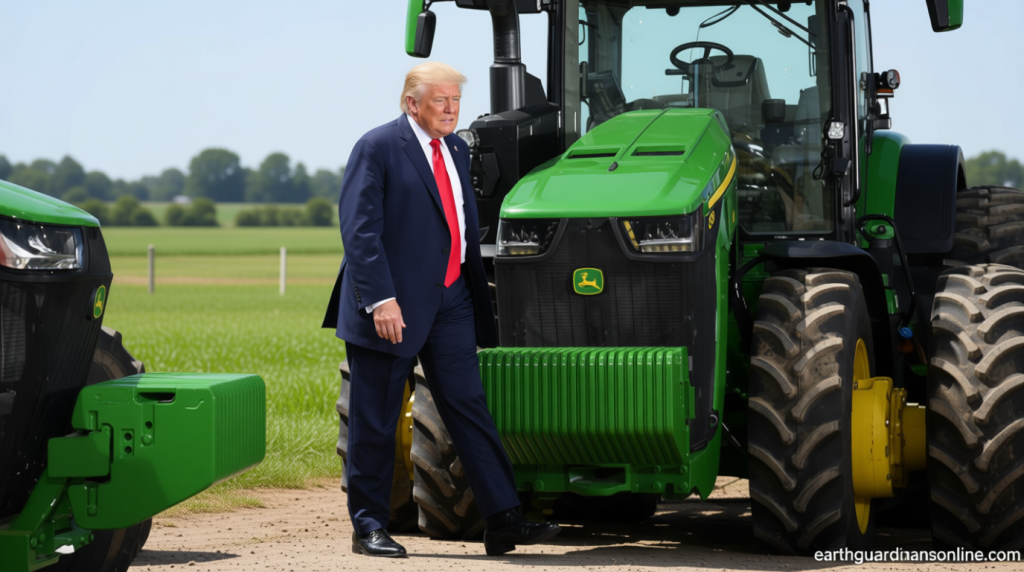
Trump’s Agricultural Gambit in Wisconsin
In a visit to farm country – President Donald Trump’s recent trip to Wisconsin’s agricultural heartland marked a rare return to the campaign trail, nearly a year after securing the state in the 2024 election. The visit, held at Custer Farms in Chippewa Falls, was part of a broader effort to reinvigorate his political base ahead of the pivotal midterm elections. While the event was designed to highlight his commitment to rural America, Trump’s remarks quickly veered toward a more personal narrative, drawing sharp contrasts between his own life and the challenges faced by farmers.
A Fountains Metaphor for Political Priorities
During the roundtable discussion, Trump gestured toward a green sign bearing the slogan “Fighting for American Farmers,” a visual anchor for his agenda. Yet, as the conversation unfolded, he redirected the focus to a seemingly unrelated topic: the condition of Washington’s fountains. “We’re very proud of Washington,” he stated, “but let me tell you, we had 22 fountains that didn’t work. Not one worked, and now they’re clean and beautiful.” The remark, delivered with a mix of pride and wit, underscored his tendency to frame policy debates through symbolic imagery, even when the connection to agricultural issues was tenuous.
The 1,025-mile journey from Custer Farms to the White House highlighted the physical and metaphorical distance between the nation’s capital and its rural constituents. As Trump presented images of the reflecting pool and other infrastructure projects, the audience’s muted response suggested a divide in enthusiasm. While supporters had waited for hours in the sweltering heat, which later gave way to a downpour, their collective silence hinted at skepticism about the president’s priorities. “I’m too cheap to put up a projector,” he joked, holding up a tiny piece of paper that barely caught the light in the crowd.
Politicking Amidst Economic Uncertainty
Trump’s visit coincided with a critical moment in the midterm race, where Republican Rep. Derrick Van Orden’s re-election bid in western Wisconsin’s dairy region hangs in the balance. The area, known for its agricultural influence, has become a focal point for the GOP’s struggle to maintain control of the House. Trump’s presence was a strategic move to align with local interests, but his remarks also exposed tensions within the party over how best to address rural economic concerns.
The president’s trade policies, particularly the imposition of tariffs, have created widespread unease among farmers. Rising costs for diesel and fertilizer—linked to the ongoing Iran war—have further complicated their financial stability. “We’ll take care of fertilizer,” Trump asserted, framing the issue as a temporary disruption caused by the conflict. His promise to address these costs was met with quiet anticipation, though the audience’s reaction remained subdued. “What happened here is artificial with the energy and the fertilizer,” he added, hinting at a potential solution, but leaving the details vague.
Despite his efforts to bolster support, Trump’s comments revealed a disconnect with the agricultural community. He contrasted his own struggles with those of farmers, claiming their lives were “much better than my life.” “You have a nice, safe, beautiful life,” he said, a line that drew mixed responses. While some attendees nodded in agreement, others appeared unconvinced. This moment, far from an empathetic acknowledgment of hardship, instead highlighted his approach of emphasizing personal success over collective challenges.
Reactions from the Field and the Capitol
Brad Peterson, a local farm owner and participant in the roundtable, later described the event as a “farming reality check.” He noted that while Trump’s presence was a welcome sight, the lack of visible support for his policies was evident. “We’d rather have fair trade than the subsidies,” Peterson said, echoing a sentiment shared by many in the audience. Yet, the president’s own words suggested a belief that subsidies were still necessary, despite his public advocacy for free-market principles.
Van Orden, the incumbent representative, took the opportunity to defend Trump’s record. “If anybody says this administration doesn’t care about farmers,” he declared, “you can look them straight in the eye and call them a pile of manure.” His statement, delivered with fervor, underscored the partisan divide in the region. For Van Orden, the event was a chance to reinforce his alignment with Trump, even as the political landscape shifted.
Democratic challenger Rebecca Cooke, however, offered a more critical perspective. Growing up on a farm just miles from the one Trump visited, she described the local electorate as feeling “betrayed by him.” “He’s coming into the lion’s den,” Cooke told CNN, “but farmers just want stable marketplaces to feed the world. They’re not looking for government handouts.” Her comments reflected a broader frustration with policies perceived as favoring urban elites over rural communities. “It’s a slap in the face to come here and talk about coastal decisions that hurt family farms,” she added, emphasizing the perception that Trump’s agenda was disconnected from the realities of agricultural life.
Trump’s remarks also touched on the importance of fair trade, a concept he claimed had been overlooked by his own administration. “A farmer once told me that fair trade was far more important than subsidies,” he recounted, a story that earned a brief burst of applause. But the moment was undercut by his admission that farmers still relied on government aid, suggesting a pragmatic acceptance of subsidies despite his rhetoric. This contradiction sparked debate among attendees, with some questioning whether Trump’s promises would translate into meaningful action.
As the event concluded, the atmosphere remained charged with anticipation. Trump’s return to Wisconsin, a state that had been pivotal in his 2024 victory, signaled his continued engagement with the agricultural sector. Yet, the questions lingering in the room—about the sustainability of his policies and the true cost of his promises—hinted at an electorate increasingly wary of his approach. The reflecting pool, once a symbol of his political legacy, now stood as a backdrop for a conversation that was as much about positioning as it was about progress.
Van Orden’s defense of Trump’s policies, combined with the farm owner’s cautious optimism, illustrated the complex dynamics at play. While the president’s influence was undeniable, the need for tangible solutions remained urgent. As the midterm campaign heats up, the fate of Wisconsin’s farmers—and the broader agricultural community—will likely determine the outcome of key races. Trump’s ability to balance his personal narrative with the economic realities of his supporters will be a test of his political acumen, even as the reflecting pool continues to reflect the waters of his rhetoric.
