
New image of the Crystal Ball Nebula captures the ‘spectacular’ throes of a dying star
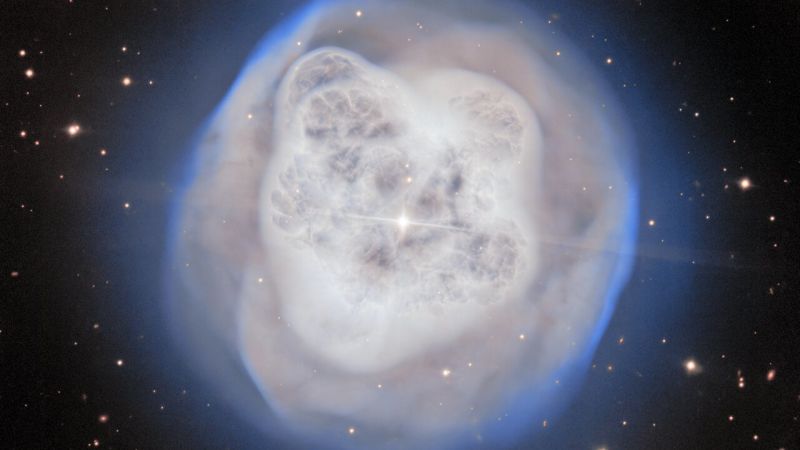
Crystal Ball Nebula’s Stunning Dying Star Image Reveals Cosmic Beauty
New image of the Crystal Ball – Astronomers have released a groundbreaking image of the Crystal Ball Nebula, capturing the final dramatic moments of a star’s life in breathtaking detail. This newly unveiled view, taken by the Gemini Multi-Object Spectrograph, highlights the intricate gas structures and vibrant colors that define the nebula, officially classified as NGC 1514. The object’s nickname stems from its iridescent, spherical form, which resembles a luminous gemstone in space. Located 1,500 light-years from Earth in the Taurus constellation, the nebula offers a rare glimpse into the complex dance of stellar death and rebirth, showcasing how celestial phenomena can be both beautiful and scientifically significant.
Unveiling the Nebula’s Cosmic Secrets
The Crystal Ball Nebula image was captured using advanced telescopes, revealing layers of gas and dust that swirl in intricate patterns. These visuals, generated by the Gemini North telescope on Maunakea in Hawaii, provide a new perspective on planetary nebulae—a type of celestial object formed when a star expels its outer layers, creating a glowing shell around its core. The image’s clarity is attributed to the telescope’s ability to filter light into distinct wavelengths, allowing researchers to study the nebula’s composition and structure. Red hues, for instance, indicate ionized hydrogen, while blue tones reflect oxygen, both critical elements in the life cycle of stars.
“The Crystal Ball Nebula is not just a science target—it’s a visual marvel that reminds us of the universe’s artistic side,” said Travis Rector, an astronomer from NOIRLab. NOIRLab, part of the National Science Foundation, uses cutting-edge technology to explore cosmic processes, and the nebula’s stunning appearance has drawn attention beyond its scientific value. The team’s primary research goals were unrelated, but the nebula’s unique form made it an irresistible subject for observation.
The Binary Star System’s Influence
What makes the Crystal Ball Nebula particularly intriguing is its connection to a binary star system. In this scenario, two stars orbit each other, and their gravitational interactions shape the nebula’s structure. The longer orbital period of the system—nearly nine years—allows the companion star to influence the gas expelled by its dying counterpart. This dynamic process creates the nebula’s cloudlike, symmetrical appearance, as the orbiting star churns and compresses the gas shell. Such interactions are common in planetary nebulae, where binary systems play a key role in the formation of complex shapes.
The Crystal Ball Nebula’s unique form is a result of this dual-star environment. While the primary star sheds its outer layers, the secondary star’s gravitational pull modifies the flow of gas, leading to the creation of luminous, sculpted structures. Rector explained that the interaction between the stars is akin to how a spinning machine can transform a simple material into a decorative masterpiece. The nebula’s beauty, therefore, is not accidental but a product of cosmic mechanics, offering clues about how stars evolve and how their remnants interact with surrounding space.
Historical Discoveries and Technological Breakthroughs
Though the Crystal Ball Nebula has been observed for over two centuries, its recent image has brought fresh insights into its origins. William Herschel, the English astronomer who coined the term “planetary nebula,” first documented NGC 1514 in 1790. Modern tools like the James Webb Space Telescope have since expanded our understanding, revealing details previously unseen. “The Crystal Ball Nebula’s appearance changes dramatically depending on the light wavelengths used,” noted Jan Cami, a researcher at Western University in London, Ontario. This variability underscores the importance of multi-wavelength imaging in unraveling the complexities of stellar evolution.
As the Crystal Ball Nebula continues to evolve, its visual and scientific allure remains undiminished. The image not only captivates the eye but also serves as a testament to the power of observational astronomy. By studying such phenomena, scientists gain valuable insights into the life cycles of stars, the formation of planetary nebulae, and the role of binary systems in shaping cosmic structures. The nebula’s striking appearance, combined with its scientific significance, highlights the intersection of beauty and discovery in the universe.
