
Iran war ripple effects are increasing risks of acute hunger for millions, World Food Programme chief says
Iran War Ripple Effects Are Increasing Risks of Acute Hunger for Millions, World Food Programme Chief Says
Iran war ripple effects are increasing – The ongoing conflict in Iran is creating a cascade of challenges that are pushing millions of people closer to the brink of severe food insecurity, according to Carl Skau, the acting Executive Director of the World Food Programme (WFP). In a recent interview with CNN, Skau highlighted how the war’s consequences are not only affecting the region but also amplifying global hunger crises. With the Strait of Hormuz—the vital waterway through which a significant portion of the world’s oil is transported—remaining closed, the price of fuel has skyrocketed, imposing a massive financial burden on the WFP’s operations. This has led to an unprecedented surge in the cost of essential supplies, including fertilizers that are crucial for agricultural production in countries like Sudan.
Fuel Costs Fuel Global Food Crisis
Skau explained that the closure of the Strait of Hormuz has created a domino effect on fuel prices, which in turn has driven up the cost of food worldwide. “Fuel costs have risen exponentially, making every aspect of our work more expensive,” he said. This includes transportation of aid, energy for food processing, and the maintenance of logistics networks. The WFP, which depends heavily on international donations, is now forced to make tough decisions about resource allocation. “We’re already taking from the hungry to give to the starving,” Skau noted, underscoring the dire situation caused by shrinking budgets.
The situation has been further exacerbated by the disruption of fertilizer supplies. With the strait serving as a critical artery for transporting these resources from the Gulf to regions in need, the closure has delayed or prevented their delivery. This is particularly alarming for countries like Sudan, where the availability of fertilizers is essential for sustaining crop yields and feeding a population already struggling with food insecurity. “Without these supplies, we’re not just losing the ability to grow food—we’re losing the means to keep people from going hungry,” Skau added.
Funding Shortfalls Threaten WFP’s Reach
Skau also emphasized the role of funding cuts in worsening the crisis. The WFP has experienced a dramatic decline in donations, with the United States, its largest contributor, reducing its 2026 pledge to $731 million from $4 billion in 2024. “This is a massive shift,” he said, noting that the organization is now navigating an environment where support is not keeping pace with escalating needs. Unlike previous global emergencies, such as the war in Ukraine or the pandemic, the current funding levels have not seen a rebound, leaving the WFP to rely on dwindling resources to respond to emergencies.
The funding shortfall has forced the WFP to prioritize certain populations over others, often at the expense of the most vulnerable. For example, in parts of South Sudan, where a region is facing famine, the organization can only deliver aid by air. However, this method is costly, and the strain on resources has limited the scope of assistance. “If we continue this air bridge, we’re burning through a lot of our budget,” Skau explained. “We can’t help everyone in need, and that means some people are left without support.”
Global Hotspots Feel the Brunt of the Crisis
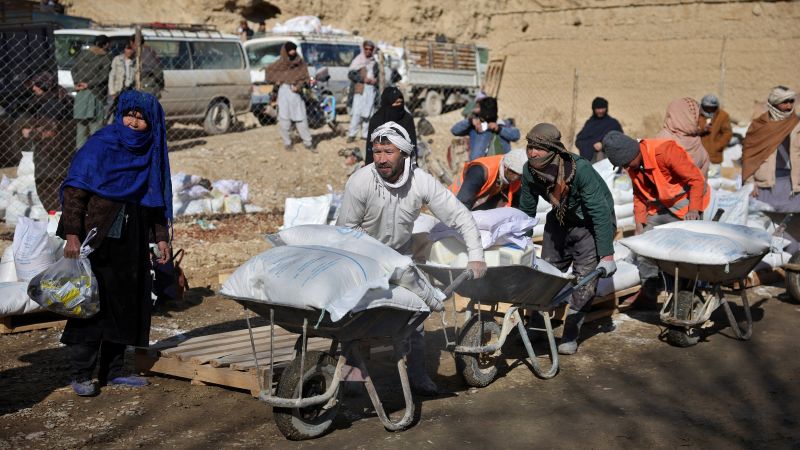
The WFP has observed the consequences of the crisis in several regions, including Sri Lanka, Somalia, and Afghanistan. In Afghanistan, Skau described how local teams are grappling with the question of who to assist first. “We don’t have the capacity to help every woman-headed household with children,” he said. “So we’re having to decide which families get the most urgent support.” In one scenario, the organization might choose to focus on households with more than five children, leaving those with fewer children without aid. “That decision has massive implications,” Skau warned.
Similarly, in Lebanon, hundreds of thousands of people have been displaced, and the WFP is struggling to meet their food requirements. The organization’s ability to operate efficiently has been hampered by these cuts, forcing it to adapt its strategies in real time. Skau also mentioned the ongoing challenges in Ukraine, where over 80 incidents have disrupted WFP’s distribution points, warehouses, and partner assets. A recent missile strike on a warehouse in Dnipro, Ukraine, highlighted the fragility of the situation, with the WFP having to secure alternative routes for supplies.
Despite these challenges, the WFP remains committed to alleviating suffering. Skau pointed out that the organization has been working tirelessly to address food insecurity in regions like Sudan, where 20 million people are already struggling to access enough nourishment. “The situation in Sudan is dire, and the closure of the strait has only made it worse,” he said. He also noted that the WFP’s operations are no longer just about responding to immediate needs but also about preventing long-term crises.
US Leadership and Global Stability
While the US is still the WFP’s largest donor, its contribution has dropped significantly under the Trump administration. Skau acknowledged this reduction but expressed gratitude for the continued support. “We are thankful for the US commitment, but we also know we need to push for more,” he said. The WFP has been advocating for richer nations to take greater responsibility in mitigating the effects of the crisis on the poorest populations. “A hungry world is an unstable world,” Skau argued. “It’s in the interest of the US to ensure that no child goes to bed without food.”
Skau stressed that the current funding landscape has shifted, with donors showing less willingness to increase contributions. “Last year, we saw a 40% drop in funding compared to the previous year,” he said. This decline has forced the WFP to rethink its approach and make difficult choices. “We’ve never had to do this before,” he admitted. “Now, we’re not just dealing with one crisis—we’re managing multiple overlapping ones.”
Looking ahead, Skau remains hopeful but cautious. “Even if the Strait of Hormuz reopens tomorrow, the impact of this conflict will be felt for years to come,” he said. The WFP is preparing for the long term, but its ability to do so depends on the generosity of donors. “We need a global effort to ensure that people in the most vulnerable regions are not left behind,” Skau concluded. “Otherwise, we risk seeing more than 45 million additional people facing acute hunger by the end of the year.”
Calling for a Collective Response
Skau’s comments reflect a broader concern about the interconnected nature of global crises. The war in Iran, combined with rising fuel costs and funding cuts, has created a perfect storm for food insecurity. “We’re not just dealing with one issue—we’re dealing with the convergence of multiple factors,” he said. “This is a complex challenge that requires a coordinated and sustained response.”
As the WFP continues its mission, it faces the daunting task of stretching limited resources across the world. Skau’s leadership, which began last week following Cindy McCain’s departure, brings a new perspective to the organization’s efforts. With a background as a former Swedish diplomat, he is determined to highlight the urgency of the situation and rally support from international partners. “We need to remind the world that this is not just a regional problem—it’s a global one,” Skau said. “Every decision we make now will shape the future of millions.”
In the end, Skau believes that the key to overcoming the crisis lies in the willingness of wealthier nations to step up. “It’s not just about money—it’s about solidarity,” he said. “The WFP is doing its part, but we can’t do it alone.” As the war continues to ripple across the globe, the stakes for food security have never been higher, and the WFP is counting on the international community to respond with the urgency and generosity this moment demands.
