
A submersible ride revealed a vast whale graveyard. And it holds more than just bones
A Submersible Expedition Unearthed One of Earth’s Largest Whale Graveyards
A submersible ride revealed a vast – Deep beneath the waves, in the uncharted depths of the southeastern Indian Ocean, a team of researchers has uncovered a sprawling underwater cemetery. This site, one of the most significant discoveries in marine paleontology, spans over 1,200 kilometers and contains hundreds of fossilized remains, including one that may belong to an entirely new species. What makes this graveyard remarkable is not just its size, but the mix of ancient and modern whale skeletons, indicating a continuous cycle of life and death in this region for at least five million years.
The Depths of a Living Necropolis
While the site is a graveyard in the traditional sense, it also functions as a vibrant ecosystem. At depths exceeding 15,000 feet, the ocean floor is home to a dense concentration of whale remains, some of which are recent enough to still bear scavengers. These “whale falls” form a critical food source for deep-sea organisms, from bone-eating worms to chemosynthesis-dependent bivalves and brittle stars. The presence of such life forms alongside fossilized remains suggests that this location has served as a natural feeding ground for millennia.
The discovery was made during an expedition led by the Global Hadal Trench Exploration Program, an international initiative to investigate Earth’s least-explored oceanic regions. Using the submersible Fendouzhe, part of the Chinese Academy of Sciences’ Institute of Deep-Sea Science and Engineering, the team explored the Diamantina Fracture Zone, a geological feature southwest of Australia. This area, shaped by the tectonic separation of the Australian and Antarctic landmasses around 30 to 40 million years ago, now hosts a unique concentration of whale remains.
Beaked Whales: Rare but Resilient
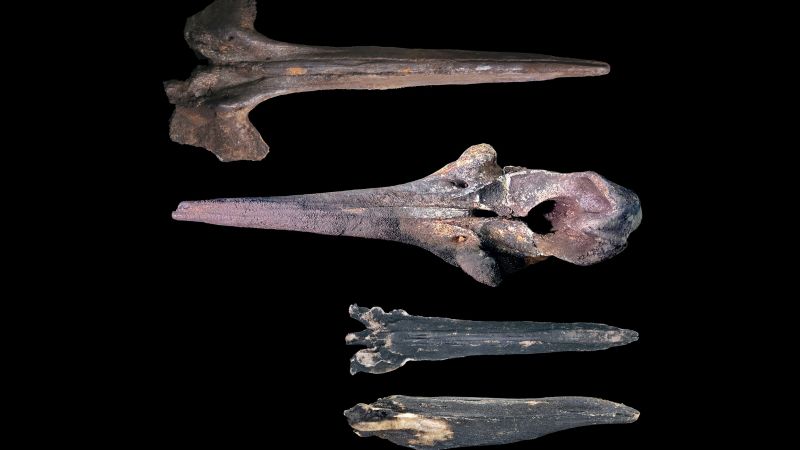
Among the fossils, beaked whales dominate. These deep-diving creatures, with elongated, dolphin-like skulls, are rarely observed near the surface. Their elusive nature has left many aspects of their biology a mystery, yet their remains have accumulated in this graveyard for millions of years. The researchers noted that the site’s fossil density—up to 760 remains per square kilometer in certain areas—far surpasses what has been recorded in similar locations.
“It’s astonishing to find such a concentration of whale skeletons in one place,” said Peng Zhou, a co-lead author of the study. “This site appears to be a hotspot for deep-sea deposition, likely due to its unique topography and currents.” Zhou, who conducted the expedition using the submersible Tan Suo Yi Hao, emphasized the challenges of reaching such depths. “The remoteness and pressure make exploration difficult, but the rewards are immense,” he added.
Scavengers and New Discoveries
The graveyard is not only a repository of bones but a thriving habitat for deep-sea life. Some of the modern carcasses still bore colonies of scavengers, including brittle stars and worms, which rely on whale falls for sustenance. These organisms, many of which may be previously unknown to science, thrive in the absence of sunlight, using chemical energy from decomposing remains to survive. This process, known as chemosynthesis, supports a complex web of life in the abyssal zone.
“The ecological significance of this site is immense,” said Olivier Lambert, a vertebrate paleontologist at the Royal Belgian Institute of Natural Sciences. “Until now, whale falls were primarily associated with large baleen whales, but this discovery shows that beaked whales also contribute to deep-sea biodiversity in ways we hadn’t fully recognized.” Lambert, who was not part of the expedition, highlighted the uniqueness of the find. “The fact that this necropolis has been accumulating for millions of years is almost as surprising as the sheer volume of remains we encountered.”
The team’s 32 dives in early 2023 revealed over 485 whale-fossil deposits, alongside five active modern whale falls. Using robotic arms and a specialized slurp sampler, they collected 43 fossils and scavenging organisms, providing a snapshot of the site’s biological and geological history. The abundance of remains, estimated to exceed 10 million, underscores the site’s role as a long-term sink for whale skeletons. Some of these bones may be buried under layers of sediment, further enriching the area’s fossil record.
Historical and Geological Context
Located in the Diamantina Fracture Zone, the site’s formation is linked to tectonic shifts that split the Australian and Antarctic continents. This geological history has created a deep-sea environment conducive to the preservation of whale remains. The area’s ridges and trenches likely channel carcasses into the graveyard, where they accumulate over time. The researchers noted that fossil skulls of beaked whales have been found nearby, sometimes snagged by trawlers or fishing vessels in regions off Iberia, South Africa, and the Kerguelen Islands.
“This graveyard is a testament to the resilience of marine ecosystems,” Zhou explained. “Even in the most extreme depths, life persists through these remarkable cycles of decay and renewal.” The expedition also included visits to the Challenger Deep, the ocean’s deepest point, where the submersible Fendouzhe made history in 2020. However, the Diamantina Zone’s unique combination of ancient and modern remains has captivated scientists, offering insights into both past and present marine life.
The study, published in the journal *Nature*, has sparked renewed interest in deep-sea research. Lambert pointed out that the graveyard’s longevity challenges previous assumptions about whale mortality patterns. “It’s not just about the number of remains, but their distribution across such a vast area,” he said. “This suggests a consistent and sustained process of whale carcass deposition, likely influenced by oceanic currents and the density of beaked whale populations in the region.”
As the team continues to analyze their findings, the Diamantina Zone’s significance grows. Its role as a necropolis and an ecological hub highlights the interconnectedness of deep-sea environments. The discovery also raises questions about the broader distribution of whale falls and the potential for uncovering new species in these unexplored regions. With each dive, the secrets of the abyss come to light, revealing a world where life and death coexist in profound harmony.
“The sight of the beaked whale’s skull—so small yet so powerful—was a moment that changed everything,” Zhou reflected in an email to CNN. “It reminded us that even the most remote parts of the ocean hold stories waiting to be told.”
For scientists, the Diamantina Zone represents a rare opportunity to study the long-term impacts of whale remains on deep-sea ecosystems. The site’s history, stretching back millions of years, offers a unique window into the evolution of marine life. As research in the Hadal Trench progresses, the Diamantina graveyard may become a cornerstone of understanding deep-ocean biodiversity and the cycles of nature that govern it.
