
The tanks in Cushing, Oklahoma, are hitting bottom. The oil market is about to hit a tipping point
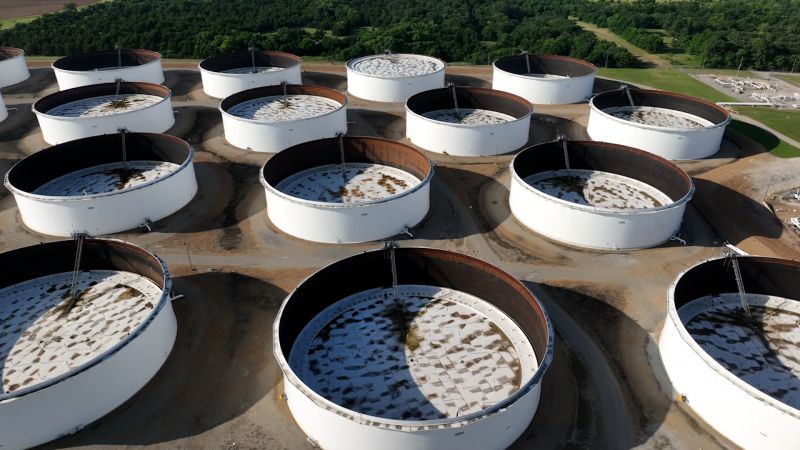
The Tanks in Cushing, Oklahoma, Are Approaching Critical Low Levels
The tanks in Cushing Oklahoma are hitting – At the heart of America’s energy infrastructure lies a town that has long claimed its place as the global pipeline crossroads. Cushing, Oklahoma, is more than just a geographical point—it is the central artery through which the nation’s crude oil flows. A giant sign at the intersection of Main Street and South Stiles Road, crafted from pipes and complete with a valve, serves as a stark reminder of the town’s role. This isn’t mere symbolism; it reflects the town’s practical significance as the primary storage and pricing hub for West Texas Intermediate (WTI) crude. In times of stability, Cushing functions as a critical node, ensuring that oil reaches refineries across the country. But as of late, the town is facing a unique challenge: its oil reserves are dwindling at an alarming pace, potentially setting off a chain reaction in the broader market.
A Global Supply Crisis
Cushing’s current inventory stands at 21.6 million barrels, a figure that has sparked concern among industry analysts. This number is not just a statistic—it represents the town’s near-empty storage tanks, which are operating at levels dangerously close to their capacity limits. For context, the town’s typical storage capacity is around 75 million barrels, but its reserves have fallen to a point where they are barely holding steady. When oil levels dip below 20 million, the system enters a state of crisis, with unusable sludge accumulating at the bottom of the tanks. This situation is particularly worrying because it signals a breakdown in the supply chain, one that could ripple across the globe.
The root of this problem lies in the shifting dynamics of international energy markets. America has become the last resort for regions that traditionally relied on Middle Eastern oil. During the Iran war, demand for US crude surged to unprecedented heights, overwhelming Cushing’s capacity. As a result, oil is flowing out of the town faster than it can be replenished, creating a temporary imbalance. This phenomenon is not limited to Cushing, however. US diesel stocks have reached their lowest levels since 2003, while gas inventories have also declined, now sitting 5% below their year-ago levels. Outside of Cushing, other commercial crude storage facilities are experiencing similar depletion, with a single week alone seeing a drop of 7.2 million barrels.
The Role of Global Stockpiles
Despite the massive supply shock, the US oil and gas prices have not yet reached record highs. This is largely due to the pre-existing global surplus of oil, which acted as a buffer before the crisis intensified. Oil stockpiles in the world’s wealthiest nations are currently at 2.6 billion barrels, according to the US Energy Information Administration. David Oxley, chief climate and commodities economist at Capital Economics, notes that this level is just 100 million barrels above operational stress levels. “The market is on the edge,” he explains. “It can’t sustain this rate of decline indefinitely.”
According to Natasha Kaneva, head of commodities strategy at JPMorgan, the situation mirrors the human body’s circulatory system. “Like blood pressure, the issue is circulation,” she says. “The system doesn’t fail because oil disappears—it fails because the flow is disrupted. Once the network loses enough working volume, even minor disruptions can cause major issues.” This perspective underscores the fragility of the current system. If the market continues to hemorrhage oil, the consequences could be severe. Pipelines may struggle to maintain pressure, and refineries could be unable to meet the diverse fuel demands of their customers.
Potential Market Fallout
At the current rate of depletion, the global oil market could enter a dangerous zone within a month. This means that even a small disruption—such as a pipeline leak or a refinery fire—could send prices skyrocketing. Weather events, like hurricanes or extreme cold, could also exacerbate the situation, creating a perfect storm of volatility. “Prices could become wildly unpredictable,” Kaneva warns. “A single incident might trigger a panic, causing the market to react with extreme speed.”
Analysts have identified a possible trigger for this scenario: the Strait of Hormuz. If the strait remains closed, the strain on Cushing’s inventory will intensify. The town’s reserves are already so low that any further reduction could push the system to its breaking point. “We’re at a critical juncture,” said Mike Sommers, CEO of the American Petroleum Institute, during an interview on CNN’s *The Lead*. “The levels we’re seeing now are unheard of, and they’re starting to raise alarms.” Sommers’ comments highlight the urgency of the situation, as the market teeters on the brink of a potential crisis.
Historically, when Cushing has reached its operational minimum, fuel prices have spiked to historic highs. This pattern was evident in 2008, 2022, and 2023, each time signaling a shift in market dynamics. If this trend repeats, the next spike could come faster than anticipated. The question is, how long can the market withstand this pressure? With storage levels declining and global supply chains stretched thin, the answer may be closer than many expect.
One possible solution is an export ban, which could help stabilize Cushing’s reserves by redirecting excess oil to other markets. However, such a move has limited political appeal and could lead to long-term consequences, including higher prices for consumers. Alternatively, the market might rely on natural dynamics to adjust, but this approach could result in rapid and severe price fluctuations. “It’s not just about the oil itself,” said Sommers. “It’s about the system that moves it. If that system falters, the entire market could collapse.”
The situation in Cushing is a microcosm of a larger global issue. As the world’s energy markets become more interconnected, the vulnerability of a single hub increases. The town’s tanks are now a symbol of this fragility, their emptiness a warning sign for the entire system. While the immediate impact of the crisis remains uncertain, the signs are clear: the oil market is on the edge of a tipping point. Whether this leads to a temporary adjustment or a full-scale panic depends on how quickly the system can recover and how much pressure it can absorb before the final drop.
The Path Forward
Industry leaders are calling for immediate action to prevent the crisis from escalating. Some argue that increased production or infrastructure investment could alleviate the pressure, while others emphasize the need for policy interventions. The challenge lies in balancing these factors without causing additional instability. As the weeks pass, the market will be watching closely to see if Cushing’s reserves can be replenished or if the system will collapse under its own weight.
For now, the world remains in a state of uncertainty. The oil market, once a robust and resilient network, is now teetering on the edge of a critical threshold. The implications of this threshold being crossed could reshape energy economics for years to come. As the inventory levels in Cushing continue to fall, the question is no longer whether the market will face a crisis—it’s how soon that crisis will arrive and what form it will take.
