
How Trump’s takeover fractured America’s birthday party
How Trump’s Takeover Fractured America’s Birthday Celebration
How Trump s takeover fractured America – In June 2026, as the nation prepared to commemorate its 250th anniversary, a group of progressive organizers hoped to foster unity through a shared celebration of democracy. Their plans for the America250 initiative envisioned a series of community-driven events across the country, aiming to bridge divides and honor the legacy of the United States. However, the return of Donald Trump to the presidency—this time as the 47th leader—shifted the focus of the commemoration, turning it into a platform for his vision of a more patriotic and partisan narrative.
A Polarized Celebration
Originally, the America250 project was designed to bring together diverse communities in a spirit of collective pride. It included everything from local festivals to educational programs, reflecting a broad range of American identities. Yet, with Trump’s re-election in November 2024, the project’s tone began to change. Critics argue that the president’s influence transformed the anniversary into a tool for reinforcing his political agenda rather than celebrating the nation’s shared values.
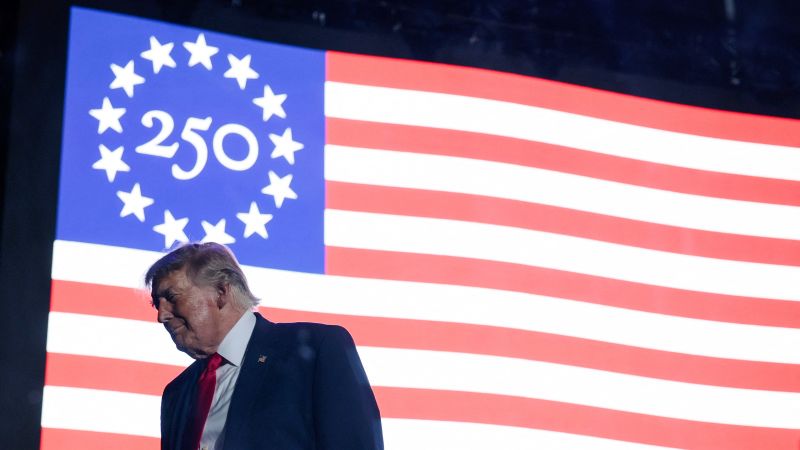
The conflict reached a new level in June when Trump unveiled his own initiative, Freedom 250, to dominate the festivities. This new organization, though officially non-partisan, was quickly accused of being a vehicle for the administration’s ideological goals. Events like the National Mall’s “Great American State Fair” were now seen as emblematic of a government-controlled celebration, overshadowing the original efforts of Next250, a coalition of grassroots groups.
A Counterprogram on the Streets
Amid this shift, Next250 adapted its strategy. On Saturday, a communal festival in Washington, D.C., will take place, featuring an indigenous-led opening ceremony, a march beginning at the former Black Lives Matter Plaza, and voter registration stations. This event, held just steps away from the White House, represents a direct challenge to Trump’s centralized approach. The organization’s efforts highlight the tension between top-down presidential control and grassroots activism, as they strive to maintain the anniversary’s inclusive spirit.
“It’s a lost cause to expect anything unifying and exciting coming out of Washington,” remarked John Dichtl, president and CEO of the American Association for State and Local History. Dichtl, who had advised states on their 250th planning, noted that the administration’s actions had turned the celebration into a partisan spectacle, prioritizing political messaging over national unity.
Some state and local planners, facing pressure from federal resources directed toward Freedom 250, have distanced themselves from the national events. This fragmentation has raised concerns about the anniversary’s ability to serve as a cohesive national moment. Meanwhile, Next250 continues to push for a counter-narrative, emphasizing that the United States belongs to all its people, not just the administration’s allies.
The Rise of Freedom 250
The transformation began in December 2025, when Trump announced his plans for the 250th anniversary via a video on his Truth Social platform. He declared it would be “a celebration of America like no other,” highlighting a partnership between public and private entities under the banner of Freedom 250. This initiative, however, was met with skepticism, as its structure and control seemed to favor the administration’s priorities.
Trump’s decision to take over the festivities was partly motivated by a personal grudge. The nonprofit America250, which had been managing federal celebrations, was led by a loyalist who was abruptly dismissed. This move allowed Trump to rebrand the anniversary, using his influence to reshape the narrative. While Freedom 250 was officially independent, its operations were heavily guided by top Trump advisors, raising questions about its neutrality.
“The administration doesn’t own the 250th anniversary, nor do they own the story of this country,” asserted Linda Sarsour, a Next250 organizer and activist known for leading the Women’s March on Washington. Her statement underscored the group’s belief that the celebration should reflect the collective voice of the American people, not the singular vision of one leader.
Freedom 250’s financial arrangements have also sparked debate. The organization lists about two dozen sponsors on its website, many of which are linked to Trump’s allies. Companies like Palantir, Lockheed Martin, and Oracle, which hold significant federal contracts, are among the major contributors. Others, such as the Ultimate Fighting Championship and Penske Corp., are led by individuals like Dana White and Roger Penske, both of whom have close ties to the president. These sponsors have already begun promoting their own events, including a UFC fight on the White House lawn and an IndyCar race in August.
Questions of Oversight
Interior Secretary Doug Burgum, when asked about Freedom 250’s funding, stated to CNN’s Dana Bash that the group’s finances would be managed through the National Park Foundation’s standard reporting processes. However, this assurance has not quelled concerns from watchdog groups and congressional Democrats, who are investigating the nonprofit’s operations. Richard Painter, a former White House ethics lawyer, warned that the administration’s direct involvement with Freedom 250 without congressional approval could undermine its credibility.
The controversy extends beyond funding. The National Park Foundation, while overseeing Freedom 250’s finances, has acknowledged the group’s autonomy in deciding donor disclosure. Yet, with Trump’s allies actively shaping the events, the line between public and private influence has become blurred. Critics argue that this lack of oversight has created an environment where the anniversary is used to advance political interests rather than promote national dialogue.
A Debate Over Accountability
Freedom 250’s CEO, Keith Krach, has defended the organization’s transparency, stating in an interview with CNN that “we’re all about accountability and transparency.” He emphasized that managing the books effectively was a key part of his role, but the question remains: does this commitment extend to publicly revealing donors who may have political connections? While the group has not yet fully disclosed its funding sources, its leadership insists that its financial practices align with the principles of good governance.
The push for a unified celebration has also faced challenges from within the community. Some state and local planners, wary of the federal government’s dominance, have chosen to scale back their own events. Others have embraced Trump’s vision, citing the economic benefits of federal funding. This divergence has created a patchwork of celebrations, with some states hosting grand events and others opting for smaller, more localized commemorations.
As the 250th anniversary approaches, the debate over its meaning intensifies. While the National Mall hosts Trump’s “Great American State Fair,” Next250 and its allies continue to advocate for a celebration that reflects the diversity of the American experience. Their efforts, though underfunded and
