
Serbian President Vucic says he will resign within weeks amid student-led protests
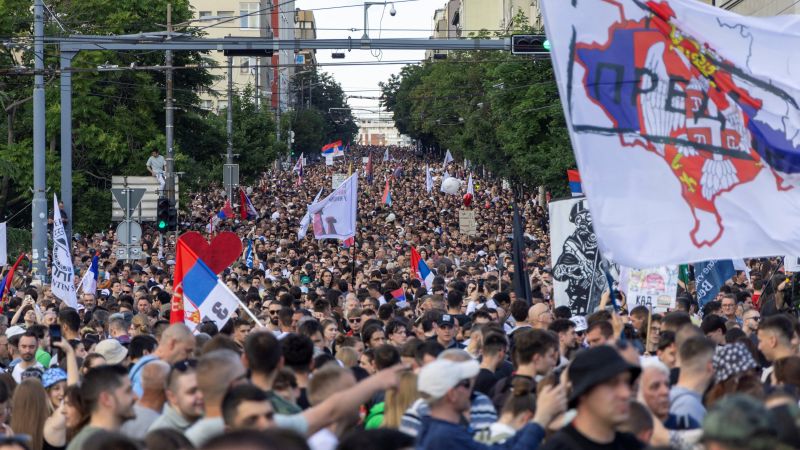
President Vucic Announces Resignation Amid Growing Protests
Leadership Shift Triggered by Public Outcry
Serbian President Vucic says he will – On Saturday, Serbian President Aleksandar Vucic declared his intention to resign within weeks, signaling a potential leadership transition in the Balkan nation. This move comes after nearly 18 months of sustained anti-government protests, primarily driven by a student-led movement. The protests gained momentum following a tragic incident in November 2024, when an awning at a railway station in Novi Sad collapsed, killing 16 people. The disaster has become a symbol of systemic government failures, with critics accusing authorities of poor oversight in infrastructure projects and widespread corruption.
Political Reforms and Electoral Strategy
Vucic’s announcement was made during a pro-government rally in Belgrade, where he addressed supporters who had traveled from across the country. He proposed that his Serbian Progressive Party (SNS) would lead the upcoming presidential election and early parliamentary vote, originally scheduled for 2027. “My proposal is for our list, the winning list in the upcoming elections, to be named ‘United Serbia,’” he stated, emphasizing unity under a new banner. While he hinted at stepping down, he left the exact timeline unspecified, leaving room for speculation about when the parliamentary dissolution would occur.
Enduring Influence and Strategic Maneuvering
Despite his resignation pledge, Vucic’s political trajectory remains intact. Analysts suggest that his departure could pave the way for him to assume the role of prime minister if the SNS secures a majority in the early elections. This would continue a pattern where Vucic’s influence over Serbia’s governance persists, regardless of his official title. In a February interview with Reuters, Vucic expressed uncertainty about his future but hinted at a desire to remain involved in shaping his legacy. “I would like to be less engaged in politics or not at all, but taking care of my legacy might require some sort of engagement; we’ll see,” he remarked.
Student Movement and Opposition Demands
The student-led protests have been a focal point of recent unrest, with demonstrators in Novi Sad demanding immediate reforms. They gathered to honor the victims of the railway station collapse and called for snap general elections as a means to hold the government accountable. The movement has grown in strength, drawing support from various opposition groups and civil society organizations. Savo Manojlovic, head of the student opposition group Move-Change, criticized Vucic’s approach, stating, “By resigning and with early presidential and parliamentary elections, Vucic is trying to preempt his inevitable fall, because of protests and because of the student movement, which has more support than he does.”
Protests and Foreign Allegations
Vucic’s opponents argue that the protests reflect deepening dissatisfaction with his administration. During his rally, he accused anti-government demonstrators of working with unnamed foreign powers to destabilize the country, a claim that protesters deny. “For the thousand and first time, we are offering you our hand. We forgive everything you have done, but we are not naive, and we will not forget what has been done to the country in the last year,” he told supporters, underscoring his commitment to maintaining control.
EU Aspirations and Domestic Challenges
Serbia’s bid to join the European Union hinges on its ability to strengthen democratic institutions and combat corruption. The country’s alignment with Russia and China has been a balancing act for Vucic, who has navigated international relations while consolidating domestic power. His recent pledge to address corruption within the party has been framed as a concession, though opposition figures remain skeptical. They accuse him of perpetuating graft and aligning with organized crime, while also criticizing his administration’s handling of media freedom.
Public Sentiment and Electoral Prospects
The protests have exposed a rift between Vucic’s government and the populace, particularly among younger generations. Students, who have taken the lead in demanding transparency, have become a powerful force in shaping public opinion. Their calls for early elections have intensified pressure on Vucic, who faces a challenge from both the opposition and the student movement. Analysts note that his strategy involves maintaining a strong presence in the political landscape by placing a loyal ally in the presidency, ensuring his influence endures beyond his current term.
Legacy and Future Moves
Vucic’s 12-year tenure as president or prime minister has seen him dominate Serbia’s political scene, but the recent unrest suggests a potential shift. While he has not confirmed the exact date of his resignation, the timing of his announcement raises questions about whether the protests have forced him into a corner. Days prior, students in Novi Sad held a commemorative event, highlighting the tragedy and linking it to broader concerns about governance. A subsequent rally in Kraljevo, south-central Serbia, is expected to further mobilize dissent.
Government Response and Policy Promises
In response to the growing discontent, Vucic outlined a series of policy pledges, including pension increases, enhanced financial aid for the poor, and improvements to state-run health services. These measures aim to alleviate public frustration and secure votes in the upcoming elections. However, critics argue that such promises may not address the root causes of the protests, such as corruption and mismanagement in public projects. The collapse of the awning in Novi Sad, which exposed vulnerabilities in infrastructure, has become a rallying point for those demanding accountability.
Historical Context and Political Dynamics
This wave of protests marks the largest series of demonstrations since the 2000 ousting of Slobodan Milosevic. The student movement has played a pivotal role, uniting diverse groups under a common demand for change. Vucic’s decision to resign may be a calculated move to preserve his political dominance, ensuring his allies inherit power while maintaining his influence. His ability to navigate this transition will depend on the SNS’s performance in the elections and the public’s response to his proposed reforms.
Broader Implications for Serbia
As Serbia prepares for a pivotal political moment, the country’s future remains uncertain. The protests have not only challenged Vucic’s leadership but also tested the resilience of his party. With early elections looming, the political stage is set for a showdown between the SNS and opposition forces. Analysts like Radivoje Grujic from Warsaw observe that Vucic’s resignation does not signal an end to his political career. “This is not at all the end of Vucic,” Grujic noted. “He already has a plan, one that definitely does not mean he’s going to go into political retirement — quite the opposite.” The situation in Serbia now hinges on whether Vucic’s strategies can quell the unrest or if the protests will culminate in a fundamental shift in power. As the nation grapples with its path forward, the interplay between grassroots movements and elite political maneuvering will define the outcome of the upcoming elections and the country’s trajectory in the years to come.
