
Peter Thiel in Aspen: The pope is ‘working for the Chinese Communists’
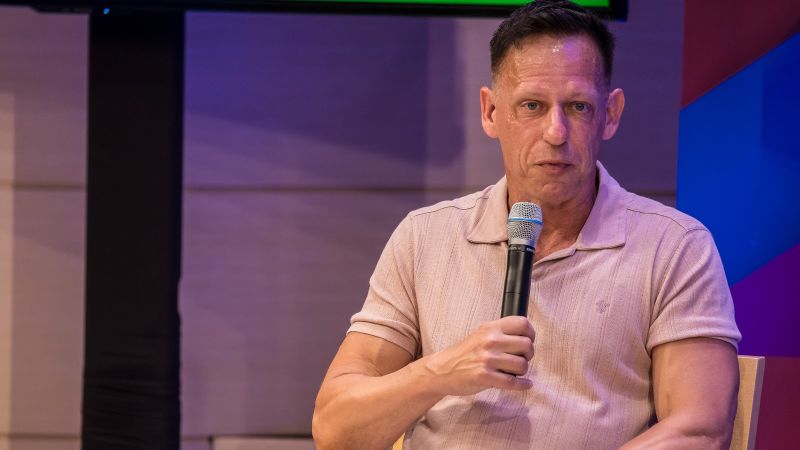
Peter Thiel in Aspen: The Pope Accused of Chinese Communist Influence
Peter Thiel in Aspen – At the Aspen Ideas Festival in Colorado, tech magnate Peter Thiel sparked controversy with a series of sharp critiques on the trajectory of artificial intelligence and the future of Western political systems. His remarks, delivered in a nonrecorded panel, included a pointed allegation that Pope Leo XIV, the first U.S.-born pope in history, is functioning as a “Chinese communist agent” by advocating for AI regulation. Thiel’s argument drew laughter from the audience, underscoring the provocative nature of his claims.
The Pope and AI Regulation
Thiel’s focus on the Vatican centered on Leo’s May encyclical, “Magnifica Humanitas,” which called for global oversight of artificial intelligence. He contended that the document’s emphasis on curbing AI development could inadvertently benefit China by slowing its technological rivalry with the United States. “The Pope’s message could influence some Americans, but it’s unlikely to be heeded by people in China,” Thiel said, suggesting that the encyclical would create an imbalance in the “race between the US and China” to advance AI.
“I think there’s going to be a democratic-socialist takeover of the Democratic Party.”
Thiel’s broader critique extended to the U.S. political landscape, where he warned of a shift toward “techno-authoritarianism.” He accused the Democratic Party of being increasingly dominated by far-left forces, arguing that its institutions have become a breeding ground for extremism. “The weird ways that politics has gone haywire is telling me something very deep,” he remarked, emphasizing his belief that Western democracies are at risk of destabilization due to decades of technological stagnation.
Thiel’s Political Philosophy and Influence
Thiel, a co-founder of PayPal and Palantir, has long been a figure of influence in Silicon Valley. His early support for former President Donald Trump positioned him as a key player in the tech sector’s political activism. Additionally, he played a pivotal role in JD Vance’s rise to prominence, having previously hired him at Mithril Capital before backing his political career. This dual role as both investor and political strategist has shaped his perspective on governance and economic systems.
During the Aspen panel, Thiel engaged in a spirited debate with political scientist Francis Fukuyama. Their discussion, titled “Humanity at the End of History,” marked a significant departure from their earlier 2012 exchange, which focused on technological stagnation and economic inequality. This time, the conversation took on a more urgent tone, addressing the survival of Western democracy in the face of global competition and ideological shifts.
Friction with the Vatican
Thiel’s animosity toward the Vatican isn’t a recent development. In March, he held an exclusive lecture series on the Antichrist in Rome, just a few blocks from the Holy See. The event reportedly unsettled Catholic institutions, prompting two universities to distance themselves from hosting the talks. Thiel’s theory posits that the Antichrist could emerge not as an individual, but as a centralized world government promising to safeguard humanity from existential threats like AI and climate change.
Despite the Vatican’s silence on his remarks, Thiel’s comments have ignited debate. Critics argue that his skepticism of democratic institutions and support for elite-led governance align with a form of “techno-authoritarianism.” However, he maintains that such systems are necessary to counteract the growing influence of populist movements and the erosion of traditional political frameworks.
The Democratic Party’s Transformation
Thiel’s assertion that the Democratic Party is under threat from far-left factions has gained traction in recent months. He cited the 2023 election of New York City Mayor Zohran Mamdani as a key example of this shift, noting that democratic socialist candidates have made significant gains in local and national elections. “The Republican Party doesn’t matter that much. It’s the less important one,” he said, implying that the Democratic Party’s direction could determine the future of the United States.
In a separate critique, Thiel accused the Vatican of undermining U.S. technological progress by promoting a vision of AI regulation that he views as excessively cautious. He framed the Pope’s encyclical as a tool for advancing Chinese interests, suggesting that the document’s call for international cooperation on AI could be used to slow down U.S. innovation. “This is not just a philosophical stance—it’s a strategic move,” Thiel claimed, highlighting his belief in the intersection of religion and geopolitics.
Revisiting Fukuyama’s End of History Thesis
Thiel’s debate with Fukuyama revisited the latter’s famous “End of History” theory, which argued that liberal democracy would represent the final form of government after the Cold War. While Fukuyama stressed the resilience of democratic systems, Thiel challenged this view, asserting that institutions once seen as pillars of stability are now sources of paralysis. “Democracy isn’t failing—it’s being reshaped by forces that prioritize ideology over pragmatism,” he said, contrasting his perspective with Fukuyama’s optimism.
The pair’s discussion also touched on the broader implications of AI’s development. Thiel warned that the technology’s rapid advancement could outpace human governance, necessitating a new model of leadership. Meanwhile, Fukuyama urged maintaining existing democratic structures to prevent the rise of authoritarian regimes. Their exchange underscored the growing divide between those who see AI as a tool for progress and those who view it as a threat to autonomy.
Legacy and Impact of Thiel’s Remarks
As the Aspen Ideas Festival concluded, Thiel’s remarks left a lasting impression on attendees. His characterization of the Pope as a “Chinese communist agent” highlighted his tendency to frame global issues through a geopolitical lens. While some dismissed his claims as hyperbolic, others saw them as a reflection of his deep concern for the United States’ strategic position in the world.
Thiel’s influence extends beyond the panel, shaping conversations in both tech and politics. His warnings about the Democratic Party’s transformation and the potential for a “techno-authoritarian” takeover have resonated with conservatives and libertarians who fear the erosion of free-market principles. Yet, his critiques also prompt questions about the role of religious institutions in modern political discourse and the balance between regulation and innovation in AI development.
As the U.S. approaches the 250th anniversary of its Declaration of Independence, Thiel’s remarks serve as a reminder of the ongoing tensions between tradition and progress, between governance and technology, and between the West and rising global powers like China. His vision of the future, while controversial, underscores the urgency of addressing these challenges before they reshape the political landscape irreversibly.
