
Trump heads to Mount Rushmore, where efforts to impose his likeness have stalled
Trump Heads to Mount Rushmore Amid Stalled Efforts
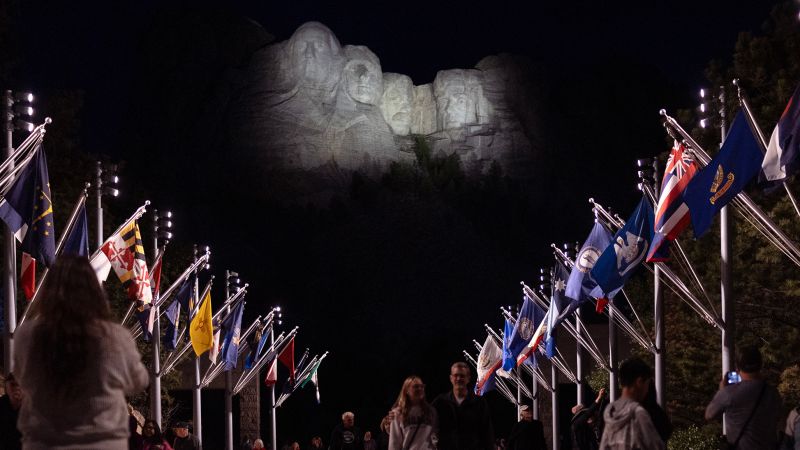
Trump heads to Mount Rushmore where – President Donald Trump’s upcoming visit to Mount Rushmore has reignited interest in his long-standing ambition to have his face carved into the iconic national monument. While the idea has been a recurring topic in his public campaigns, the project’s progress remains uncertain. Trump’s plan to join the ranks of George Washington, Thomas Jefferson, Theodore Roosevelt, and Abraham Lincoln at the monument has faced significant resistance, particularly in South Dakota, where the final decision rests. The visit comes as a symbolic moment for the former president, who has long viewed the site as a potential legacy marker.
Challenges to the Monument’s Legacy
Although Trump has frequently mentioned the proposal during speeches and social media posts, the actual implementation has not moved forward. In 2018, South Dakota Governor Kristi Noem humorously recalled the moment when Trump first floated the idea, noting that he was “totally serious” about the concept. “He wasn’t laughing, so he was totally serious,” Noem said during an interview. Yet, the technical and logistical challenges of altering the monument’s structure have hindered progress. Gutzon Borglum, the original sculptor, had already predicted the difficulties of adding a fifth figure to the granite face in 1936, warning that the composition was “fixed” and would be hard to change.
“He wasn’t laughing, so he was totally serious. … I said, ‘Come pick out a mountain,’” Noem explained in a 2018 interview with the Argus Leader.
Today, the National Park Service, led by Interior Secretary Doug Burgum, has acknowledged the possibility of incorporating Trump’s likeness. However, the process requires not only political support but also engineering feasibility. A bill introduced by Trump ally Rep. Anna Paulina Luna has yet to gain momentum, leaving the project in a state of limbo. The debate over whether Trump’s image should be added has become a focal point of discussions about national identity and historical representation.
Political and Cultural Implications
Trump’s return to Mount Rushmore is framed against a backdrop of evolving political and social dynamics. In 2020, his speech before the monument took a more confrontational tone, as he criticized “angry mobs” for erasing historical figures. “Our nation is witnessing a merciless campaign to wipe out our history,” he declared, linking the monument to broader cultural conflicts. This year, the visit is expected to emphasize unity and commemoration, yet the same themes of preserving historical narratives remain central to his vision.
“Our nation is witnessing a merciless campaign to wipe out our history, defame our heroes, erase our values, and indoctrinate our children,” Trump said during his 2020 speech at Mount Rushmore.
While Trump has successfully influenced other national landmarks, such as the renaming of a Florida airport, Mount Rushmore presents a unique challenge. The monument’s existing figures are deeply symbolic, and adding a fifth would require a consensus on its historical significance. Critics argue that Trump’s proposal reflects a broader trend of political influence on cultural institutions, while supporters see it as a tribute to his impact on American history. The visit may serve as both a campaign stop and a symbolic statement about his place in the nation’s legacy.
As Trump heads to Mount Rushmore, the debate over his inclusion highlights the intersection of politics and art. The monument, originally carved to honor four presidents, now stands as a test case for the modern era’s approach to historical commemoration. With the bill still in the drafting stage, the outcome of this effort will depend on the balance between political will and technical realities. Whether Trump’s likeness becomes part of the enduring legacy or remains a symbolic aspiration, the visit underscores the ongoing influence of his vision on national iconography.
