
Keiko Fujimori declared winner of razor-edge Peru election
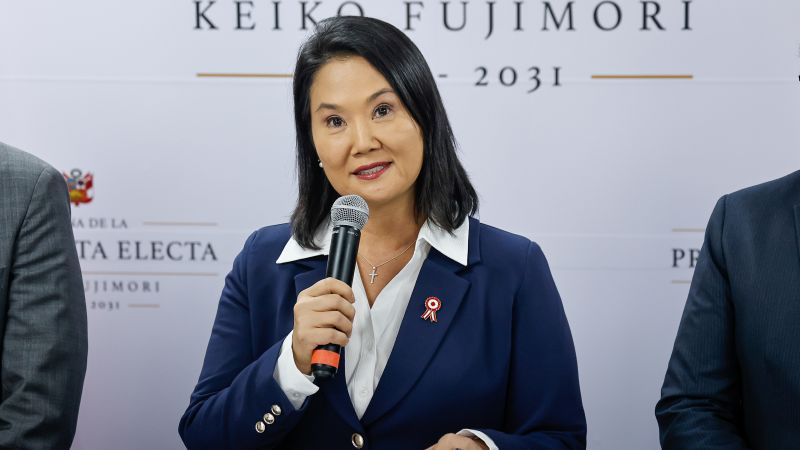
Keiko Fujimori Secures Peru’s Presidency in Tight Electoral Race
Keiko Fujimori declared winner of razor – Peru’s presidential election has reached a decisive conclusion, with conservative contender Keiko Fujimori emerging victorious in a closely contested race. The National Office of Electoral Processes officially announced her triumph on Friday, confirming she had narrowly surpassed leftist rival Roberto Sánchez in the June 7 runoff. Fujimori’s win, secured by a mere 49,641 votes out of an estimated 18 million cast, marks her fourth attempt to claim the nation’s top office—a path that had previously seen her fall short in 2011, 2016, and 2021. This narrow margin of victory has intensified debates over the legitimacy of the results, especially in a country deeply divided by political tensions.
At the heart of the election was Fujimori’s legacy as the daughter of former president Alberto Fujimori, whose own tenure left an indelible mark on Peru’s political landscape. Keiko, 51, will be sworn in as president on July 28, stepping into a role that has long been associated with her family’s influence. Her administration will be supported by Luis Fernando Galarreta as first vice-president and Miguel Ángel Torres Morales as second vice-president. This transition comes amid a decade of political instability, a period often attributed to the actions of her father, who was removed from power in 2000 and later convicted of corruption, embezzlement, and human rights abuses.
Fujimori’s victory was celebrated with a heartfelt message on X, where she expressed gratitude to voters for their trust. “Peru is entering a new chapter,” she wrote, vowing to lead the country with “responsibility, humility, and a profound sense of duty.” Her tone reflected both the significance of the win and the weight of the challenges ahead. The close race, with Fujimori’s Popular Force party narrowly edging out Sánchez’s Together for Peru coalition, has underscored the nation’s polarized electorate. With 50.13% of valid votes compared to Sánchez’s 49.86%, the margin was so slim that it sparked immediate scrutiny of the counting process.
The election’s tight outcome has reignited discussions about the role of her father in shaping Peru’s current political climate. Alberto Fujimori, a former leader known for his neoliberal policies and authoritarian tendencies, was ousted in 2000 amid widespread protests. His conviction in 2009 for crimes including corruption and human rights violations further deepened the rift between his supporters and critics. However, his controversial pardon in 2023 has rekindled debates about his legacy, with some viewing it as a symbol of enduring political influence and others as an attempt to reshape the country’s narrative.
Roberto Sánchez, the leftist candidate who lost by just 49,641 ballots, has already signaled his intention to challenge Fujimori’s victory. In a statement following the final vote count, he accused the electoral system of irregularities, particularly in the overseas voting process. Sánchez’s campaign plans to appeal the decision to the Inter-American Commission on Human Rights (IACHR), a move that highlights the potential for legal disputes over the results. This confrontation underscores the deep ideological divides in Peru, where Fujimori’s right-wing platform and Sánchez’s progressive agenda have clashed over issues ranging from economic policy to social reforms.
The National Jury of Elections, which declared Fujimori the winner, maintained that no significant discrepancies were found in the voting process after a thorough review. The jury’s rejection of Sánchez’s appeal has provided some clarity, though the narrow margin of victory leaves room for continued controversy. Analysts suggest that Fujimori’s win could signal a shift toward more conservative governance in Peru, a country that has oscillated between left and right in recent years. Her leadership may also bring a renewed focus on her father’s era, with many questioning whether his policies will influence her administration’s approach to key challenges.
Fujimori’s political journey has been marked by both persistence and controversy. She first entered the public eye as the first lady at 19, a role she held during her father’s presidency. Her decision to run for president in 2011, 2016, and 2021 highlighted her determination to break into the political mainstream, despite setbacks. The 2026 election, however, appears to have been the breakthrough she needed, with her campaign emphasizing economic stability and a return to traditional values. Supporters argue that her victory reflects a growing desire among Peruvians for change, while opponents see it as a continuation of the Fujimori family’s dominance.
The election’s outcome is poised to reshape Peru’s political future, as Fujimori’s Popular Force party now holds the majority in Congress. This could enable her to push forward with legislative agendas that align with her campaign promises, potentially impacting everything from trade policies to social welfare programs. Meanwhile, Sánchez’s refusal to recognize the results may lead to prolonged political uncertainty, with his party vowing to contest the legitimacy of the administration. Such developments could prolong the period of instability that has characterized Peru in recent years.
Fujimori’s victory also raises questions about the broader implications of her leadership. With her father’s legacy still a point of contention, her campaign has walked a fine line between honoring his past and distancing herself from his controversies. Her supporters view her as a pragmatic leader capable of steering Peru toward economic recovery, while critics worry about the potential for repeating past mistakes. The narrow margin of victory, however, suggests that the country remains deeply divided, with the election serving as a microcosm of the larger ideological battle.
As the transition begins, Fujimori will face the daunting task of uniting a fractured nation. Her administration’s success will depend on its ability to address pressing issues such as inflation, unemployment, and public trust in institutions. The presence of her father’s shadow looms large, with some voters attributing her victory to his political networks and others to her own appeal. The coming months will be critical in determining whether Fujimori can carve out a distinct identity or be perceived as a continuation of the Fujimori era.
The election’s outcome has sparked a wave of analysis and speculation, with media outlets and political analysts weighing in on its significance. For many, Fujimori’s win represents a shift in Peru’s political direction, offering hope for stability after years of turmoil. Yet, the razor-thin margin of victory and Sánchez’s impending legal challenge mean that the path to this new chapter will be anything but smooth. As Fujimori prepares to assume office, the nation watches closely, aware that her leadership will be tested by the very forces that have shaped its history.
