
Far-right Alternative for Germany party reelects leaders as protesters and police clash
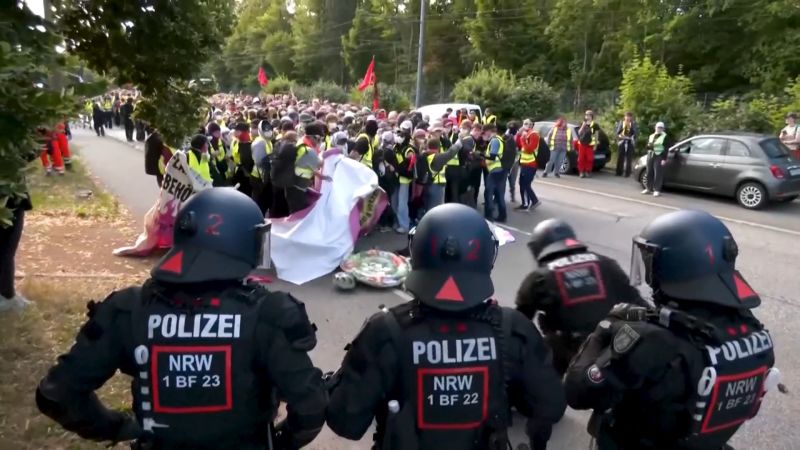
Far Right Alternative for Germany Party Reelects Leaders Amid Rising Protests and Political Tensions
Far right Alternative for Germany party – The Far Right Alternative for Germany (AfD) party, a prominent far-right political force in Germany, successfully reelected its leadership at its national convention in Erfurt, despite ongoing clashes between protesters and law enforcement. Alice Weidel, the party’s co-chair, retained her position with 81% of the vote, while Tino Chrupalla, the other co-leader, secured 70%. The event, which took place amid fierce opposition, underscored the AfD’s growing influence and the polarizing nature of its ideology. As Germany’s largest opposition party, the AfD has faced both support and criticism for its policies, with its recent leadership vote becoming a flashpoint for public debate.
Protests Reflect Growing National Divides
Thousands of demonstrators gathered outside the convention, some blocking roads and engaging in heated confrontations with police. The protests highlighted the AfD’s impact on Germany’s political landscape, as the party gains momentum in former communist eastern regions while encountering strong resistance in western states. Party officials emphasized the importance of the vote, calling it a demonstration of their commitment to democratic processes. Chrupalla, during the convention, labeled protesters as politically motivated disruptors, arguing that their actions were a last resort of opponents aiming to destabilize the AfD’s growing presence.
Historians and analysts have noted the symbolic significance of the AfD’s timing, with the convention coinciding with the 100th anniversary of a key Nazi Party meeting held in the same area in 1926. While the AfD leadership denies drawing direct parallels, critics suggest the connection is intentional, reinforcing the party’s ideological shift toward nationalism. The debate over historical alignment underscores the AfD’s broader appeal and the ongoing discourse around its role in Germany’s political future.
AfD’s Electoral Gains and Policy Evolution
The Far Right Alternative for Germany has seen a dramatic rise in support since its resurgence in the 2025 national election, where it garnered 20.8% of the vote—the highest for a far-right group since World War II. This growth has been driven by public dissatisfaction with economic conditions and social policies, even as critics accuse the party of advancing extremist agendas. The AfD’s ability to secure significant votes has forced mainstream parties to adopt a “firewall” strategy, avoiding collaboration to distance themselves from its far-right stance.
Recently, the AfD has broadened its platform beyond migration issues, positioning itself as a defender of national interests. It has embraced policies such as opposing military aid to Ukraine and supporting Russia’s position in international conflicts, which has attracted voters disillusioned with current government priorities. Chrupalla expressed confidence in the party’s trajectory, stating that the re-election signaled a path toward potential government leadership. “We are not just a protest group,” he declared. “Our success shows we can lead Germany into a new era.”
State Election as a Crucial Test
The upcoming September 6 state election in Saxony-Anhalt presents a pivotal opportunity for the Far Right Alternative for Germany. A victory securing 40% or more of the vote could mark a historic milestone, potentially allowing the party to form a coalition or hold a majority. This development has drawn attention to the AfD’s influence on regional politics, as it seeks to consolidate power and expand its national footprint. The party has already begun campaigning, framing its message around economic reform and a return to traditional values.
Meanwhile, anti-fascist groups like Widersetzen continue to challenge the AfD’s growth, denouncing its policies as threats to democratic principles. Lena Raupach, a spokesperson for one such organization, criticized the party for its “extremist tactics,” including proposals for mass deportations and nationalist rhetoric. “The Far Right Alternative for Germany is not just about opposition; it’s about reshaping Germany’s political identity,” she stated. “We must not let it redefine our democracy.”
Legal Challenges and Political Strategy
The Far Right Alternative for Germany has faced legal scrutiny, with its designation as a “proven right-wing extremist group” by the Federal Office for the Protection of the Constitution temporarily suspended during a court case. The ruling allowed the party to continue its activities without the stigma of extremist labels, a move it has claimed as a strategic victory. Mainstream parties, however, have criticized the decision, suggesting it weakens the AfD’s accountability.
Despite legal hurdles, the AfD remains focused on its political goals, leveraging its growing support to push for coalition possibilities. The party’s recent re-election of leaders has been framed as a step toward greater political influence, with its leaders asserting that they are poised to challenge the current government’s policies. As the state election approaches, the Far Right Alternative for Germany continues to navigate a complex political environment, balancing its ideological roots with the need to broaden its appeal.
Conclusion and Future Prospects
The re-election of AfD’s leadership highlights its resilience and adaptability in the face of opposition. While the party’s polarizing policies remain a point of contention, its ability to attract significant support underscores its relevance in Germany’s evolving political scene. As the state election nears, the Far Right Alternative for Germany will face the ultimate test of its influence, with the potential to reshape the nation’s political landscape. Whether it can translate this momentum into governance remains to be seen, but the path it has chosen is clear: to challenge the status quo and redefine Germany’s political future.
