
A 48-star US flag, the size of a single bedroom apartment, has draped a Minnesota community in red, white and blue mystery
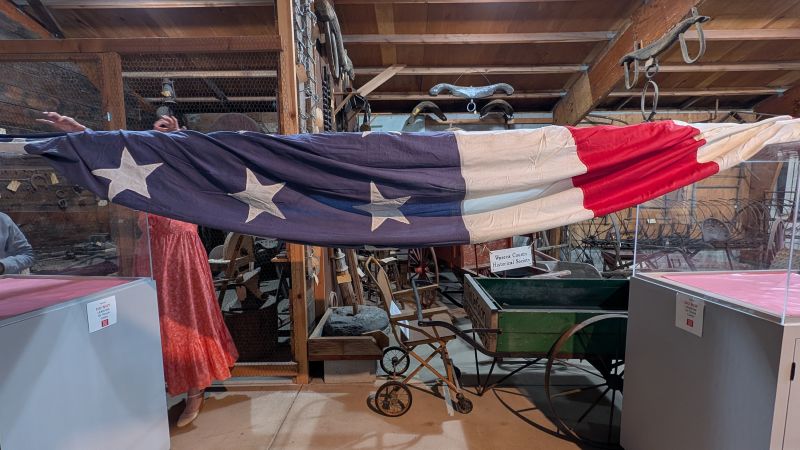
A 48-Star US Flag, the Size of a Single Bedroom Apartment, Has Draped a Minnesota Community in Red, White, and Blue Mystery
A 48 star US flag the size – During the annual fair’s cleanup, amid layers of dust and cobwebs, residents of Waseca County, Minnesota, stumbled upon a massive bundle wrapped in oil cloth tucked into the eaves of a historic cabin on display inside a fairgrounds hall. The discovery sparked curiosity, prompting questions from local volunteers. One county commissioner, intrigued by the item’s unusual presence, asked, “What’s that?” as the team carefully extracted it from its hidden location. Unwrapping the parcel revealed a series of 13 wide fabric strips, each nearly 1.5 feet in width, meticulously arranged into stripes. When combined with a blue field adorned with stars, the result was a colossal US flag that exceeded the dimensions of the cabin itself. Its size—approximately 19 by 36 feet—spanned over 680 square feet, roughly equivalent to a standard one-bedroom apartment in New York City. This massive artifact, long overlooked, now stands as a symbol of historical intrigue.
A Timeline of Stars and Stripes
The flag’s design, featuring 48 stars, immediately raised questions about its origin. Historical researchers at the Waseca County Historical Society noted that this configuration was official from 1912 until 1959, following the admission of Alaska and Hawaii into the union. “The United States emerged from the Great Depression and World War II as one of the leading nations of the world,” said the National Park Service, contextualizing the era of the flag’s design. However, the exact date of its creation remains uncertain. While the star count narrows the timeline to between 1912 and 1959, the craftsmanship adds further layers to the mystery.
“The number of stars on the American flag first grew to 48 in 1912 when New Mexico and Arizona officially became states,” explained a historian at the National Park Service. “That period marked a significant transformation in the nation’s identity, and this flag may have been a reflection of that era.”
The flag’s stars, each larger than an outstretched hand, were sewn onto the blue field with precise attention to detail. Yet, the maker(s) apparently missed some edges, creating a subtle imperfection that hints at its non-professional origins. The stripes, in contrast, were machine-sewn, with certain rows double-stitched while others bore single lines. “It’s very uneven, and you can tell multiple people had their hands going to make it come to life,” noted Elizabeth Anselmo, a member of the historical society, in an interview with CNN. This mix of techniques suggests a blend of traditional and modern methods, a unique characteristic that could help date the flag’s creation.
The Art of Unraveling a National Symbol
Historians are piecing together the story of this flag through meticulous analysis. The uneven stitching in the double rows indicates amateur work, as curators have determined. “The combination of hand- and machine-sewn elements points to a time when craftsmanship and industrial production coexisted,” Anselmo added. This duality of techniques, they believe, aligns with the early 20th century, when the US was transitioning from a nation of handcrafted goods to one increasingly reliant on mechanized manufacturing.
Despite these clues, the flag’s origins remain a puzzle. “It probably came in more than 50 years ago, and nobody that currently works here, or recently worked here, knows,” said Amy Danielson, former co-director of the Waseca County History Center. “It’s not catalogued … so that makes it more mysterious.” Danielson emphasized that the flag’s size alone suggests it was intended for public display, perhaps as a ceremonial piece. “Its presence in such a large form implies it was meant to be seen, and the real question is: where was it seen, and by whom?” she pondered.
“Its size alone tells us it was meant to be seen,” Danielson remarked. “But the real question is: where was it seen, and by whom?”
The flag’s journey to the fairgrounds hall is as enigmatic as its design. For decades, it had been stored rolled up in a county building, untouched and forgotten. This week, however, the historical society sought to unveil it fully, requiring a coordinated effort to handle its weight. They reached out to the local fire department for assistance, hoping to hoist the flag without damaging it. Yet, the existing wooden support along the edge near the flagpole proved insufficient, necessitating reinforcement. The team’s patience and ingenuity were tested as they worked to keep the flag from touching the ground, respecting the US Flag Code during its display.
With over 50 volunteers and community members gathered at the fairgrounds hall on Monday morning, the process of unfurling the flag began. The group included elected officials, local historians, and enthusiasts eager to participate in the discovery. “This is a moment of shared history,” said a volunteer, highlighting the community’s connection to the artifact. As the flag was slowly unrolled, the red and white stripes revealed their grandeur, while the blue field shimmered with the 48 stars. The effort to fully display it has reignited interest in its purpose and provenance.
While the flag’s historical significance is clear, its exact origin and intended use are still under investigation. Could it have been crafted for a specific event, such as a town celebration or a patriotic parade? Or was it a personal project of a local artisan? The historical society is compiling data, analyzing patterns, and cross-referencing records to uncover these details. “We’re not just looking for the flag’s maker,” said Anselmo. “We want to understand the story behind it—why it was made, how it was used, and what it means for our community.”
As the mystery unfolds, the 48-star flag serves as a reminder of the enduring power of symbols. Its rediscovery has sparked conversations about Minnesota’s historical ties to national identity and the role of local institutions in preserving such artifacts. For now, the flag stands as a testament to the past, its story woven into the fabric of the present. Whether it was displayed in a forgotten corner of a community hall or draped over a significant public event, the flag’s journey from obscurity to prominence continues to captivate those who now seek to unravel its secrets.
