
Trump rings opening bell to mark first day of trading for Trump Accounts
Trump Accounts Launch, Marking New Era for Childhood Investments
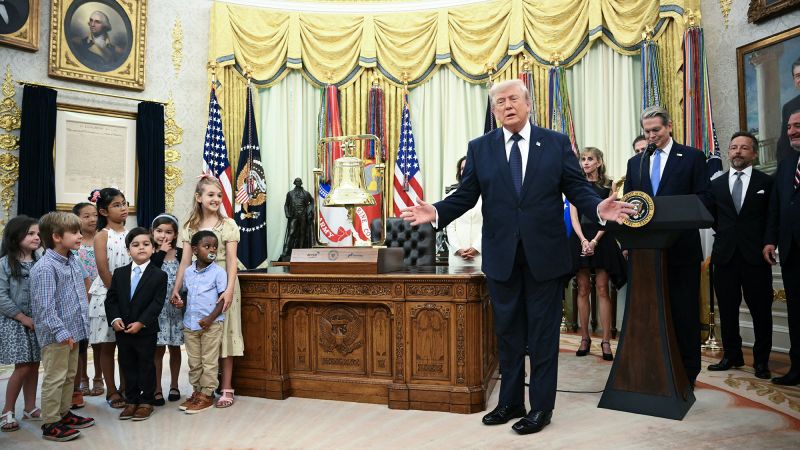
Trump rings opening bell to mark – On Saturday, July 4, 2026, the Trump Accounts officially began operations, one year after their legislative framework was finalized. This initiative, designed to provide financial support for children, was launched with a ceremonial event featuring President Donald Trump. During the week of the launch, Trump participated in the traditional opening bell ringing at both the Nasdaq and the New York Stock Exchange, an act that underscored the significance of the program. The event took place from the Oval Office, with the president flanked by officials from the NYSE, Nasdaq, and White House staff, as well as Republican Senator Ted Cruz, who had been a vocal advocate for the legislation.
Trump Accounts: A New Tool for Families
The Trump Accounts are part of a broader effort to expand tax-advantaged investment options for minors. These accounts now stand alongside established vehicles such as custodial Roth IRAs and 529 college savings plans, each offering distinct benefits and rules. While they do not simplify the decision-making process for families, they have sparked renewed interest in early childhood investing. According to the Treasury Department, the program aims to create a pathway for third parties to contribute to a child’s financial future and provides federal seed money for newborns, with the potential to influence generations to come.
“This will be one of the president’s most enduring legacies, and the great bounty of this will go for generations to come,” Treasury Secretary Scott Bessent remarked during the event.
President Donald Trump, addressing the audience from the Oval Office, praised the initiative as “absolutely incredible for children.” He emphasized the program’s role in fostering financial opportunity from birth. The ceremony also featured remarks from Michael and Susan Dell, who announced a $6.25 billion donation to fund the Trump Accounts in December. Brad Gerstner, CEO of Altimeter Capital, who spearheaded the campaign, added his own insights, highlighting the program’s potential to reshape how families plan for their children’s futures.
Eligibility and Federal Contributions
As of the launch, over 6 million Trump Accounts have been established for children under 18, according to the Treasury Department. Of these, 1.4 million will receive a $1,000 federal pilot contribution, a measure intended to encourage participation. However, the number of accounts opened so far represents only a small portion of the eligible population, with tens of millions of children potentially qualifying. To qualify for the $1,000 federal contribution, a child must be a U.S. citizen with a valid Social Security number, born between January 1, 2025, and December 31, 2028, and have an account opened before the program’s full implementation.
The accounts operate within a framework that allows investments in mutual funds or exchange-traded funds (ETFs) tracking the S&P 500 or other equity-focused indices. Annual fees are capped at 0.1% of a child’s assets, ensuring affordability. For every $1,000 invested, the expense will not exceed $1, making the program accessible to a wide range of families. The Treasury also clarified that parents can choose from multiple investment options, with the default set as the State Street SPDR Portfolio S&P 500 ETF (SPYM), which mirrors the performance of the S&P 500.
Partnerships and Digital Tools
Robinhood and the Bank of New York were selected to manage the initial phase of the Trump Accounts, offering parents and guardians an app to monitor investments. The platform, available on Apple and Google stores, or directly through TrumpAccounts.gov, simplifies tracking and management for families. This digital integration aims to make the program more user-friendly, especially for those unfamiliar with traditional investment tools.
Additionally, the Treasury announced that individuals can donate publicly traded stocks to Trump Accounts, allowing for flexible contributions. SpaceX president Gwynne Shotwell pledged to donate shares of the company to over two million accounts, demonstrating the program’s appeal to high-profile supporters. This feature enables families to leverage both cash and equity contributions, broadening the program’s accessibility and impact.
Funding and Long-Term Vision
The Trump Accounts were launched with the support of bipartisan efforts, though their design reflects a conservative approach to financial planning. The program’s federal seed money is intended to provide an initial boost for newborns, encouraging long-term savings. By offering a structured investment vehicle, the accounts aim to reduce the financial burden on families while promoting the value of early savings. This aligns with the broader goal of ensuring children have a financial foundation to build upon as they grow.
While the accounts are not without complexity, they represent a significant step forward in childhood financial support. The Treasury has positioned them as a complement to existing tools rather than a replacement, acknowledging that families must weigh various factors when selecting the best option. The initiative’s focus on education and awareness is evident in its outreach efforts, with plans to expand investment choices in the coming months.
Key Details and Frequently Asked Questions
To further clarify the program, the Treasury has released an FAQ section detailing essential information for families. This resource covers how the accounts will be taxed, the permissible uses of funds, and whether they might affect eligibility for federal benefits. For instance, the accounts are structured to allow tax-free growth, with distributions taxed as income when the child reaches adulthood. The money can be used for a variety of purposes, including education, housing, or other personal needs, depending on the family’s goals.
The program also addresses concerns about its impact on existing benefits. The Treasury has stated that contributions to Trump Accounts will not disqualify families from receiving other forms of federal aid, provided they meet standard criteria. This reassurance is intended to alleviate worries about the program’s financial implications. Furthermore, the flexibility to choose between different ETFs means parents can tailor their investments to match their risk tolerance and long-term objectives.
The launch of Trump Accounts marks a pivotal moment in U.S. financial policy, blending political ambition with economic strategy. By creating a dedicated vehicle for childhood investments, the program seeks to empower families to build wealth for their children. As the program evolves, the Treasury has outlined plans to introduce additional investment options, including alternative ETFs, to further enhance its appeal. This expansion reflects a commitment to adapting the initiative to meet the diverse needs of families across the country.
With the launch date behind them, the focus now shifts to how families will utilize these accounts. The combination of federal support, third-party contributions, and digital accessibility positions the Trump Accounts as a unique opportunity for financial growth. As more parents open accounts, the program’s impact on children’s futures is expected to grow, offering a tangible example of how policy can shape long-term economic outcomes. The Trump Accounts are not just a financial tool but a symbol of the nation’s dedication to fostering generational wealth.
