Canada-EU alliance isn’t meant to be a US rival with ‘better manners,’ Carney says

Daftar Isi
Carney Says Canada-EU Alliance Is About Resilience, Not Rivalry
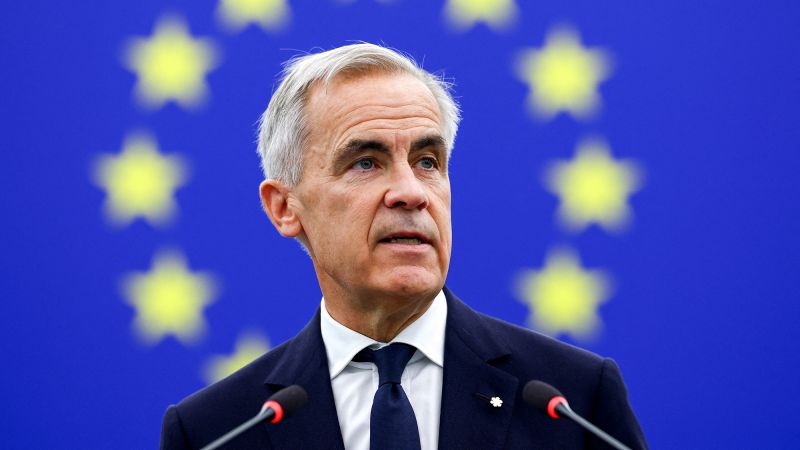
Earthguardiansonline.com – Canadian Prime Minister Mark Carney said a Canada EU alliance isn t meant to become a competing geopolitical bloc aimed at the United States. Instead, he presented deeper cooperation with Europe as a way for democratic countries to protect their economies, sovereignty and institutions during a period of growing global uncertainty.
Speaking to European lawmakers in France, Carney addressed the possibility of a closer formal relationship between Canada and the European Union. European Commission President Ursula von der Leyen had proposed making Canada the EU’s first “associate member,” an idea that prompted a renewed tariff threat from US President Donald Trump.
Canada and the European Union are already dealing with tariffs imposed by Washington. Carney argued that stronger ties should not be viewed simply as a reaction to the United States, but as a practical effort to reduce vulnerabilities in trade, security and critical supply chains.
“I’m not proposing a third bloc in order to become a great power rival, only with better manners,” Carney said.
Protecting open markets and democratic sovereignty
Carney said the central goal of closer Canada-EU cooperation is resilience. He described a partnership designed to ensure that no outside power can use economic dependence, market access or trade restrictions to pressure democratic governments.
“We do not seek power to dominate others. On the contrary, we are pursuing resilience so no one can control our open markets, impair our sovereignty, threaten territorial integrity or undermine our freedoms, our democracies, our rule of law.”
The proposed partnership reflects broader concerns among US allies about tariffs being used as political leverage. Carney’s message was that countries with shared democratic values can strengthen their ability to withstand such pressure by expanding reliable trade, investment and security relationships.
He also pointed to the historic ties between Canada and Europe, at times speaking in French during his address. Yet his argument focused on current challenges, including climate change, economic coercion and pressure on democratic norms.
Energy, minerals and technology could deepen cooperation
Critical minerals and energy security were among the areas Carney highlighted for greater collaboration. These resources are increasingly important for advanced manufacturing, energy systems and emerging technologies, making dependable supply a strategic priority for both Canada and Europe.
Canada could help meet European demand through supplies of liquefied natural gas and hydrogen, Carney said. Such cooperation could support energy security while reducing dependence on individual suppliers during periods of disruption.
Defense production was another potential area of partnership. Canada and European countries could work more closely on equipment, industrial capacity and shared security interests. Carney also identified payment systems and artificial intelligence as opportunities for cooperation, including work on AI safety protocols.
For democratic governments, AI policy raises questions about innovation, security, accountability and public trust. Coordinated safety standards could allow Canada and European partners to shape rules for developing and deploying powerful technologies while supporting economic growth.
More opportunities for Canadians and Europeans
Carney’s vision went beyond trade and security. He called for deeper people-to-people connections that would make it easier for younger Canadians and Europeans to live, work and study across the Atlantic.
He said a stronger relationship could become an example for other democracies seeking dependable partners while maintaining open markets and the rule of law. In that sense, the Canada EU alliance isn t meant to exclude the United States, but to give Canada and Europe more options and greater independence in an unsettled global economy.
“Europe and Canada are stronger together,” Carney said. “A Canada-EU alliance would create a beacon for other democracies.”
FAQ: What Could a Closer Canada-EU Relationship Mean?
Would Canada become a member of the European Union?
No. The proposal discussed by von der Leyen was for Canada to become the EU’s first “associate member,” not a full EU member. Details of what that status would involve were not specified in Carney’s remarks.
Why are energy and critical minerals important?
Europe and Canada are looking to secure reliable access to resources needed for industry, clean-energy systems and advanced technology. Greater cooperation could help both sides diversify supply and reduce the risks created by dependence on a limited number of trading partners.
Is the proposed partnership directed against the United States?
Carney said it is not. He described the effort as a resilience project for democratic countries, intended to protect open markets, sovereignty and democratic institutions rather than create a rival power center.