Fed Chairman Kevin Warsh faces pressure to show his hand

Daftar Isi
Warsh’s Jackson Hole Silence Could Reshape How Markets Price American Debt
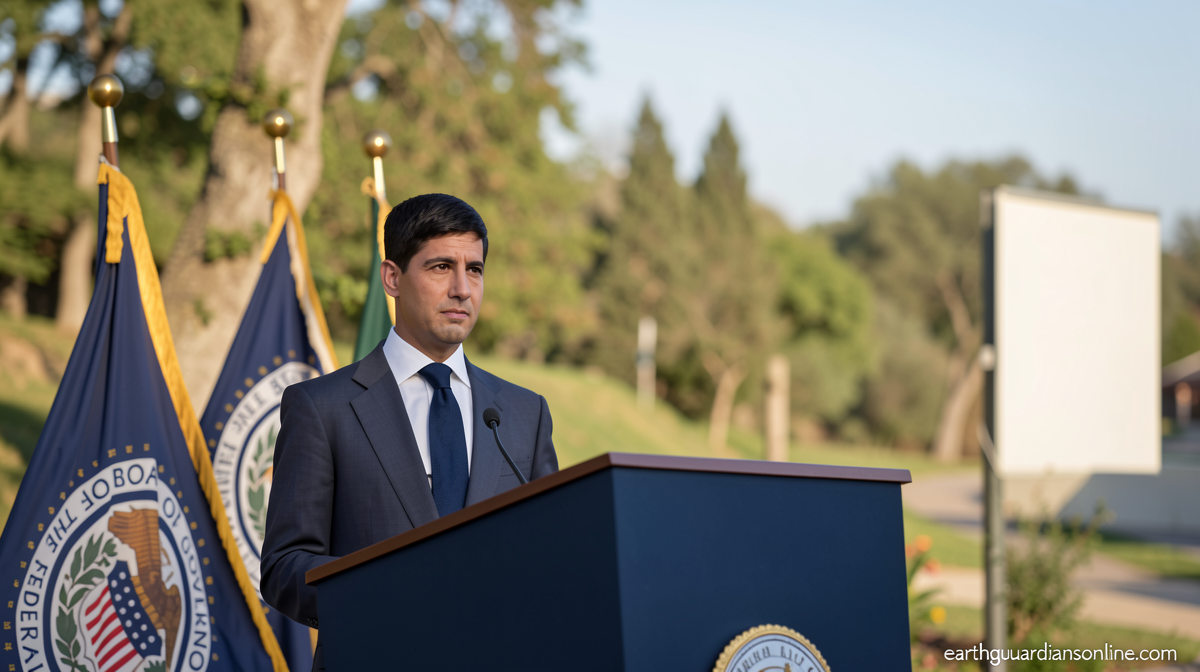
Earthguardiansonline.com – For over twenty years, the person sitting at the Federal Reserve’s helm has used the keynote slot at Jackson Hole to telegraph the direction of monetary policy. That convention is about to shatter. Kevin Warsh, who assumed the chairmanship roughly three months ago, is scheduled to address the Federal Reserve Bank of Kansas City’s annual economic symposium in Jackson Hole, Wyoming, on Friday — and every indication points toward a deliberate refusal to offer rate-path signals.
The stakes extend well beyond a single speech. With inflation ticking upward again, a growing chorus of Warsh’s own colleagues pushing for the first rate increase since July 2023, and a $40 trillion federal debt pile demanding ever-larger interest outlays, the absence of guidance from the chair could amplify volatility across Treasury and corporate bond markets for weeks.
A Break From Two Decades of Convention
Central bankers, finance ministers, and policymakers from dozens of nations converge on the Wyoming mountains each August for what has become the most closely watched gathering in global monetary policy. Historically, the sitting Fed chair’s keynote served as a de facto policy preview: markets parsed every adjective, every conditional clause, every hedged forecast embedded in the remarks.
Warsh has dismantled that practice almost immediately upon taking office. Since his appointment, he has withheld the incremental clues Wall Street once extracted from each FOMC statement and press conference. The result has been a visible repricing of long-duration government debt. Following his post-meeting briefing last month — in which he offered no commentary on the trajectory of the federal funds rate — long-term Treasury yields jumped, a move traders interpreted as anxiety that the central bank will underreact to persistently elevated price pressures.
“I don’t expect any signals to come out of Kevin Warsh’s Jackson Hole speech,” said Jan Groen, chief US economist at global financial firm Societe Generale. “And if I’m right, I think the market is not going to like it.”
The Reaction Function Question
At the heart of the investor frustration lies a technical but consequential concept: the central bank’s “reaction function.” In plain terms, it describes what the institution monitors, how it interprets economic data, how it balances competing risks, and what specific developments would trigger a change in policy judgment. The Brookings Institution laid out that framework in an analysis published last month, noting that a transparent reaction function allows markets to calibrate expectations without needing explicit rate forecasts.
Warsh has repeatedly declined to articulate his own reaction function when pressed by reporters. At a July gathering in Sintra, Portugal, he argued that the bond market can “actually understand quite well” the Fed’s likely course of action even without such a framework. That characterization has drawn pushback from fixed-income professionals who argue the market’s primary information need is precisely the reaction function itself.
“The bond market is really looking to the Fed for clues on their reaction function,” said Ian Kresnak, senior investment strategist at Vanguard. “What’s driving a lot of the volatility in the rates market is uncertainty around how the Fed is going to respond to inflation.”
The distinction matters. A reaction function explains the decision rule; “forward guidance” — the more explicit tool used by prior chairs — projects a specific rate path conditional on the economy unfolding as anticipated. Warsh appears to reject both, preferring to let market participants infer policy from data rather than from the chair’s own language.
What the Survey Data Reveals
A CNBC poll of 31 economists, strategists, and investors conducted this week found that 80 percent of respondents believed Warsh should elaborate his economic reasoning in greater detail. Investors at financial firm Glenmede, in an analyst note dated August 24, framed the Jackson Hole platform as Warsh’s most natural venue to do exactly that, arguing that disclosing his reaction function “could reduce some of the uncertainty driving recent volatility in bond markets.”
The note underscored a broader point: the symposium’s format — a long-form address rather than a tightly scripted press conference — gives the chair latitude to articulate personal views without the constraints of a post-meeting Q&A.
Inflation, Deficits, and the September Crossroads
The macro backdrop complicates any silence. Current inflationary pressure is being fueled by a confluence of factors: tariff-imposed cost increases, geopolitical conflict disrupting supply chains, and the enormous capital expenditure cycle surrounding artificial-intelligence infrastructure. Fed officials are debating whether these forces warrant an imminent tightening move.
Simultaneously, expanding government deficits and a swelling issuance of corporate debt have independently lifted bond yields over recent months. Higher yields translate directly into larger annual interest obligations for the federal government, compounding the fiscal burden already embedded in the $40 trillion debt stock.
Market pricing currently assigns roughly a 34 percent probability to a rate hike at the September 15–16 FOMC meeting, per CME FedWatch data. The odds climb meaningfully at subsequent sessions through year-end.
“It’s a close call whether or not they hike at all this year,” said Jim Caron, chief investment officer of portfolio solutions at Morgan Stanley Wealth Management.
Whether Warsh chooses to speak plainly on Friday — or doubles down on opacity — will determine whether the coming autumn sees a gradual normalization of rate expectations or a sharper repricing as traders scramble to fill the guidance vacuum themselves. The Jackson Hole stage, for once, may matter less for what is said than for what is conspicuously withheld.
Related Reading
Frequently Asked Questions
What is Fed Chairman Kevin Warsh faces pressure?
Fed Chairman Kevin Warsh faces pressure is the main topic of this guide. The article explains the context, practical details, and next steps readers should understand.
Why does Fed Chairman Kevin Warsh faces pressure matter?
Fed Chairman Kevin Warsh faces pressure matters because readers are looking for a useful answer, not just a short summary. Good content should match search intent and help them decide what to do next.