Record share of kindergartners missed required vaccines last year as Trump executive order takes aim at state mandates

Daftar Isi
Kindergarten Vaccine Exemptions Hit All-Time High as Federal Push Reshapes Immunization Policy
Earthguardiansonline.com – The number of American kindergartners entering school without full vaccination coverage reached a historic peak during the 2025–26 academic year, according to data released Monday by the Centers for Disease Control and Prevention. Roughly 157,000 newly enrolled schoolchildren lacked complete protection against at least one state-mandated vaccine — a figure nearly 20,000 higher than the previous year. The 4.2% exemption rate marks the highest share ever recorded and represents roughly double the proportion seen ten years ago.
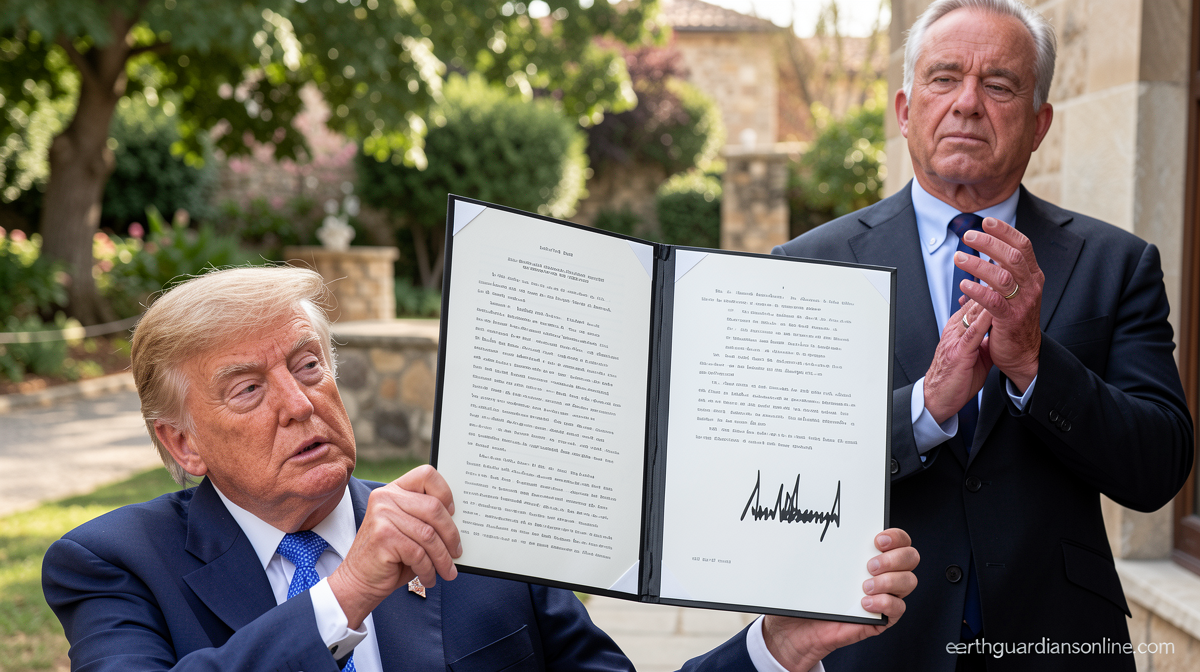
The timing of the CDC release coincides with a sweeping executive order signed by President Donald Trump the prior week, which seeks to fundamentally alter how the federal government engages with childhood immunization policy. The directive instructs agencies to “give parents more information and options” and explicitly calls on states to “provide religious and medical exemptions” to school vaccine mandates. The administration’s stated goal is to “maximize parental choices over vaccinations for their children,” a framing that positions parental preference as the central organizing principle of immunization policy rather than population-level disease prevention.
Where Authority Actually Resides
Despite the federal government’s expanded rhetoric, the constitutional architecture of vaccine policy remains unchanged. All fifty states maintain their own statutes requiring specific immunizations before a child may attend school, and every state permits medical exemptions. The vast majority additionally authorize non-medical carve-outs, typically categorized as religious or philosophical. According to the National Conference of State Legislatures, only four states — California, Connecticut, Maine, and New York — do not permit exemptions beyond medical grounds.
New York eliminated its religious exemption pathway in 2019, a decision prompted by measles outbreaks that ranked among the largest the country had experienced in decades. That episode underscored how quickly gaps in coverage can translate into community-wide transmission when herd immunity thresholds are not met.
The Numbers Behind the Trend
The CDC figures reveal that the surge in exemptions is overwhelmingly non-medical. Just 0.2% of last year’s exemptions were granted on medical grounds, a proportion that has remained essentially flat for years. Exemptions rose in every state except nine, and nearly half of all states now report exemption rates above 5%.
The practical consequence is visible in coverage data. The measles-mumps-rubella (MMR) vaccination rate among kindergartners slipped marginally from 92.5% to 92.4% over the past school year. While the decline is small in absolute terms, it leaves the population well below the 95% threshold epidemiologists identify as necessary to sustain herd immunity and prevent resurgent outbreaks. Pockets of under-vaccination, once isolated, are expanding into larger and more consequential gaps in community protection.
Federal Leverage and State Pushback
The executive order directs the Department of Justice, the Department of Education, and the Department of Health and Human Services to link compliance with the new federal guidelines to the disbursement of federal funding. The precise mechanism for enforcing this linkage has not been detailed publicly, but the threat of funding conditions represents the most direct tool available to the executive branch for influencing state-level vaccine mandates.
State officials have responded with a mix of quiet dismissal and explicit reaffirmation of existing policy. Texas’s health department told CNN in an email: “Federal recommendations do not change the requirements in Texas.” Other states, including those that have historically aligned with federal guidance and those that have deliberately diverged from it, indicated the order does not compel any legislative or regulatory change at the state level.
Maine’s approach illustrates the science-based counter-narrative. Dr. Puthiery Va, director of the Maine Center for Disease Control and Prevention, issued a statement affirming the state’s commitment:
“Vaccines are our most effective defense against vaccine-preventable illnesses. In Maine, vaccines remain available at no cost to eligible children through the Maine CDC’s Immunization Program. Maine’s school and child care immunization requirements remain unchanged by federal actions to date.”
Legal and Legislative Pathways
Any alteration to state vaccine exemption statutes must pass through state legislatures, many of which will not reconvene until January. That timeline creates a window in which the federal order’s practical effect remains uncertain. Courts, however, can move faster. Mississippi began permitting religious exemptions in 2023 following a federal court order, and a parallel effort in West Virginia to introduce religious exemptions is currently entangled in litigation. Before those judicial interventions, both states were recognized for exceptionally high childhood vaccination coverage.
The Supreme Court has previously upheld broad state authority over vaccine policy, most famously in a 1944 decision affirming that states may require immunization for school attendance. Whether the current executive order’s funding-conditioning strategy will survive judicial scrutiny remains an open question, particularly given that the order frames its directives as recommendations rather than mandates.
What Parents and Communities Should Understand
For families navigating these shifting signals, the operative rules have not changed: state law determines which vaccines are required for school entry, and state law determines which exemptions are available. The federal order does not, by itself, create new exemption categories or eliminate existing ones. What it does introduce is a political and financial pressure point — the prospect that continued alignment with state vaccine mandates could affect federal funding streams to schools and health programs.
Epidemiologically, the trend toward higher exemption rates carries tangible risk. Diseases like measles, which were declared eliminated in the United States in 2000, require sustained community-level coverage above 95% to remain suppressed. Each additional percentage point of exemption erodes that buffer. The 4.2% figure, while modest in isolation, represents a direction of travel that public health officials have warned could, if unchecked, recreate the conditions that fueled the outbreaks of the early 2020s.
Related Reading
Frequently Asked Questions
What is Record share of kindergartners missed required?
Record share of kindergartners missed required is the main topic of this guide. The article explains the context, practical details, and next steps readers should understand.
Why does Record share of kindergartners missed required matter?
Record share of kindergartners missed required matters because readers are looking for a useful answer, not just a short summary. Good content should match search intent and help them decide what to do next.