
California, and the dangerous sudden resurgence of GOP voter fraud fever
The Unexpected Revival of GOP Voter Fraud Anxiety in California
California and the dangerous sudden resurgence – As the political landscape shifts, a familiar refrain has resurfaced on the Republican right: accusations of widespread voter fraud in California. This unexpected revival has sparked renewed scrutiny of the state’s election procedures, with figures like former representative Adam Kinzinger and Florida Governor Ron DeSantis leading the charge. While the claims lack concrete evidence, they have gained traction on social media, fueled by a mix of disinterest in factual details, ideological polarization, and a desire to reframe the narrative of recent elections.
From Skepticism to Certainty: A Shift in Tone
On a typical Sunday in early June 2026, Charles Gasparino of Fox Business Network expressed frustration with the “stolen election” narrative, criticizing the president for perpetuating it. However, by late afternoon, his perspective had shifted. Gasparino, who once dismissed the idea of election manipulation, began entertaining the possibility that the results in California were being tampered with. This transformation highlights the evolving nature of voter fraud discourse, where even well-established skeptics can find themselves questioning the integrity of a state they once viewed as a Democratic stronghold.
“I hate the ‘stolen election’ stuff from the president,” Gasparino declared. “But maybe it is,” he added hours later, hinting at a new wave of doubt.
The resurgence of these claims is not limited to individual pundits. Former GOP Rep. Adam Kinzinger, who had previously been a vocal critic of the president’s election fraud assertions, noted that Trump’s insistence on a rigged California election had reignited the conversation. This reflects a broader pattern: as the political season heats up, long-dormant suspicions about voting processes are being rekindled, even in the absence of verifiable data.
California’s Electoral Mechanics and the Democrat Advantage
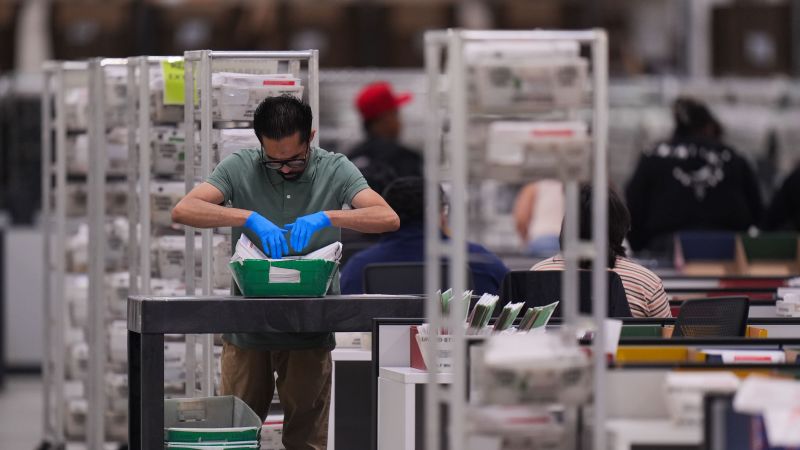
California’s election system, known for its meticulous ballot-counting procedures, has long been a target of criticism from Republicans. The state’s reliance on mail-in voting, combined with its complex administrative framework, has led to extended counting periods. While this process ensures accuracy, it also creates opportunities for conspiracy theories to take root. As CNN’s Elex Michaelson has explained, late-counted mail ballots have historically tilted in favor of Democrats. This is partly because mail voting tends to increase turnout among voters who are more likely to support Democratic candidates, particularly in urban areas like Los Angeles.
Yet, the allegations of fraud have grown beyond mere speculation. Republican lawmakers and media personalities have framed these claims as urgent warnings, despite the lack of evidence. The argument is that mail voting, by its nature, introduces vulnerabilities—such as ballot stuffing or voter suppression—into the system. This narrative has gained momentum as Republicans, including those who once distanced themselves from election denial, now align with the idea that California’s results could be compromised.
From 2020 to 2026: A Cycle of Doubt and Denial
Five years after the 2020 election, the Republican party’s focus on voter fraud has undergone a notable transformation. Initially, the claims of widespread ballot irregularities were dismissed by many GOP leaders, who sought to distance themselves from the chaos of January 6, 2021. However, the recent push to scrutinize California’s electoral process suggests a return to the same rhetoric that once divided the country.
Florida Governor Ron DeSantis, who had once stood as a moderate voice in the GOP, exemplifies this shift. During the 2024 GOP presidential primaries, DeSantis had challenged Trump’s assertions of a stolen election, stating that “all those theories did not prove to be true.” But by mid-June 2026, he had pivoted, citing “serious structural vulnerabilities” in California’s system. “New batches of votes always seem to go one way,” he remarked, implying that the state’s counting process might be biased toward certain outcomes.
“Count until you get the result you want?” DeSantis asked on CNBC, suggesting a calculated approach to election verification.
This revival has also seen the involvement of federal prosecutors. The U.S. attorney’s office in Los Angeles recently announced “multiple election fraud investigations,” a move that has amplified fears of systemic manipulation. Jay Clayton, the U.S. attorney for the Southern District of New York, further contributed to the narrative when he stated on CNBC that California had “created the opportunity for fraud.” Though Clayton emphasized that he was not accusing the state of outright theft, his words have done little to quell the growing anxiety.
Even more troubling is the fact that some of these claims have been debunked. For instance, the LA US Attorney’s office had already refuted viral assertions that large numbers of votes had been added to the totals in the mayoral race without benefiting Republican candidate Spencer Pratt. Despite this, prosecutors like Clayton have not corrected the record, allowing misinformation to persist in the public eye.
The Democratic Advantage and the GOP’s Strategic Focus
California’s political dynamics have long been predictable: Democrats dominate both state and local elections. Yet, this consistency has been weaponized by Republicans to question the legitimacy of the results. After the primary, when Democratic candidates retained their lead, the GOP framed this as evidence of a rigged system. “It was not possible for Pratt to fall behind after the big lead he had,” Trump asserted on Truth Social, echoing a pattern seen in 2020.
Meanwhile, House Speaker Mike Johnson has taken a more dramatic stance, declaring that “some of these efforts are so diabolical and so far upstream it is impossible to prove.” His statement underscores the Republican strategy of framing the election as a battleground of hidden influences, where evidence is secondary to the perception of injustice. “But think everybody knows instinctively something is wrong here,” Johnson added, tapping into a collective sense of unease that has taken hold among his base.
“Some of these efforts are so diabolical and so far upstream it is impossible to prove,” Johnson said, suggesting a near-impenetrable barrier to evidence-based arguments.
While the allegations may seem alarmist, they have found a receptive audience. Social media platforms have accelerated the spread of these theories, creating echo chambers where suspicion is amplified. The state’s deep-blue reputation, combined with its role as a key battleground, has made it a prime target for Republican frustrations. Even those who had previously dismissed such claims are now engaging with them, often without critically examining the data.
A New Era of Voter Fraud Narratives
As the 2026 election cycle progresses, the GOP’s renewed focus on California’s voting system signals a broader trend. The party’s leaders are leveraging the state’s reputation for thoroughness to argue that its election procedures are flawed, even as they ignore the evidence that contradicts these claims. This strategy not only rekindles old doubts but also aims to reshape public perception of the state’s electoral process.
The implications of this revival are significant. By framing California as a potential hotbed of fraud, Republicans have shifted the focus from other states where such claims had previously been more prominent. The narrative now centers on the idea that the state’s processes, once seen as reliable, are now under threat. This has created a feedback loop, where the growing skepticism further fuels the spread of misinformation, even in the absence of concrete proof.
As the GOP continues to push these claims, the question remains: how far will they go to sustain the narrative? The answer may lie in the political climate, where the pursuit of legitimacy often takes precedence over factual accuracy. California, once an afterthought in national politics, now stands at the center of a renewed debate over the integrity of American elections. Whether this revival leads to meaningful change or another wave of partisan rhetoric remains to be seen.
