
Justice Jackson slams Supreme Court’s handling of rush appeal in Louisiana redistricting case
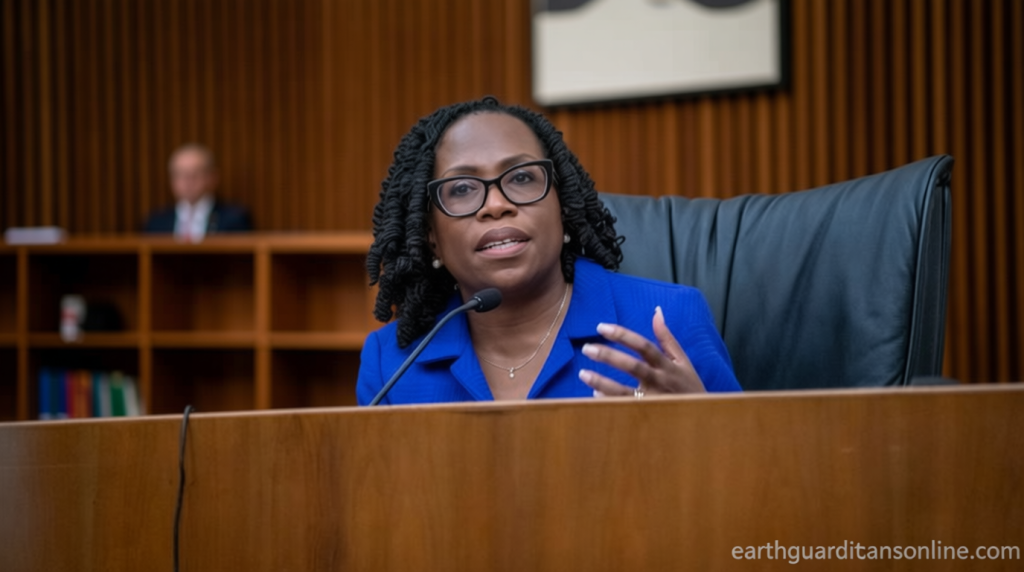
Justice Jackson Critiques Supreme Court’s Handling of Louisiana Redistricting Case
Justice Jackson slams Supreme Court s handling – On Monday, Justice Ketanji Brown Jackson delivered a sharp criticism of the Supreme Court’s expedited approach to a pivotal redistricting matter in Louisiana, emphasizing the need for judicial caution during an election year. She argued that the court had not upheld its own neutrality, potentially appearing biased in the process. Speaking at an event in Washington organized by the American Law Institute, Jackson underscored that courts should remain impartial, stating, “Courts are apolitical, not supposed to be issuing rulings that are in the political realm.” She called for consistency in applying established legal principles, warning that deviations could create the impression of favoritism.
Supreme Court’s Rushed Decision Sparks Debate
The controversy arose after the Supreme Court on May 4 fast-tracked Louisiana’s request to adjust its congressional districts, bypassing its standard month-long review period. This move came following a landmark ruling that significantly weakened the Voting Rights Act, which Louisiana had leveraged to justify its urgent action. The court’s decision, outlined in a single paragraph, left little room for analysis and did not reveal the voting breakdown among justices. Jackson became the lone dissenter in this instance, highlighting her concern about the ruling’s implications.
“We have to be scrupulous about sticking to the principles and the rules that we apply in every case and not look as though we’re doing something different in this kind of context,” Jackson said, reflecting her written dissent.
Jackson’s comments aligned with her previous arguments against the court’s handling of emergency cases, particularly those involving redistricting. She criticized the use of a streamlined process for urgent matters, suggesting it undermined the thoroughness of the regular judicial system. “It’s not doing, I think, the court, the lower courts, or our country a service with that kind of procedure,” she added, criticizing the court for creating an expedited lane of decision-making that might prioritize speed over fairness.
Impact of the Voting Rights Act Decision
The Supreme Court’s April ruling, which dismantled key provisions of the Voting Rights Act, has triggered widespread changes in redistricting across Southern states. These adjustments are expected to advantage Republicans and further diminish the representation of Black lawmakers in Congress. While the decision was anticipated, it coincided with President Donald Trump’s campaign to maximize the political benefits of redrawn maps, aiming to secure GOP control of the House in the upcoming elections.
Jackson, who was appointed to the Supreme Court by President Joe Biden in 2022, has consistently voiced skepticism about the court’s rush to resolve cases on an emergency basis. Her remarks during Monday’s event drew comparisons to a lecture she delivered at Yale earlier this year, where she explored similar concerns about judicial processes. She noted that the court’s accelerated handling of the Louisiana case risked undermining its own credibility and creating a perception of partisan influence.
“I think we have to be very constrained,” Jackson said, stressing the importance of maintaining procedural consistency. “My view was it would be a more neutral way to handle the matter to just stick with the rule that we always apply in situations like this.”
The court’s decision in late April, which effectively nullified the Voting Rights Act’s protections, has had far-reaching consequences. By allowing states to redraw districts without federal oversight, the ruling has enabled a surge in gerrymandering efforts, particularly in states with historically discriminatory practices. Louisiana’s swift action to reshape its maps ahead of the midterms exemplifies this trend, raising questions about the court’s role in political outcomes.
Jackson’s Broader Concerns About Judicial Efficiency
During the event, Jackson also addressed the court’s broader approach to emergency cases, particularly those that have emerged under the Trump administration. She criticized the growing reliance on expedited rulings, arguing that they complicate the court’s ability to address complex legal issues with the same rigor as standard cases. “Setting up this other lane of adjudication” on the emergency docket, she said, “has the potential to erode the legitimacy of the judicial process.”
This critique echoed Jackson’s earlier frustrations with the court’s handling of the Louisiana case. She pointed out that the justices had not provided clear reasoning for their decision, leaving the public to speculate about its motivations. “Courts are supposed to be grounded in principles, not in the immediate political winds,” she stated, underscoring her belief that the decision could be seen as an attempt to align with partisan interests.
Conservative Justices’ Stance and the Debate Over Partisanship
The Supreme Court’s conservative justices, including Samuel Alito, Clarence Thomas, and Neil Gorsuch, supported the expedited ruling, with Alito questioning whether the court had violated any established principles. In his opinion for the Louisiana emergency case, Alito asked, “What principle has the court violated? The principle that we should never take any action that might unjustifiably be criticized as partisan?”
“The principle that we should never take any action that might unjustifiably be criticized as partisan?” Alito wrote, framing the issue as a potential breach of judicial impartiality.
Jackson, however, maintained that the court’s decision in the Louisiana case demonstrated a lack of consistency. She argued that the justices should have adhered to their usual process, which includes a detailed review period, to ensure neutrality. “We have to be really, really careful” in election years, she warned, to avoid giving the appearance of favoring one political group over another. Her focus on perception, rather than explicit accusations of political motivation, reflects a strategic approach to maintaining the court’s image as an impartial institution.
Despite her concerns, Jackson did not directly claim the ruling was politically driven, instead highlighting the importance of procedural fairness. This stance contrasts with her earlier exchanges with Justice Alito, where she had challenged the conservative justice’s characterization of her arguments as “insulting,” “trivial,” and “baseless.” The back-and-forth during the Louisiana case underscored the ideological divide within the court, with Jackson advocating for a more deliberate process and Alito defending the need for swift action.
Redistricting as a Tool for Political Advantage
As the midterms approach, the influence of redistricting on electoral outcomes has become increasingly pronounced. Louisiana’s decision to act quickly on its congressional maps, following the Voting Rights Act’s weakening, illustrates how states are using the process to secure political advantages. This strategy is part of a larger pattern, with Southern states redrawing districts in ways that favor Republican candidates, potentially reducing the number of Black representatives in Congress.
Jackson’s comments on the Louisiana case fit into a broader discussion about the court’s role in shaping electoral dynamics. She has long been critical of the justices’ willingness to prioritize emergency rulings over traditional procedures, arguing that such decisions risk creating an uneven playing field. By emphasizing the importance of consistency and transparency, she aimed to reinforce the idea that the court should serve as a neutral arbiter rather than a political actor.
The debate over the Supreme Court’s handling of the Louisiana case has intensified as the midterms loom. With the court’s decision potentially reshaping the political landscape, critics argue that the justices have failed to uphold their commitment to impartiality. Jackson’s remarks, though focused on the specific case, have sparked wider conversations about the court’s role in democracy and its ability to remain independent in politically charged environments.
Conclusion: The Future of Judicial Neutrality
Jackson’s critique serves as a reminder of the challenges facing the Supreme Court in maintaining its perceived neutrality. As states exploit the weakened Voting Rights Act to reshape districts, the court’s expedited decisions have drawn scrutiny. While the justices defend their approach as necessary for timely rulings, Jackson and others warn that the process could erode public trust. The Louisiana case, she argues, highlights the need for the court to balance speed with fairness, ensuring that its actions do not inadvertently tilt the scales in favor of political interests.
With the midterms approaching, the impact of redistricting on the upcoming elections will be closely watched. Jackson’s emphasis on procedural consistency and judicial restraint underscores her belief that the court should play a stabilizing role, not a decisive one, in shaping political outcomes. As the debate continues, her words may serve as a rallying point for those concerned about the Supreme Court’s growing influence in partisan matters.
