Kennedy Center exterior remains covered after Trump’s name is removed

Kennedy Center Exterior Remains Covered After Trump’s Name Is Removed
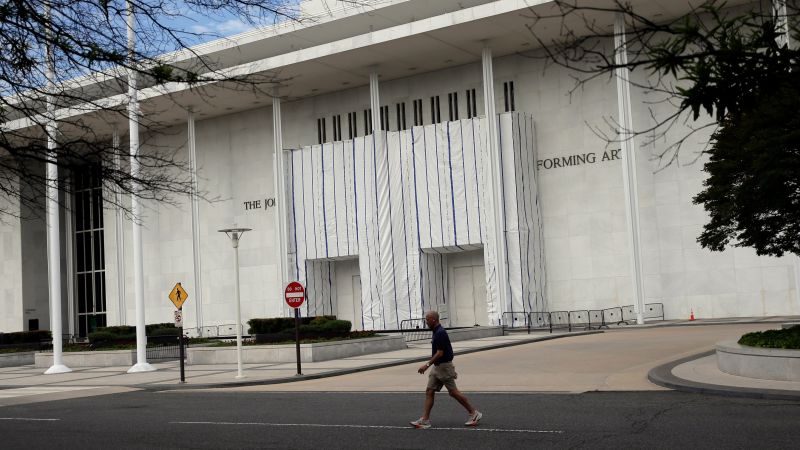
Kennedy Center exterior remains covered after – Sunday brought a mix of anticipation and bewilderment to the Kennedy Center as striped tarps still draped over its facade, obscuring the last remnants of President Donald Trump’s name. Visitors arrived expecting to see the iconic arts venue free from the political symbolism that had sparked debate since the president’s name was officially removed on Saturday, following a federal judge’s directive. Among them was Stephen Caken, a New York resident who had traveled to Washington, DC, for an internship, expressing confusion over the lingering coverage. “It seems like they’re trying to just kind of take away attention from this whole charade,” Caken told CNN, highlighting the lingering uncertainty about the center’s decision to keep the tarp in place.
Symbolism and Visitor Frustration
Despite the removal, much of the building’s exterior—where the metal letters bearing Trump’s name were installed in December—remained draped in tarps on Sunday afternoon. This obscured the view for many, including John Mathew Smith, a Maryland resident who had made the trip to witness the change. Smith, who viewed the name addition as a symbolic attack on American heritage, argued that Trump’s actions were part of a larger effort to “deface America’s symbols.” “To me, he’s trying to deface America’s symbols before he starts finishing defacing the country itself,” Smith said, emphasizing the perceived threat to national identity.
Tim Terpstra, a Washington resident living nearby, expressed similar concerns. He arrived at the center for the second time this weekend, hoping to see the tarps lifted. “It would be nice to be able to see to make sure that it is down, and no vestiges of what was up there still remain,” Terpstra remarked, underscoring the public’s desire for a complete erasure of the president’s presence. The continued coverage of the facade has raised questions about the Kennedy Center’s commitment to compliance with the court’s ruling and its willingness to fully address the symbolic implications of the name change.
Legal Context and the Name Addition
The removal of Trump’s name followed a legal battle that began in December. A federal judge, Christopher Cooper, ruled that the Kennedy Center had acted unlawfully by adding the president’s name to the building, which was originally named after assassinated President John F. Kennedy. This decision came as part of Trump’s broader campaign to reshape the nation’s capital, with the center becoming a focal point of his cultural agenda. Despite the ruling, the Kennedy Center initially kept the name on display, seeking to delay compliance through an appeal. The appeals court later declined to halt the order, allowing the removal to proceed.
Residents who had long cherished the Kennedy Center as a cultural hub in the city’s deep-blue district felt a deep symbolic impact from the name addition. The decision to install Trump’s name on the building, which had served as a beacon of American art and culture, was seen as a challenge to its historical significance. While the center had taken steps to reverse the change in some areas, it maintained Trump’s name on the exterior as part of its strategy to resist the judge’s order. This stance reflected a broader tension between the venue’s role as a cultural institution and its alignment with political initiatives.
Public Response and Symbolic Struggles
On Friday, as crews prepared to dismantle the letters, crowds gathered to observe the process. Protesters cheered as workers set up scaffolding, some chanting “Take it down” and labeling the laborers as “heroes” for their efforts. A video captured the moment when workers, working through a small opening in the scaffolding, appeared to remove the letters just after 3 a.m. on Saturday. This visual confirmation of the removal was met with mixed reactions, with some visitors still confused about the lingering tarps.
Rep. Joyce Beatty, an Ohio Democrat and ex-officio trustee of the Kennedy Center’s board, had been a vocal critic of the name addition. Her legal challenge against the change led to the court’s ruling, and she celebrated the removal by posting a social media video of herself dancing to the “YMCA” song, a nod to Trump’s signature move. This gesture underscored the personal and political stakes of the dispute, as well as the symbolic weight of the Kennedy Center’s facade.
Trump’s Cultural Initiatives in Washington
While the Kennedy Center’s name change was a recent focal point, Trump’s efforts to influence the city’s cultural landscape extend beyond this single act. During his second term, the president used the venue to promote works that aligned with his aesthetic and ideological preferences. In December, he hosted the Kennedy Center Honors, a prestigious event that recognized artistic excellence. The center also showcased the premiere of Melania Trump’s documentary, further intertwining the administration’s influence with the institution’s programming.
Trump’s impact on Washington, DC, has also included physical transformations. He paved over the White House Rose Garden to create a sprawling patio reminiscent of his Mar-a-Lago estate, demolished the East Wing to accommodate a massive ballroom, and altered the color of the Lincoln Memorial Reflecting Pool. These changes were part of his vision to modernize the city’s architecture, though critics argued they diminished its historical character. Additionally, the administration launched plans to construct a golf course, build the world’s tallest arch on a traffic circle near Arlington National Cemetery, and establish a sculpture garden along the Potomac River, all of which have drawn attention to the symbolic and practical implications of his urban redesign.
Broader Implications and Ideological Shifts
Trump’s influence in Washington has not been limited to physical alterations. His administration has also prioritized ideological alignment over aesthetic considerations, as seen in its ongoing review of the Smithsonian Institution. This review aims to reshape the organization’s narrative to reflect the president’s views on American history and culture. Similarly, at the George Mason Memorial—a tribute to one of the nation’s founding fathers—the administration removed references to the fact that Mason, a slave owner, had paradoxically championed individual rights. These actions have sparked debates about the balance between historical accuracy and political symbolism in public spaces.
As the legal fight over the Kennedy Center’s name continues, the venue’s appeal is expected to play out in the coming weeks. The removal of Trump’s name marks a significant step in the city’s cultural evolution, yet the lingering tarps serve as a reminder of the ongoing debate over its symbolic role. For many, the Kennedy Center represents more than just a venue for the arts—it embodies the nation’s cultural heritage, and its transformation under Trump’s influence has become a microcosm of broader discussions about power, identity, and the role of public institutions in society.
CNN’s Devan Cole, Betsy Klein, and Kaanita Iyer contributed to this report, providing insight into the unfolding developments at the Kennedy Center and their implications for the city’s cultural and political landscape. As the tarps remain in place, the event continues to serve as a symbol of the complex relationship between art, politics, and the public’s perception of national symbols. Whether this marks the end of a contentious chapter or the beginning of another remains to be seen, as the Kennedy Center navigates the delicate balance between its historical legacy and contemporary political currents.