
Kennedy Center misses judge’s deadline to remove Trump’s name from building and asks for more time
Kennedy Center Seeks Extension to Remove Trump’s Name from Building
Legal battle continues as venue faces pressure to comply with federal order
Kennedy Center misses judge s deadline – The U.S. Kennedy Center, a prominent cultural hub, has fallen behind schedule in removing President Donald Trump’s name from its prominent signage, prompting a formal request for an extension to meet the requirements of a federal judge’s directive. The venue, which has long been a symbol of American artistic excellence, is now at the center of a contentious legal dispute over its decision to rename a key section of its complex in honor of the former president. The deadline set by U.S. District Judge Casey Cooper to certify full compliance with the order was originally Friday night, but the center has yet to finalize the process, citing unforeseen challenges.
According to federal attorneys representing the Kennedy Center, crews had been working diligently to strip the Trump name from its exterior display, with progress expected to conclude in the early hours of Saturday. However, the efforts were temporarily halted by severe thunderstorms that swept through Washington, D.C., creating logistical hurdles for the team. The center’s representatives emphasized that the delay was unavoidable, as weather conditions disrupted their ability to complete the task as planned. “We’re making every effort to ensure the name is fully removed, but natural forces have played a role in slowing our progress,” one official stated.
Despite the setback, the center remains committed to adhering to the court’s order, though the legal battle shows no signs of abating. On Friday, an appeals court upheld the judge’s ruling, rejecting a last-minute motion to pause the proceedings. The decision, delivered in a brief and unsigned ruling, was unanimous among the three judges on the panel, including Gregory Katsas, a Trump appointee, and Patricia Millett and Robert Wilkins, both Obama appointees. The court’s stance underscores the gravity of the issue, as the Kennedy Center must now navigate the final stages of the name removal process while facing potential legal challenges.
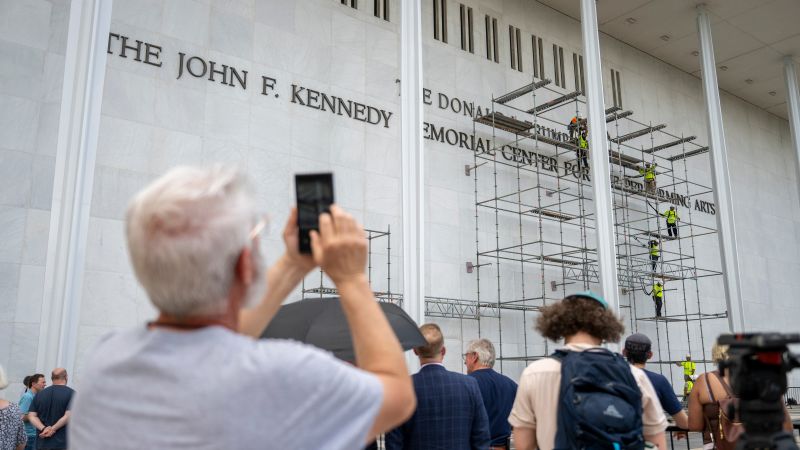
As the scaffolding was erected beneath the signage, a small group of protesters gathered to observe the work, chanting slogans like “Take it down” and applauding the workers they called “heroes.” Rep. Joyce Beatty, the Ohio Democrat leading the legal campaign against the name change, joined the crowd to inspect the progress and pose for a photograph under the structure. “We know we’re on the right side of justice and the law,” Beatty said, receiving support from the demonstrators. “No matter what happens, we’ll keep fighting for the Kennedy family’s legacy.” Her comments reflect the broader sentiment of those opposing the renaming, which has sparked debates about the appropriateness of associating the center with Trump’s administration.
“Every bit of the way, there’s going to be a legal fight,” Beatty added, emphasizing the long-term nature of the dispute.
The name change, which occurred in December, was approved by the Kennedy Center’s board of trustees to honor Trump for his contributions to the arts institution. However, the move drew swift criticism from the Kennedy family, who argued that the renaming diminished the legacy of their patriarch, President John F. Kennedy. The center also faced a legal challenge, with the Justice Department filing a 22-page petition to the D.C. Circuit to extend the ruling. In that filing, the department reiterated its stance that removing the name now could confuse the public, especially if the legal battle ultimately results in reversing the decision.
One of the key concerns raised by the Justice Department is the financial impact of compliance. The bylaws of the Kennedy Center stipulate that any funds received under the Trump name must be returned to donors if the name is removed. The department warned that the immediate loss of hundreds of millions of dollars in private contributions could jeopardize the center’s financial stability. “This decision could affect the Center’s ability to sustain its operations,” the filing stated, highlighting the economic stakes involved.
While the center has taken steps to reverse the name change in some areas, it has left the letters “The Donald J. Trump and” intact on the building’s front facade. This partial compliance has drawn mixed reactions, with some supporters of Trump viewing it as a strategic compromise, while critics argue it signals a lack of commitment to the ruling. The situation has also reignited discussions about the balance between honoring public figures and maintaining institutional integrity.
Earlier in the week, the board of trustees had approved a resolution to establish the “Trump Kennedy Center Fund,” a separate initiative aimed at securing additional private donations to support the arts center. A Kennedy Center official told CNN that the fund would complement the $257 million allocated by Congress through Trump’s “One Big Beautiful Bill,” which had been a major funding source for the institution. This move has been interpreted by some as an attempt to ensure continued financial backing for the center, even as the legal battle unfolds.
The Justice Department’s legal arguments also emphasized the historical significance of the Kennedy Center. The venue, which opened in 1971, has been a cornerstone of American performing arts and a symbol of bipartisan cultural efforts. Critics of the name change argue that associating it with Trump’s presidency undermines this legacy, particularly given his role in shifting the center’s leadership and programming. The center, however, maintains that the renaming was a symbolic gesture of appreciation, not a concession to political pressure.
As the scaffolding work progressed through the early hours of Saturday, crews worked to cover the signage with a protective layer, obscuring the progress from view. The effort to remove the Trump name from the building’s exterior is part of a broader campaign to ensure the center fully complies with the court’s order. While the center has made strides, the legal team is still seeking clarity on whether the judge will grant their request for an extension, which would provide additional time to complete the process.
The ongoing saga has captured national attention, with media outlets and political figures weighing in on the issue. Some have criticized the center for not meeting the deadline, while others have defended its decision to accommodate the weather-related delay. As the deadline looms, the Kennedy Center’s ability to navigate the legal and public pressures will be a critical test of its commitment to the rule of law and its role as a cultural landmark. Whether the center can finalize the removal of Trump’s name in time remains uncertain, but the situation continues to unfold with significant implications for both the institution and the legal process it now faces.
