Reflecting Pool woes: Trump administration turns to hydrogen peroxide in latest bid to beat back algae

Reflecting Pool Woes: Trump Administration’s Battle Against Algae
Reflecting Pool woes – The Lincoln Memorial Reflecting Pool, a cornerstone of Washington D.C.’s iconic landmarks, faced an unexpected challenge shortly after its $14 million overhaul under the Trump administration. Completed just over a week ago, the renovation involved refilling the pool’s 300,000 square feet with 6.5 million gallons of clean water, a project that had been in the works for months. Yet, within days of the water’s return, the pool became a focal point of debate as algae began to proliferate, raising questions about the effectiveness of the latest cleanup measures.
Algae Outbreak and Immediate Response
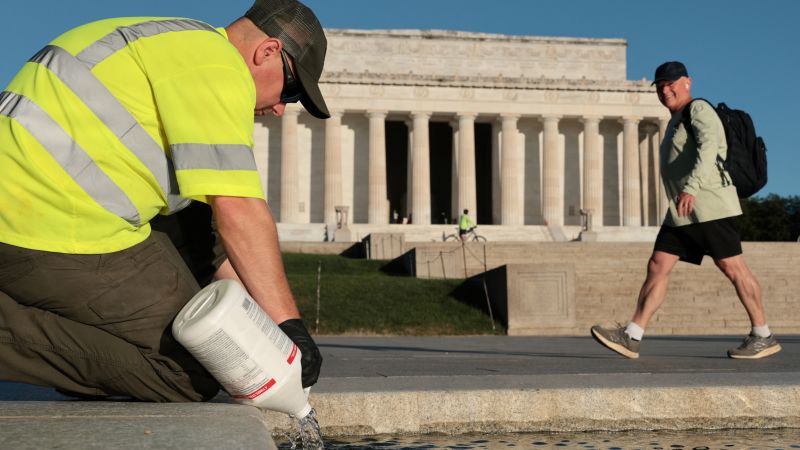
The algae issue, which has plagued the pool for decades, emerged as crews worked to restore the iconic water feature. Workers clad in hip-waders were seen manually extracting algae clumps, while additional efforts involved the use of hydrogen peroxide to combat the growth. Despite these actions, the pool’s water gradually took on a murky green hue, prompting concerns about the long-term success of the administration’s efforts.
“It would take an entire lifetime to clean this pool,” remarked a worker who spoke to CNN, highlighting the daunting nature of the task. The sentiment echoed a growing frustration among those who had anticipated a pristine restoration.
The Department of the Interior, responsible for overseeing the project, claimed that advanced filtration systems were now in place. Specifically, the “ozone nanobubbler” technology was deployed, a state-of-the-art solution designed to target algae at its source. A spokesperson for the department assured CNN that the nanobubbler had “successfully destroyed the algae bloom,” though the process was still ongoing. Hydrogen peroxide, described as a “milder treatment,” was also employed to address the issue, with officials emphasizing its environmental safety.
Public Reactions and Mixed Perceptions
Visitors and local residents expressed a range of opinions about the pool’s condition. Danielle Khan, a Washington, D.C., worker, noted that the renovation appeared to have little visible impact. “I know a lot of money went into this, but I can clearly see algae growing,” she said, adding that the pool “looks exactly the same” as it did before the project.
Valerie, a tourist from Chicago, was more critical. “It’s not good. I mean, it looks green,” she said, describing the water as “swampy” and expressing disappointment with the current state. Meanwhile, Dinika Seth, a visitor from North Carolina, offered a contrasting view. “It’s getting cleaner,” she stated, pointing to the water and suggesting that the renovations had improved the pool’s appearance. However, she acknowledged that the algae problem still needed to be fully resolved.
Steve Hay, a resident of Harrisburg, Pennsylvania, speculated that the mixed reactions might reflect political divides. “Either way, all I know is I’m looking at it, I’m enjoying it,” he said, implying that personal enjoyment of the pool’s aesthetics could vary depending on one’s perspective of the administration.
Origins of the Algae Problem
Analysts suggested that the algae outbreak was not entirely unforeseen. The issue reportedly began almost immediately after the pool was refilled last week. CNN first reported the presence of the algae just one day following the water’s addition, with some areas showing visible growth near the edges. A worker who had been wading in the pool confirmed the substance was algae, though initial responses from the Interior Department were cautious. At first, a spokesperson was unsure whether the algae was “residual from supply lines,” which had remained dormant during the eight weeks of construction.
“It’s part of the normal startup process. We are removing the algae, and the nanobubblers will maintain the pool and keep it alg,” the spokesperson later clarified, attributing the issue to the natural process of system activation. However, the delay in addressing the problem sparked criticism, with some questioning the thoroughness of the initial cleanup strategies.
Technological Claims and Industry Involvement
The Department of the Interior highlighted the new filtration system as a key component of its solution, describing it as “state of the art.” The system, developed by Greenwater Services, an Ohio-based firm, was marketed as a patented innovation capable of reducing toxins, microcystins, nitrates, and phosphates from contaminated water. The company’s website claims its technology is “backed by government and academic research,” a statement that has been used to justify the investment in the system.
Despite these claims, Greenwater Services did not respond to CNN’s inquiries about the algae situation. Eddie Wood, a representative of Atlantic Industrial Coatings, the firm responsible for resurfacing the pool, distanced his company from the water management aspects. “My company had nothing to do with water, only waterproofing and water tightening,” Wood said, expressing pride in his team’s contribution to the project. However, he left the algae issue to others, emphasizing that the physical structure of the pool had been restored with precision.
Challenges and Ongoing Efforts
The algae problem has underscored the complexities of maintaining a public water feature, even with modern technology. While the nanobubbler and hydrogen peroxide were deployed as part of the cleanup, the algae’s rapid return raised doubts about the sustainability of these measures. Critics argued that the pool’s conditions could worsen if the underlying causes of algae growth were not addressed, such as nutrient levels in the water or insufficient circulation.
As the situation evolves, the Trump administration continues to monitor the pool’s progress. The Department of the Interior has not confirmed whether the president himself is aware of the algae outbreak or has engaged in discussions about it. Questions about the president’s involvement were directed back to the Interior department, which reiterated its confidence in the current approach.
With the Reflecting Pool now a symbol of both political and environmental challenges, the focus remains on whether the combined efforts of nanobubbler technology and chemical treatments can achieve the desired clarity. For now, the green tint persists, a reminder that even the most ambitious renovations require time to fully realize their intended outcomes.