
Supreme Court says Alito’s verbal reaction to Sotomayor was based on a ‘misunderstanding’
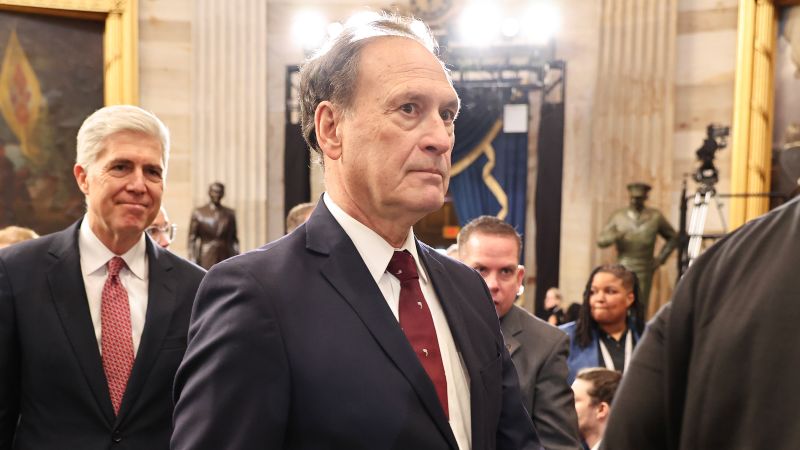
Supreme Court: Alito’s Verbal Response to Sotomayor Was a Misunderstanding
Supreme Court says Alito s verbal – The U.S. Supreme Court clarified that Justice Samuel Alito’s sharp verbal exchange with Sonia Sotomayor stemmed from a “misunderstanding.” In a recent statement, the court emphasized that Alito had not anticipated Sotomayor would deliver her dissent aloud, resulting in an unexpected interaction that highlighted the justices’ varied styles of engagement in oral arguments.
Unanticipated Courtroom Dynamic
The incident occurred during a high-stakes case on asylum policies, where Sotomayor, the court’s most senior liberal justice, took to the bench to present her dissent. Alito, a conservative justice, had planned to summarize his opinion but was caught off guard by Sotomayor’s verbal approach. The court’s spokesperson noted that Sotomayor’s chambers had informed Alito beforehand about her intention to read the dissent aloud, a practice that is uncommon but not entirely new in the Supreme Court’s tradition.
This rare moment of friction came as the court navigated its final weeks of the current term, with decisions on immigration and cultural issues shaping its legacy. The verbal exchange between Alito and Sotomayor underscored the growing ideological divide among justices, particularly as conservative and liberal factions continue to diverge in their interpretations of legal procedures and social impact.
Context of the Metering Policy
The case centered on the metering policy, which permits federal agents to deny asylum seekers entry before they cross the border. This policy, supported by both Democratic and Republican administrations, has been a point of contention in recent years. The Supreme Court’s 6-3 ruling to uphold the policy marked a pivotal moment in immigration law, with the conservative majority asserting that it provides a structured framework for asylum evaluations.
Justice Sotomayor’s dissent highlighted the policy’s human consequences, drawing a historical analogy to the 1930s when the U.S. government turned away the St. Louis, a ship carrying Jewish refugees. Over 900 passengers on that voyage were later killed in the Holocaust, a reference Sotomayor used to underscore the potential for similar tragedies under the current system. Her remarks, however, were met with a reaction from Alito that reflected his surprise at the public nature of the dissent.
Alito’s Admission of Oversight
Alito, who authored three of the four opinions released on Thursday, acknowledged his lack of awareness about Sotomayor’s plan. “I would have added more to my bench statement if I’d known a dissent would be read aloud,” he remarked, a rare acknowledgment of procedural oversight in the typically polished environment of the Supreme Court. Sotomayor’s verbal dissent, though uncommon, allowed her to directly convey her concerns to the bench, a tactic that has become more frequent in recent years.
The exchange between Alito and Sotomayor, though brief, captured the tension between the court’s factions. It also sparked broader discussion about how justices communicate their dissent in public forums. While Sotomayor’s approach has been praised by some for its clarity, others viewed it as a strategic move to amplify her critique of the metering policy.
Broader Implications for Legal Discourse
Justice Sotomayor’s verbal dissent added a new dimension to the court’s deliberations, showcasing her willingness to challenge decisions openly. This incident followed her earlier public apology for remarks made about Justice Brett Kavanaugh, where she expressed frustration with his concurring opinion on ICE operations. The current exchange, however, was not just a personal moment but a reflection of the court’s evolving dynamics.
The Supreme Court’s decision to uphold the metering policy has been interpreted as a key victory for the conservative bloc, which has consistently advocated for stricter immigration enforcement. Meanwhile, the dissent serves as a reminder of the liberal justices’ commitment to emphasizing the humanitarian aspects of legal rulings. As the court prepares for the next term, this episode may influence how justices present their opinions in the future.
