
Trump’s red card call stirs political storm around World Cup
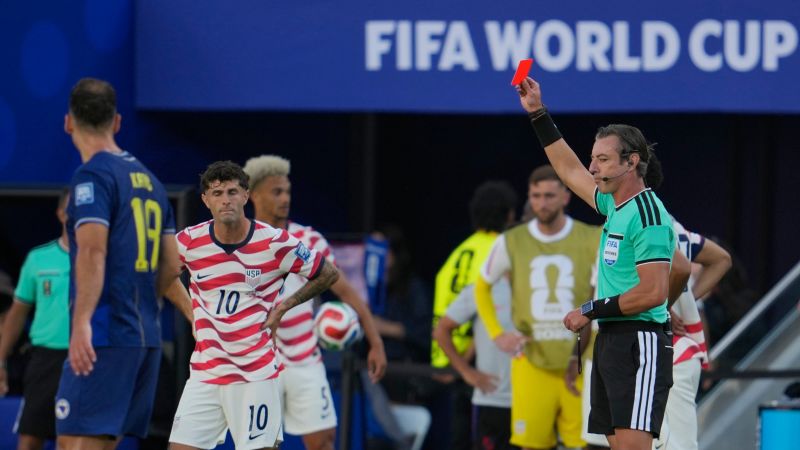
Trump’s Red Card Controversy Sparks Political Tensions at World Cup
Trump s red card call stirs – In the run-up to the 2026 World Cup, a rare phenomenon occurred in American sports: the tournament’s events seemed largely disconnected from Donald Trump’s political agenda. However, this equilibrium was disrupted after the president intervened in a high-stakes decision involving U.S. star player Folarin Balogun. Despite being dismissed during the group stage match against Bosnia and Herzegovina and receiving a one-game ban, Balogun will now face Belgium in the knockout round on Monday, thanks to a last-minute appeal by Trump. The twist has ignited a new wave of political discourse, with the World Cup becoming a stage for debates about fairness, influence, and the integrity of international competition.
A Presidential Intervention in Soccer
Trump’s involvement in the Balogun case has drawn sharp criticism from global soccer organizations. The president’s public praise for FIFA’s reversal of the suspension—posted on his social media platform, Truth Social—has framed the decision as a correction of “a great injustice.” While his words carry rhetorical weight, the intervention has raised questions about the extent of his influence over the sport’s governing body. During a Monday press briefing in the Oval Office, Trump emphasized his proactive role, claiming he had called FIFA President Gianni Infantino to request a review of the red card. “I didn’t say, ‘You have to do this,’” Trump explained, adding that he believed Balogun’s offense didn’t merit a penalty. His comments have been interpreted as both a strategic move and a challenge to FIFA’s authority.
“Thank you to FIFA for doing what was right, and reversing a great injustice! President DONALD J. TRUMP,”
Trump’s call to action has not only reshaped the narrative around Balogun’s fate but also cast a shadow over the World Cup’s credibility. The president’s direct line to FIFA’s leadership has sparked speculation about his relationship with the organization, suggesting a level of political maneuvering that could affect the tournament’s outcomes. This has led to concerns that the event, which was initially celebrated for its positive momentum, is now becoming a battleground for political influence.
Global Soccer’s Reaction to the Controversy
The Royal Belgian Football Federation has criticized the decision, arguing that the reprieve for Balogun violated FIFA’s regulations and compromised fair play. A federation spokesperson stated that the pregame discussions were not in line with the organization’s transparency standards, hinting at potential procedural breaches. Meanwhile, the U.S. team’s coach defended the move, emphasizing that the focus should remain on the integrity of the game itself. “This isn’t about national pride—it’s about football in general,” the coach said, highlighting the broader implications of the incident.
The controversy has also drawn attention from UEFA, the European soccer governing body. In a Monday statement, UEFA expressed dismay over the suspension’s reversal, warning that such actions threaten the tournament’s reputation. “When the certainty of rules is no longer guaranteed by its guardians, the integrity of the game is at stake,” the statement read, underscoring the potential for political interference to disrupt the sport’s foundational principles. This has fueled discussions about whether Trump’s involvement could set a dangerous precedent for future World Cup matches.
Reevaluating the Red Card Decision
Balogun’s incident during the U.S. victory over Bosnia and Herzegovina has been scrutinized in detail. The referee initially ruled the challenge as a serious foul, citing the player’s contact with Tarik Muharemović’s leg. However, the video assistant referee (VAR) system, which has become a cornerstone of modern soccer, played a pivotal role in the decision. Slow-motion replays revealed that Balogun’s foot had grazed the defender’s leg, twisting his ankle into an awkward position. While many fans argued the contact was incidental, others contended that the VAR review had unfairly penalized the player.
Historically, such moments were judged in real time by referees, often resulting in leniency. The introduction of VAR technology, while intended to enhance accuracy, has also amplified debates over subjective calls. Balogun’s case has been cited as an example of how the system can penalize players for actions that, in isolation, may not be deemed intentional. “Clashes between players look far worse in slow motion,” one analyst noted, highlighting the challenges of judging contact under the microscope of modern technology.
Despite the controversy, the U.S. team’s chances of advancing in the tournament remain intact. For many American supporters, the focus will be on the nation’s performance on the field rather than the offside drama. However, the incident could tarnish the World Cup’s image for international audiences, particularly those in countries where the U.S. victory is seen as a significant achievement. If the national team advances, the red card controversy may fade into the background, but if it stirs enough dissent, the outcome could be remembered with a lingering asterisk.
Implications for the World Cup’s Legacy
While political interference is not new in global sports, the 2026 World Cup has become a unique case where a president’s direct involvement in a referee’s decision has captured global attention. The incident has reignited discussions about the balance between sportsmanship and political influence, with critics arguing that Trump’s intervention risks undermining the tournament’s credibility. FIFA’s decision to reverse the ban has been seen as both a victory for the president and a concession to his growing presence in the sport’s ecosystem.
Historical parallels have been drawn to iconic moments in World Cup history, such as Diego Maradona’s 1986 “hand of God” goal or Zinedine Zidane’s 2006 headbutt. These incidents, while controversial, were celebrated as part of the game’s excitement. Balogun’s case, however, introduces a new dimension: the potential for political figures to sway decisions that could determine the fate of a nation’s team. This has sparked fears that the World Cup, once a symbol of unity and sportsmanship, is now being politicized at every turn.
The debate over Balogun’s red card is not just about the technicalities of the challenge. It reflects deeper tensions between the spirit of the game and the influence of powerful figures who may see the World Cup as an opportunity to project their political agendas. Whether or not Trump’s call to Infantino was decisive, the mere perception of interference has the potential to shape public opinion. For the tournament, which relies on global goodwill, this could be a significant setback.
As the U.S. faces Belgium in the knockout stage, the stakes have never been higher. The game is expected to draw massive viewership, but the red card controversy may complicate the narrative. While the U.S. team’s on-field performance will ultimately decide the match, the off-field drama could linger long after the final whistle. The incident serves as a reminder that even the most celebrated sporting events are not immune to the forces of politics and personal influence.
Ultimately, Balogun’s reprieve has sparked a multifaceted debate. On one hand, it is a testament to the sport’s ability to adapt and correct decisions. On the other, it highlights the growing intersection between politics and soccer. As the World Cup progresses, the question remains: how will this incident shape the legacy of a tournament that has already faced its share of scrutiny? The answer may lie in the balance between fair play and the power of political intervention.
