
Trump’s role as LIV Golf host renews scrutiny over conflicts of interest
Trump’s role as LIV Golf host renews scrutiny over conflicts of interest
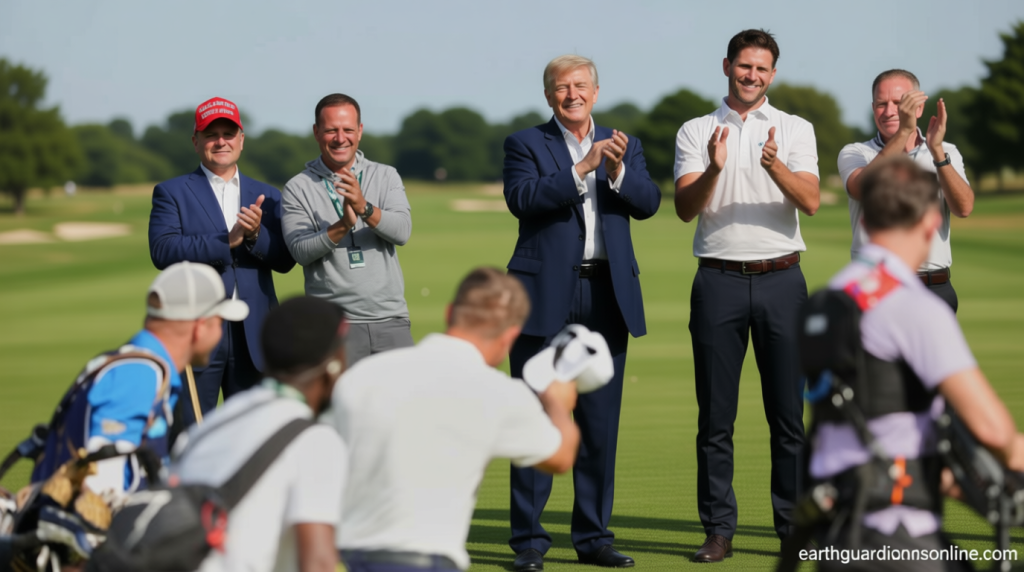
Trump s role as LIV Golf – Recent attention has focused on President Donald Trump’s involvement with LIV Golf, as he hosted an event at his Virginia estate this weekend. This action has sparked renewed debate about potential financial benefits for the Trump family from his presidential duties while supporting a league backed by Saudi Arabia, a nation embroiled in allegations of human rights violations. The controversy highlights ongoing concerns over whether Trump’s personal interests align with the public good, particularly as his businesses continue to intersect with his political role.
For years, Trump’s golf courses have served as a key platform for LIV Golf, which is largely funded by Saudi Arabia’s government. Critics argue that the kingdom’s financial backing of the league has been used to obscure its human rights record, especially in light of the 2018 assassination of Jamal Khashoggi, a prominent Saudi journalist. The kingdom recently announced it would cease funding the league after the 2026 season, a move that has not quelled the scrutiny surrounding its ties to Trump’s properties.
Analysts have emphasized the broader implications of such collaborations, noting how they might serve as part of a larger strategy to reshape public perception. This concept, known as “sportswashing,” involves countries leveraging high-profile sports events to enhance their global image. Saudi Arabia has invested heavily in this approach, not only through LIV Golf but also by acquiring top athletes for its soccer league and purchasing an English club as part of a consortium. In 2021, the kingdom signed a decade-long agreement with Formula 1 to host races, further solidifying its presence in international sports.
“Saudi Arabia is a murderous, authoritarian, anti-democratic region,” said Kathleen Clark, a government ethics professor at Washington University in St. Louis. “(Trump’s) willingness to do this is actually a really nice example about what his priorities are.”
Trump’s administration has faced criticism for its close relationship with Saudi Arabia, particularly after his meeting with Crown Prince Mohammed bin Salman last year. During that encounter, Trump dismissed questions about the crown prince’s alleged involvement in Khashoggi’s murder, calling the journalist “extremely controversial” and insisting the issue was raised to embarrass the royal family. The president later claimed that bin Salman had no knowledge of the incident, a stance that has drawn skepticism from ethics experts.
Saudi officials have consistently denied the accusations, asserting they were unaware of the journalist’s death. The Saudi Foreign Ministry released a statement in 2021 that characterized the report on human rights abuses as “negative, false, and unacceptable,” while highlighting the “inaccurate information and conclusions” it contained. Despite these denials, the events at Trump’s golf courses have continued to draw comparisons to the kingdom’s efforts to sanitize its image through sports.
Trump’s attendance at LIV Golf events has coincided with his broader engagement in the sports industry, including a recent PGA Tour stop at his Doral, Florida, facility. Over the past two weekends, the president has participated in high-profile golf events, raising questions about the transparency of his financial dealings. His assets are managed by a trust controlled by his children, and he has claimed that his time in office involves minimal direct involvement in business operations. However, experts suggest this arrangement may not fully address the perceived conflicts.
One such expert, Richard Painter from the University of Minnesota Law School, warned that Trump’s participation in these events represents just the beginning of a larger pattern. “This is just going to be the tip of the iceberg,” Painter stated. “The message has been said all over the world that if you want to get along with the Trump administration, do business with the Trump family or with his golf courses or with his son.” His comments underscore the concern that Trump’s personal brand and political influence may be creating an environment where business interests and public policy overlap.
Beyond the golf events, Trump’s administration has been linked to several other business dealings that critics argue blur the lines between private gain and public responsibility. These include accepting a $400 million luxury jet from Qatar, dining with wealthy investors at events tied to his cryptocurrency ventures, and promoting Trump-branded smartphones. Additionally, the administration has supported the development of golf properties in Scotland, further expanding the president’s personal influence in the sports sector.
White House spokespeople have defended these actions, stating that there are no conflicts of interest. For instance, Anna Kelly, a White House spokeswoman, noted in a statement last year that Trump’s assets are in a trust managed by his children. However, some believe this arrangement may not fully eliminate the appearance of impropriety, particularly when the president’s business interests are tied to foreign governments with contentious records.
Meanwhile, Karoline Leavitt, the White House press secretary, addressed the issue of Trump’s interactions with cryptocurrency investors during a recent event. While the administration has highlighted these partnerships as beneficial to economic growth, critics argue that they reflect a broader trend of entangling the presidency with private ventures. The question remains whether these actions are merely coincidental or part of a calculated effort to consolidate power and influence through the sports industry.
As the Trump administration continues to navigate its relationships with international partners, the role of LIV Golf and other sports initiatives serves as a focal point for ethical debates. The golf events, while seemingly innocuous, have reignited discussions about the potential for private interests to shape public policy. With the Saudi government’s funding decisions and Trump’s personal involvement, the line between advocacy and influence appears increasingly blurred, prompting a deeper examination of the president’s priorities and the transparency of his financial dealings.
