
‘I am a living statue’: How DR Congo’s most famous soccer fan is keeping Patrice Lumumba’s legacy alive
‘I am a living statue’: How DR Congo’s most famous soccer fan is keeping Patrice Lumumba’s legacy alive
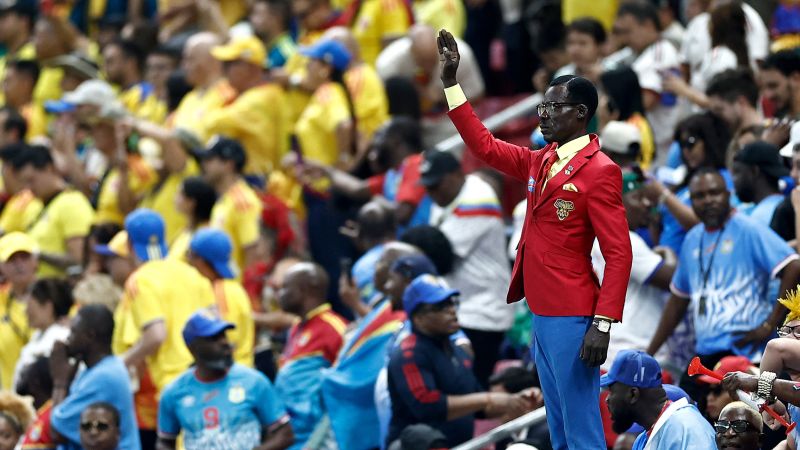
I am a living statue – The Democratic Republic of Congo’s return to the World Cup in 2026 marked a milestone for the nation, which had not participated since its 1974 debut as Zaire. The opening match against Portugal was a moment of immense pride, highlighted by Yoane Wissa’s goal in the second half, the first in DR Congo’s World Cup history. Yet, amid the excitement of the team’s performance, a lingering question echoed through the stadium: Would the legendary supporter, Michel Kuka Mboladinga, be present to carry the spirit of the nation? Known as “Lumumba Vea” — a name that evokes the memory of Patrice Émery Lumumba, Congo’s first prime minister — Mboladinga’s silent vigil during matches has become a symbol of resilience and historical connection.
The Silent Sentinel of the Field
Mboladinga’s reputation as a cultural icon began to take shape during the 2025 Africa Cup of Nations in Morocco, where he stood motionless atop a platform, arms outstretched and eyes fixed on the action. His unyielding posture became a striking visual, a tribute to Lumumba’s steadfast leadership. This tradition of stillness, however, was not born in 2025. For years, Mboladinga has embodied the essence of his namesake, choosing to remain an unwavering figure at every game. His presence is not merely as a fan but as a living monument to a leader whose impact transcends decades.
Lumumba, who led the Congo to independence from Belgium in June 1960, was assassinated just months later in January 1961 at the age of 35. Despite his short tenure in power, his legacy remains deeply rooted in Congolese identity. Mboladinga, who has dedicated himself to honoring this legacy, sees Lumumba as a unifying force. “Patrice Lumumba is a symbol of unity — the one who taught Congolese to stand and be proud,” he explained during an interview with CNN Sports in Mexico. The phrase, delivered with quiet conviction, underscores the enduring power of Lumumba’s vision.
From Independence to Exile
The journey of Patrice Lumumba began in the early days of Congolese freedom. As the first prime minister, he became a beacon of hope for a nation eager to redefine itself post-colonial rule. His fiery speech on June 30, 1960, at the Palace of the Nation in Léopoldville — now Kinshasa — remains one of the most iconic moments in African history. Addressing King Baudouin of Belgium, the great-great-nephew of King Leopold II, Lumumba denounced colonialism with unrelenting clarity: “Although this independence of the Congo is being proclaimed today … no Congolese will ever forget that independence was won in struggle.” His words resonated globally, inspiring generations and cementing his status as a revolutionary figure.
“Lumumba’s scathing remarks of June 1960 were not only fundamental to his reputation, but also marked him out in the United States’ mind. Because, bear in mind, the Cold War was happening, so they were particularly paranoid and thinking, ‘You’re a communist.’”
— Dr. Reuben Loffman, historian and African history lecturer
Lumumba’s boldness, however, made him a target. Within three months of his historic speech, he was ousted from power by President Joseph Kasa-Vubu, a move that set the stage for his tragic fate. A few months later, under the orders of Mobutu Sese Seko, who would later rule the DRC for over three decades, Lumumba was captured and flown to Katanga. There, he endured torture before being executed by firing squad. His body was initially buried in a shallow grave, later exhumed, dismembered, and dissolved in acid. The only surviving relic of him was a gold-crowned tooth, a haunting reminder of his persecution.
The Symbolism of Stillness
Mboladinga’s choice to remain motionless during matches is not arbitrary. It mirrors Lumumba’s image as a leader who stood resolute in the face of adversity. The pose — one hand raised, the other outstretched — reflects the iconic stance of the first prime minister, frozen in time as a symbol of defiance and determination. This act of homage transcends sport, merging the passions of the game with the gravity of history. For Mboladinga, it is a way to honor Lumumba’s sacrifices and remind the world of the struggles that shaped Congo’s modern identity.
The connection between the two men is more than superficial. Mboladinga’s resemblance to Lumumba, both in appearance and spirit, has made him a natural vessel for the leader’s memory. “He’s my inspiration,” Mboladinga told CNN Sports. “Patrice Lumumba is a symbol of unity — the one who taught Congolese to stand and be proud.” His words echo the sentiment of a nation that still cherishes the ideals Lumumba championed, even as his story is often overshadowed by the political turmoil that followed his assassination.
A Legacy Reborn on the Pitch
The 2026 World Cup match against Portugal was more than a sporting event; it was a testament to the unbroken thread of Congolese pride. Mboladinga’s presence in the stands, unchanged and unwavering, added a layer of historical resonance to the game. His ritual, though simple, carries profound meaning. It is a bridge between the past and present, linking the struggles of a nation’s early years to its current aspirations. For fans, his stillness is a reminder of Lumumba’s enduring influence, even as the team’s performance on the field brought new hope to a country still grappling with its complex history.
Lumumba’s assassination in 1961 was a pivotal moment, yet his legacy continues to inspire. The Cold War era, with its ideological battles, framed him as a communist threat, but his true legacy lies in his fight for national sovereignty. As Dr. Loffman notes, Lumumba’s rhetoric during the 1960 independence celebrations was a turning point, not only for the Congo but for the entire African continent. His vision of a united, proud Congo remains a rallying cry for modern-day activists and fans alike.
Mboladinga’s actions during the 2026 tournament underscore this connection. By standing as a living statue, he transforms the stadium into a stage for remembrance. The golden tooth, once a symbol of Lumumba’s suffering, now serves as a metaphor for his indelible mark on history. As DR Congo’s team progresses in the World Cup, Mboladinga’s silent presence ensures that the story of Lumumba — a leader who fought for freedom and dignity — is never forgotten. In a world that often prioritizes movement and change, his stillness is a powerful statement of perseverance and hope.
