The tears that might make Novak Djokovic reconsider his tennis future

Daftar Isi
A Body at Its Limit: What Djokovic’s US Open Collapse Tells Us About the Final Chapter
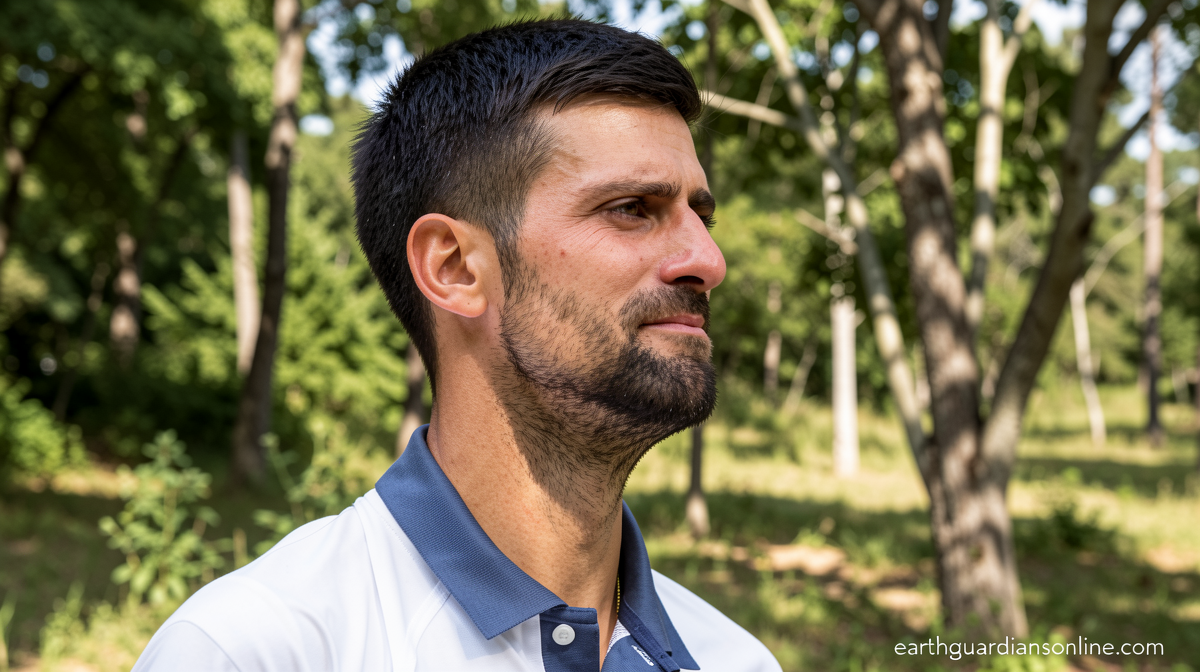
Earthguardiansonline.com – By the closing minutes of Sunday’s first-round match at the US Open, Novak Djokovic was barely upright. His back had locked, his shoulder screamed, and between points he was seen retching on the clay-hardened hardcourt surface. When the final point landed and Mariano Navone claimed the victory, the 39-year-old Serbian stood with tears streaming down his face — not the controlled, stoic expression that has defined two decades of his competitive career, but something raw and unmistakably human.
The result itself — a first-round exit at a major championship — had not happened to Djokovic in twenty years. It was, by any measure, the worst grand slam finish of his professional life. Yet the scoreline barely captures what unfolded over those three sets. The real story was written in the way his legs buckled, in the stiffness that replaced his trademark fluidity, and in the visible exhaustion that no amount of warrior instinct could paper over.
The Health Issue That Will Not Quiet Down
Djokovic had spoken earlier in the month about an underlying medical condition that has been gnawing at him for some time. He described it as something worsened by heat and humidity — precisely the conditions New York delivers in late August and early September. That condition announced itself loudly in Sunday’s match. Vomiting between rallies, progressive muscular failure, and a complete systemic shutdown by the final set were not the actions of a player managing a minor tweak. They were the actions of a body reaching its operational ceiling.
“I didn’t enjoy myself. I think it was obvious that it was an awful feeling on the court for me.”
He went further in his post-match remarks, laying bare the physical toll with an honesty that surprised even long-time observers:
“It’s something that I’ve been carrying, unfortunately, pretty much every match this year: vomiting, throwing up, a serious issue there. Then my whole body starts to collapse, basically cramping and pain. Yeah, the back just gave up in the end and shoulder.”
Those words carry weight because Djokovic has historically been reluctant to discuss physical limitations publicly. To hear him describe his body “giving up” is to hear something genuinely new from a player who has spent his career treating pain as a variable to be managed, not a signal to be heeded.
Seven Months Ago, the Picture Was Entirely Different
The disorientation of Sunday’s result is amplified by how recently the narrative pointed the other way. In January, Djokovic reached the Australian Open final, playing a five-set epic against Jannik Sinner that silenced the retirement chatter for several weeks. In July, a Wimbledon semifinal run kept alive the faint possibility of a record-breaking 25th major singles title. At the time, the 24-time grand slam champion appeared to be the sole obstacle standing between the new generation — Sinner, Carlos Alcaraz, and their peers — and the very top of the sport.
That window has now closed, at least for the foreseeable future. The tailored schedule Djokovic has adopted in recent seasons — saving his competitive energy for the four majors and treating other events as optional warm-ups — was designed to extend his career by reducing cumulative wear. It has worked to a degree. But it cannot, apparently, offset the particular strain of New York’s climate on his underlying condition, nor can it reverse the simple arithmetic of a body that has been under continuous high-intensity load since 1998.
The Retirement Question, Again
Leaving the US Open, Djokovic said he needed time to consider his future in the sport — whether he could continue subjecting his body to the level of pain now required. The question is not new. It has followed him through every new calendar year since roughly 2022, each opening week accompanied by media speculation about whether this would be the final season. In 2017, an elbow injury prompted similar doubts; the following year he answered them by claiming two of four majors.
Yet the context has shifted. Djokovic has not won a grand slam title since 2023. His two great rivals of the previous era — Roger Federer and Rafael Nadal — both captured their final majors at age 36. The physical demands of modern professional tennis, with its increased travel density and higher baseline speeds, mean that any future challenge from Djokovic against the younger cohort would require a degree of fortune that is difficult to quantify or predict.
He has previously stated his intention to remain active through the 2028 Los Angeles Olympics, framing a final competitive appearance around representing Serbia on the Olympic stage. Whether that timeline survives the next few months of recovery, medical assessment, and honest self-evaluation remains an open question.
Legacy and the Question of Success
Whatever Djokovic decides in the coming weeks, his place in the sport’s history is already sealed. Twenty-four major singles titles, a career spanning more than two decades at the highest level, and a competitive record that reshaped the physical and psychological parameters of the game. He will not be the last champion to extend his career well beyond the conventional retirement window, and the sport will continue to accommodate that choice.
What remains uncertain is whether the definition of success he applies to himself can be recalibrated. If the body will no longer permit the pursuit of another trophy, can the next year or two be framed around something else — mentorship, exhibition play, a reduced competitive schedule aimed at the Olympic goal without the full grind of tour life? Whether the champion would find satisfaction in such a redefinition is, for now, the question no one but Djokovic himself can answer.
The tears on Sunday were not merely a reaction to a lost match. They were, perhaps, the first honest acknowledgment that the body and the ambition are no longer speaking the same language. What happens next will be determined in the quiet of his recovery room, not on any court.
Related Reading
Frequently Asked Questions
What is The tears that might make Novak?
The tears that might make Novak is the main topic of this guide. The article explains the context, practical details, and next steps readers should understand.
Why does The tears that might make Novak matter?
The tears that might make Novak matters because readers are looking for a useful answer, not just a short summary. Good content should match search intent and help them decide what to do next.