
Australians think this place is boring. Here’s why you should visit anyway
Australians think this place is boring. Here’s why you should visit anyway
Australians think this place is boring – Canberra was born with a sense of underdog status. Unlike Sydney or Melbourne, the capital city of Australia lacks coastal access, a thriving opal industry, and a renowned opera house. Its origins stem from a constitutional compromise: in 1901, the Australian Constitution mandated that the capital be at least 100 miles from Sydney, the country’s most populous city at the time, to appease Melbourne, which had served as the political heart. This led to the selection of a largely undeveloped plot in rural New South Wales, where the city was named in 1911 as the “bush capital” of a fledgling nation still figuring out its identity.
For many Australians, Canberra remains a city best known for school excursions and trivia quizzes. Tourists might recall it as the answer to a geography question, while locals often describe it with a dismissive term: “daggy.” This slang, which can mean “lame” or “a bit shabby,” reflects the city’s reputation among its own citizens. Yet, as its centennial approaches, Canberra has shed its transient image and evolved into a hub where people choose to settle and create long-term lives.
The Birth of a Capital City
The city’s founding was as much about politics as it was about geography. The 1901 Constitution required a capital that balanced the interests of Sydney and Melbourne, ensuring neither city dominated the nation’s political narrative. This compromise gave rise to Canberra, a deliberate choice to establish a neutral ground. The city’s early years were marked by ambiguity, with its identity shaped by the need to satisfy competing factions. It wasn’t until the 1920s that the federal government finally moved there, cementing its role as the nation’s center.
A Place of Innovation and Equity
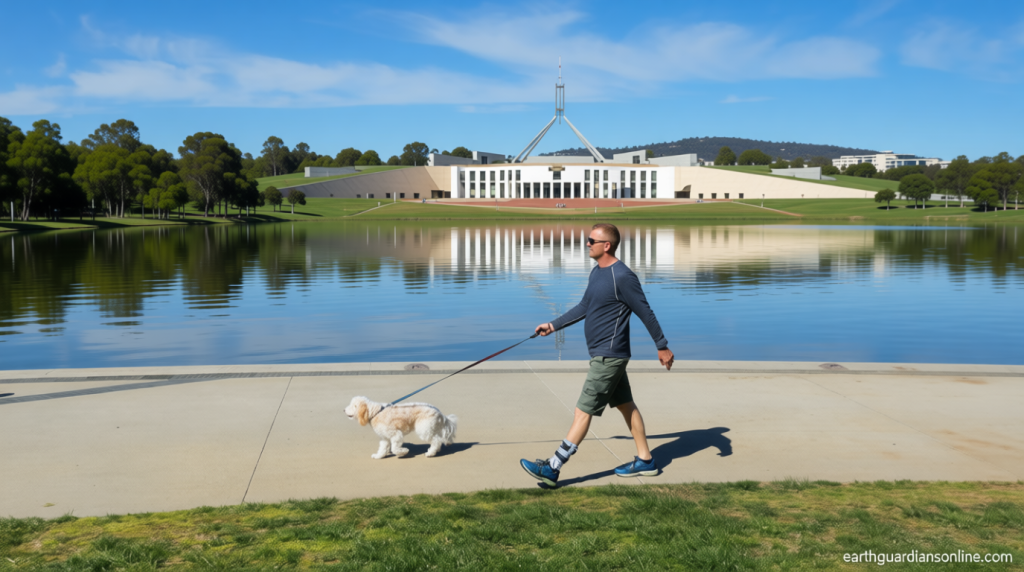
Canberra’s design was a bold experiment. In 1912, American architect Walter Burley Griffin won a contest to outline the city’s layout and key structures. His vision, described as an “ideal of the city of the future,” emphasized functionality and grandeur. One of the most iconic features was Parliament House, which he intended to be the focal point of the city without overshadowing its skyline. To achieve this, the building was constructed on a hill that was temporarily removed, allowing the structure to sit as a central landmark. The hill’s summit was later reattached, creating a unique visual effect. This design decision, according to popular lore, made Canberra the only city where citizens could literally walk on top of government officials.
As the city matured, its architecture and urban planning mirrored Australia’s growing sense of self. Post-World War II, Canberra became a canvas for expressing national aspirations. The construction of institutions like the National Gallery, National Library, and National Arboretum signaled a shift from mere political necessity to cultural ambition. “If we don’t have a national capital, we don’t have national institutions,” remarked Nicholas Brown, author of “A History of Canberra.” “Then what do we have?” His words underscore the city’s role in shaping Australia’s intellectual and artistic landscape.
“The story of Canberra is like the story of Washington DC or Brasilia, artificially planned cities plonked in the middle of nowhere,” says Brown. “It’s an awkward city to sell.”
Brown, who grew up in Canberra and now teaches history at the Australian National University (ANU), describes the city as an “experiment.” Despite its early challenges, Canberra has found its stride. The 1946 opening of ANU marked a turning point, solidifying the city as a center of education and research. Yet, its reputation as a symbol of elitism persists. “On the negative side, Canberra represents elites and privilege,” Brown admits. “But the planning of Canberra was based on equity, that kids should have access to good schools, suburbs should be planned, and roads should be good.”
Today, Canberra’s character is a blend of tradition and modernity. It hosts Saturday afternoon farmers’ markets, vibrant street art, and cafes where dogs are seen strolling with their owners in strollers. A craft beer trail winds through its neighborhoods, offering a taste of local brewing culture. These elements, combined with its world-class food scene, position the city as a destination with hidden appeal. “It’s not just a place to pass through,” says Gabe Trew, founder of Pop Canberra, a bright yellow store on Lonsdale Road. “It’s a place to discover.”
A Capital of Contrasts
The city’s evolution is best captured by its contradictions. While some Australians still view it as a dull alternative to the coastal metropolises, others see it as a beacon of innovation. Pop Canberra, for instance, embodies this duality. The shop’s aesthetic celebrates the city’s quirky reputation through Instagram-friendly items like drink coasters with the tagline “Canberra thinks you’re boring” and pencil cups shaped like its iconic round bus shelters. “I think the people who love Canberra really, really love Canberra,” Trew explains. “It’s not just about the location—it’s about the culture.”
Canberra’s modern identity is also reflected in its community-driven initiatives. The city’s parks and open spaces, once seen as underutilized, now serve as gathering places for locals and visitors alike. Its arts scene, supported by institutions like the National Gallery and the Australian National University, has grown to rival those of major global cities. Even its public transportation system, once a source of criticism, now offers a seamless experience for those exploring its diverse suburbs.
Canberra’s journey from a political compromise to a thriving urban center highlights its resilience. While it may not be the first stop for tourists, its blend of history, culture, and modernity makes it a compelling destination. For those willing to look beyond its reputation, the city reveals layers of charm and innovation. As Brown notes, Canberra’s story is one of deliberate planning and gradual growth—a testament to a nation finding its voice in the middle of the Australian bush.
