
Sitting pretty: Why the next frontier of the luxury airline arms race might be waged in the toilet
Sitting Pretty: The New Luxury Frontier in Air Travel
Sitting pretty – At the recent Center for Aviation (CAPA) Airline Leader Summit in Berlin, Emirates’ president Tim Clark launched a bold challenge to his peers in the aviation industry. Instead of focusing on aircraft or in-flight amenities, he singled out the humble toilet as the next battleground in the race to redefine luxury air travel. During a video call with CNN’s Richard Quest, Clark declared, “I’m working on en-suite bathrooms in first class,” emphasizing the importance of this innovation. His message was clear: the future of high-end travel lies in transforming the most overlooked spaces into private sanctuaries. As the global market for premium air travel intensifies, even the smallest details—like a lavatory—could determine a carrier’s standing in the competition.
The Premium Travel Market: A Billion-Dollar Battle
Despite comprising just 3% of all passengers, business and first-class cabins account for roughly 15% of total revenue in the aviation sector, according to the International Air Transport Association (IATA). This statistic underscores the strategic value of upscale seating, which has seen consistent growth. In 2024, the number of premium travelers worldwide increased by 11.8%, reaching 116.9 million, compared to an 11.5% rise in economy class passengers. This trend has pushed airlines to innovate relentlessly, with each new offering seeking to outshine the last. From personalized lounges to fully equipped suites, the focus has shifted to creating immersive experiences that cater to the elite.
Competing for the Top: A Tale of Lavatory Innovation
Air France’s La Première first-class suite, introduced in April 2024, exemplifies this shift. The cabin boasts a 38-square-foot “personalized sanctuary” featuring a full-length bed, a personal wardrobe, and a plush ambiance designed to mimic a private retreat. Around the same time, Lufthansa unveiled its Allegris cabin, a €2.5 billion ($2.8 billion) project that redefines comfort with its state-of-the-art amenities. Meanwhile, in the United States, Delta Air Lines is preparing to roll out a new first-class configuration with 44 seats—more than double its usual capacity. This limited-time offering is set to debut this month, though it will soon be replaced by flatbed suites in 2028. However, Delta’s current setup faces a unique challenge: only one lavatory is available for its 44 passengers, a common issue across most premium cabins.
Etihad Airways, however, has already set a precedent with its The Residence suite, an airborne apartment that features the first truly private bathroom in commercial aviation. Since its introduction in 2015, this innovation has raised the bar, proving that space and privacy are no longer optional luxuries. As Clark’s vision gains traction, the question remains: how can airlines balance the demand for en-suite bathrooms without compromising the layout of their cabins?
Airbus’ Vision: Redefining Cabin Layouts
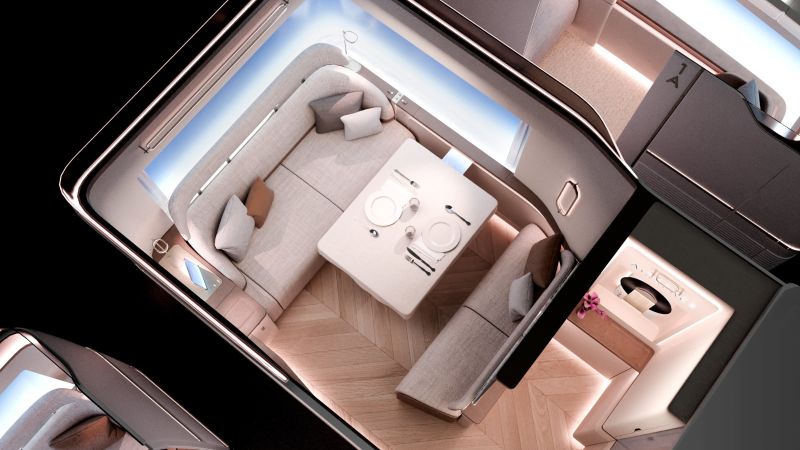
Just over a week before the CAPA summit, Airbus unveiled a groundbreaking concept for its next-generation first-class cabins, destined for its flagship A350-1000 aircraft. Central to this design is the master suite—a spacious living area that can accommodate two passengers. This cabin includes a double bed, a dressing zone, a private bar, and, most notably, an en-suite bathroom. According to Ingo Wuggetzer, Airbus’ head of cabin marketing, this trend reflects a growing desire for “absolute privacy” among travelers. “Now everybody is going to suite arrangements with closed doors, high walls, complete suites,” he explained to CNN. “I would love to fly in such an arrangement where you don’t have to go out and use the public toilet if you really want to have your privacy,” he added.
The Airbus design addresses the spatial constraints of modern aircraft by relocating key elements—such as toilets, storage compartments, and the crew staircase—into a new “center module” opposite the cockpit. This reconfiguration frees up space in the middle of the cabin, allowing for the creation of a master suite that feels secluded and exclusive. By reducing crew movement through first-class aisles, the layout also enhances passenger privacy, offering a more serene environment for those who can afford it.
The Future of Lavatory Design: Beyond the Basics
While Airbus’ concept is a significant step forward, the idea of en-suite bathrooms in first class is still in its infancy. The design team at Airbus is working closely with airlines and travelers to refine the details, but the final product will be shaped by each carrier’s unique vision. “It’s about understanding the needs of the end user,” Wuggetzer emphasized. “It’s not us that are really building the final product. We are enabling it.” This collaborative approach opens the door to limitless possibilities for the master suite space. From a sauna to an exercise zone or even a communal lounge, the future of premium cabins could see these areas transformed into multifunctional hubs tailored to individual preferences.
The competition is not just about comfort or convenience; it’s about crafting an experience that feels like a personalized escape. As airlines race to meet the demands of high-flyers, the en-suite bathroom could become the ultimate differentiator. Clark’s challenge has already sparked a wave of innovation, with Airbus leading the charge. The question now is, will this shift in focus from general amenities to private facilities redefine the entire luxury air travel landscape? The answer may lie in the details of these redesigned spaces, where every square inch is optimized to cater to the desires of the most discerning passengers.
From Concept to Reality: The Road Ahead
With 18 months of discussions under way, the Airbus concept is still a prototype, but its implications are far-reaching. The aerospace giant’s design team has already begun exploring how to integrate these features into existing and future aircraft models. However, the success of this innovation depends on how airlines adopt and adapt it. Some may prioritize a full bathroom with a shower, while others could opt for a more minimalist approach, focusing on hygiene and aesthetics. The key is to balance functionality with exclusivity, ensuring that the en-suite bathroom meets the expectations of travelers who pay a premium for such luxuries.
Meanwhile, the Ethiopian airport project—a $12.5 billion endeavor—serves as a reminder of the broader investment in infrastructure to support high-end travel. As more passengers seek out premium services, airports and airlines must align to deliver seamless experiences. The en-suite bathroom, once an afterthought, is now a symbol of this evolution. It represents not just a convenience, but a strategic move to elevate the status of first-class travel. In an industry where the competition for top-tier customers is fierce, even the smallest details can make all the difference. As Clark’s vision takes shape, the race for luxury air travel may soon be decided in the most unexpected of places: the toilet.
