
A mysterious ‘cold blob’ in the ocean has puzzled scientists. A new study says it’s an ominous sign
A Perplexing ‘Cold Blob’ in the North Atlantic Has Baffled Researchers
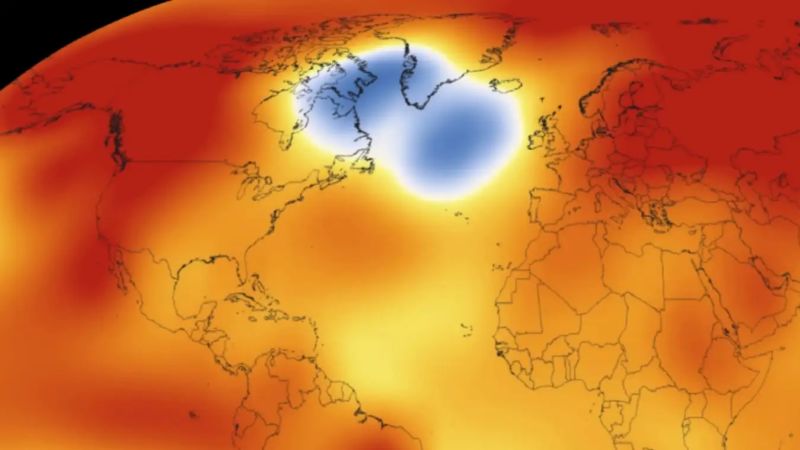
A mysterious cold blob in the ocean – Near the North Atlantic Ocean, south of Greenland and Iceland, a distinct area of water has been exhibiting an unusual trend. While most of the ocean warms under the influence of rising global temperatures, this region has been steadily cooling over the past century. A recent study suggests this phenomenon may not be a coincidence, but rather a harbinger of a significant climate shift. The research identifies the anomaly as a sign of a critical system within the ocean currents weakening, which could signal the approach of a major climate tipping point.
The Cooling Anomaly and Its Significance
Since 1900, the area referred to as the “cold blob” or “warming hole” has dropped by nearly 1 degree Celsius (1.8 Fahrenheit) in temperature. This cooling has raised questions among scientists, who have long speculated about its causes. Some believe it is due to shifts in wind patterns and cloud cover affecting surface heat loss, while others argue it reflects a broader disruption in the Atlantic Meridional Overturning Circulation (AMOC), a system that plays a vital role in regulating global climate.
The AMOC operates like a vast conveyor belt, transporting warm water from the tropics northward toward the European coast. As this water cools, it sinks and flows back south, maintaining a delicate balance of heat and salinity across the Atlantic. However, recent observations suggest this system is slowing. The new study adds to growing concerns that the AMOC is losing strength, potentially leading to severe consequences for weather patterns and sea levels worldwide.
Unraveling the Cold Blob’s Origins
To investigate the cold blob’s behavior, researchers merged ocean heat data from real-world measurements with advanced climate models. Their analysis revealed that the cooling is not limited to the surface but extends deep into the water column. This finding challenges earlier theories that attributed the anomaly solely to atmospheric factors, such as wind and cloud changes, which have a weaker impact at greater depths.
The study emphasizes that the cooling is driven by the AMOC’s diminishing strength. As the system weakens, it reduces the amount of warm water reaching the North Atlantic, leaving the region colder than expected. This insight aligns with warnings from climate scientists about the AMOC’s vulnerability to human-induced climate change. The melting of polar ice and the influx of freshwater from glaciers and increased rainfall are disrupting the balance of salinity and heat that sustains the AMOC, causing it to slow down.
Implications of a Weakening AMOC
Experts warn that a complete shutdown of the AMOC could have catastrophic effects. In the event of such a collapse, the US East Coast might experience accelerated sea level rise due to the reduced transport of warm water. Europe could face prolonged winters, with colder temperatures and disrupted weather systems. Meanwhile, African monsoons might shift, leading to extended droughts in regions that rely on seasonal rainfall for agriculture and water supply.
These potential impacts underscore the urgency of understanding the AMOC’s behavior. While the cold blob has been seen as a possible indicator of this slowdown, the study provides stronger evidence linking the phenomenon directly to the AMOC’s weakening. The data shows that the cooling is consistent across multiple datasets, reinforcing the conclusion that the anomaly is not a random occurrence but a clear signal of climate change.
“It is changing ocean heat transport,” said Stefan Rahmstorf, a study author and professor of physics and oceanography at Potsdam University in Germany. “This is driving the cooling of the cold blob.”
Rahmstorf also highlighted that the AMOC’s weakening is not just a local issue. Independent studies suggest it is at its weakest in approximately 1,000 years, raising alarms about the system’s long-term stability. The cold blob, located in a region where the AMOC delivers much of its heat, has become a focal point for scientists tracking these changes.
Expert Perspectives and Remaining Uncertainties
René van Westen, a marine and atmospheric researcher at Utrecht University, acknowledged the study’s findings but noted that previous research had already demonstrated the possibility of generating a cold blob through atmospheric changes alone. “The new study strengthens the conclusions by showing consistency across different datasets,” van Westen remarked.
David Thornally, a professor of ocean and climate science at University College London, concurred with the study’s implications but cautioned that real-world data remains sparse. “The datasets we use are best viewed as good approximations rather than perfect representations of reality,” Thornally explained. He emphasized that while the study adds valuable evidence, it does not definitively resolve the debate over the cold blob’s origins.
Jonathan Baker, a senior climate scientist at the UK Met Office, echoed this sentiment. “This study adds evidence for an AMOC contribution to the cold blob,” Baker said, “but it doesn’t settle the question entirely.” He pointed out that multiple factors could influence the cold blob, and further research is needed to distinguish between them.
A Global Climate System in Peril
The AMOC’s decline has far-reaching consequences beyond the North Atlantic. As the system weakens, it affects global ocean circulation patterns, which in turn influence weather systems, marine ecosystems, and sea level dynamics. The cold blob, once a local mystery, now appears to be part of a larger climate trend that could reshape the planet’s climate in profound ways.
Scientists continue to monitor the AMOC closely, using a combination of satellite data, ocean buoys, and historical records to track its progress. While the study provides compelling evidence of its weakening, uncertainties remain about the exact timeline and severity of potential disruptions. Some researchers suggest the AMOC could reach a tipping point as early as this century, though others believe it may take longer.
Regardless of the timeline, the implications of a weakened AMOC are clear. The cold blob serves as a visible marker of this transformation, offering a glimpse into a future where ocean currents no longer function as they once did. As the world grapples with the challenges of climate change, understanding the AMOC’s role becomes increasingly critical. The study is a step toward unraveling this mystery, but it also highlights the complexity of predicting how the Earth’s climate systems will respond to ongoing warming.
In the end, the cold blob is more than just a cold patch in the ocean. It is a sign of a delicate balance being disrupted, a warning that the Earth’s climate may be approaching a critical threshold. The findings of this study, while not definitive, contribute to a growing body of evidence that the AMOC is under strain—and the consequences could be far-reaching.
