
Coding classes are rewriting futures in a Kenyan youth prison
Coding classes are rewriting futures in a Kenyan youth prison
A journey from street vendor to tech innovator
Coding classes are rewriting futures – Kenya’s tech landscape is witnessing a transformative shift, thanks to a program that has brought coding education to a youth detention center in Mombasa. Paul Akwabi, a tech entrepreneur and founder of TechKidz Africa, recalled his own formative years during a recent visit to Shimo La Tewa Borstal Institution and Boys Education Centre. Growing up in Kibera, one of Nairobi’s most impoverished neighborhoods, Akwabi’s childhood was marked by both hardship and a burgeoning interest in technology. He spent his early years delivering drugs and other illicit items for older boys, a memory that stirred his resolve to offer second chances through digital learning.
Despite the challenges, Akwabi’s passion for technology began to take shape. At a young age, he taught himself electronics using books and by repairing radios. After completing secondary school, he worked as a street vendor to support his family while studying Computer Science at the Technical University of Mombasa. “Technology was more than a hobby for me—it was a lifeline,” Akwabi said, reflecting on how his journey from the streets to the tech world ignited the idea for TechKidz.
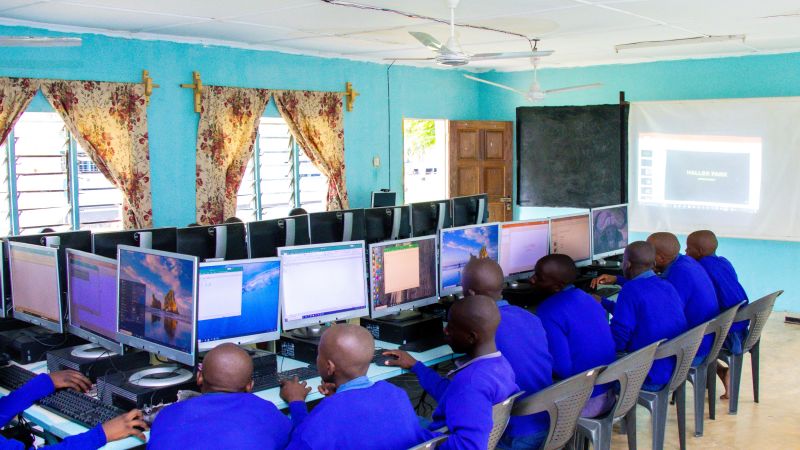
The Mombasa-based organization, TechKidz Africa, has since grown into a hub for empowering young innovators. Its mission is to bridge the gap between tech education and opportunity, particularly for those from marginalized communities. In 2024, the initiative extended its reach to Shimo La Tewa Borstal Institution, a facility where young offenders are given a chance to transform their lives through structured programs. The collaboration with Close the Gap Kenya, a nonprofit that refurbishes and donates IT equipment, allowed TechKidz to establish a computer lab and launch a three-month digital literacy course tailored for incarcerated youth.
Bringing technology to the margins
For the first 25 learners in the program, the experience was both daunting and enlightening. Many had never interacted with computers before, according to a response shared with CNN. One 19-year-old from Nyeri County wrote, “At first, it was difficult to operate the computer, having never used one before.” This sentiment was echoed by an 18-year-old from Meru County, who added, “I was able to use a computer for the first time and enjoyed typing activities. I hope to apply my graphic design skills to promote my plumbing business once I’m released.”
The course, designed to build foundational ICT skills, covers a range of topics from digital ethics to coding. TechKidz’s curriculum begins with basic concepts, such as understanding computer components and email etiquette, before progressing to advanced skills like web design and robotics. “We had to start from scratch—teaching even the basics of what a computer is and how it works,” explained Akwabi, emphasizing the importance of addressing gaps in digital knowledge before diving into technical training.
Shimo La Tewa Borstal Institution, which houses boys aged 15 to 18 who have committed serious crimes, requires participants to engage in formal education, vocational training, or agricultural programs during their three-year sentence. The three-month TechKidz course was introduced as a supplementary initiative, allowing selected learners to refine their skills and prepare for future employment. The participants are chosen based on their performance in vocational training exams, ensuring the program reaches those with the most potential.
Addressing the digital divide in Kenya
Kenya’s rapid tech growth has created opportunities, but access to technology remains uneven. A 2024 government survey revealed that while over 50% of Kenyans use mobile phones, only 11.6% have regular access to computers. This disparity is particularly stark in rural and economically disadvantaged areas, where many youth rely on cybercafés to watch movies or send messages. Jostinah Wawasi Mwang’ombe, senior superintendent of Shimo La Tewa Institution, highlighted that the prison’s population includes a disproportionate number of young men from lower-income rural backgrounds, often lacking prior exposure to digital tools.
Mwang’ombe emphasized the importance of digital hygiene training, which is now a core component of the program. “We want these boys to not only understand technology but to use it responsibly,” she said. The course equips learners with skills that go beyond technical proficiency, fostering digital literacy and awareness of online safety. For many, this is their first encounter with computers, making the initiative a critical step in their reintegration into society.
Kenya’s adult prisons face severe overcrowding, a challenge the judiciary has sought to address through decongestion efforts and a shift toward rehabilitation. Shimo La Tewa Borstal Institution, however, focuses on reintegrating young offenders by offering education and vocational programs. “The goal is to give them the tools to rebuild their lives,” Mwang’ombe said. The TechKidz partnership complements this mission, providing a pathway for youth to gain marketable skills while in custody.
Akwabi’s vision for the program is rooted in personal experience. “I thought, ‘This could have been me,’” he shared, underscoring the belief that technology can be a catalyst for change. By targeting young offenders, TechKidz aims to break the cycle of disadvantage and create opportunities for innovation. The initiative’s success is measured not just in the number of participants, but in the transformative potential it offers.
Empowering the next generation
The TechKidz curriculum is structured to gradually build confidence and competence. Starting with digital ethics and data protection, the course moves through hardware repairs and Microsoft Office skills before introducing coding and advanced design. This approach ensures that learners develop a well-rounded understanding of technology, preparing them for both employment and further education.
Mwang’ombe noted that the program’s impact is already visible. “We’ve seen a shift in how these boys view their future,” she said. One learner who completed the course expressed hope to use his graphic design skills to revitalize his business, illustrating the real-world application of the training. For others, the course is a stepping stone to careers in tech, a field that continues to expand in Kenya despite persistent barriers.
As the country’s tech sector grows, initiatives like TechKidz Africa are playing a vital role in ensuring that no one is left behind. By integrating technology into the lives of young offenders, the program challenges the notion that crime defines a person’s potential. “Technology became my pathway to possibility,” Akwabi reflected, a sentiment that now guides his efforts to uplift others through education and innovation.
With 21 out of the initial 25 participants having no prior tech experience, the program has proven its effectiveness in addressing the digital divide. CNN interviewed the learners through TechKidz staff, who relayed their responses. While names were withheld to protect privacy, the stories shared highlight the transformative power of tech education. “I was amazed by how quickly I could grasp the basics,” one learner wrote, adding that the course has already changed their perspective on technology’s role in daily life.
As Kenya continues to invest in its tech ecosystem, the inclusion of youth prisons in this effort marks a significant step toward equitable access. By providing these young men with the skills to navigate the digital world, TechKidz Africa is not only rewriting their futures but also contributing to a more inclusive tech industry. The program’s success serves as a reminder that opportunity begins with education, and that even in the most challenging environments, learning can unlock new possibilities.
