Canary in the coal mine or just a bad apple? CoreWeave debt drama roils Wall Street

Daftar Isi
CoreWeave’s Debt Jitters Put AI Financing Under a Microscope
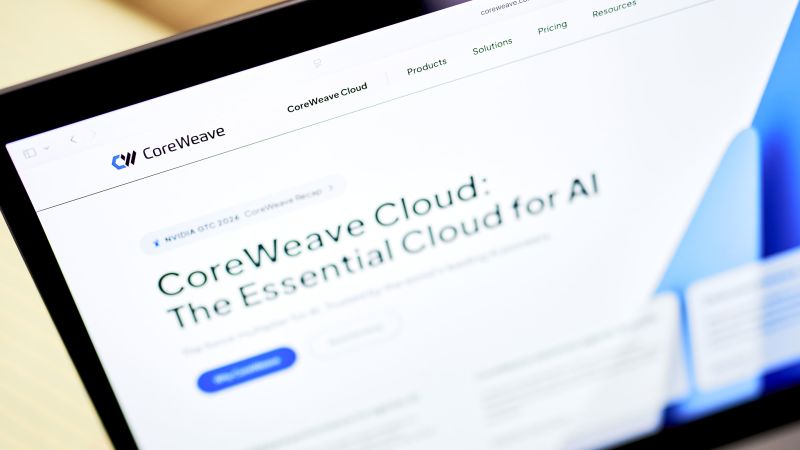
Earthguardiansonline.com – Concern over how the artificial intelligence expansion is being financed has moved to the forefront of Wall Street’s attention, with CoreWeave emerging as the clearest focal point. The New Jersey technology company supplies rented computing capacity to businesses developing AI systems, a fast-growing corner of the market often described as the “neocloud” industry.
Demand for AI computing remains a powerful investment theme, but the capital required to construct and operate data-center infrastructure is immense. CoreWeave has used substantial borrowing to pursue that opportunity, and investors are now questioning whether its future earnings will be sufficient to support the debt accumulated during its rapid expansion.
The company’s shares have fallen 30% this month as borrowing costs climbed. Some of its bonds were yielding 15% as of last week, a level markets commonly associate with considerable financial stress and an elevated perceived chance of default. Higher rates are particularly difficult for a company that is not yet profitable and carries a large financing burden.
A rapidly expanding balance sheet
CoreWeave reported approximately $52 billion in debt and lease obligations in the second quarter, compared with about $30 billion at the close of 2025. That increase illustrates both the scale of the AI infrastructure race and the risk involved when growth depends heavily on borrowed money.
Rising yields have made investors more cautious about companies that need continuous access to capital. Smaller businesses with significant leverage can be more exposed when interest rates rise, especially if expected revenue from data centers arrives more slowly than planned.
Gil Luria, head of technology research at D.A. Davidson, said CoreWeave should not automatically be treated as a signal that the broader AI economy is headed for failure.
“Canary in the coal mine implies that if CoreWeave fails, that the whole ecosystem is going to fall, that the whole AI economy is going to fail. I don’t think that’s the case,” Luria said.
His view is that AI spending includes both disciplined and questionable financial behavior. CoreWeave’s situation, he argued, is more representative of a company-specific problem than proof that the entire technology investment cycle is unsound.
“The AI economy is full of good behavior and bad behavior,” Luria said. “They are a bad apple, but there’s other bad apples. They just represent some of this bad behavior.”
Broader questions about AI returns
The market’s unease extends beyond one company. Investors are attempting to determine whether the enormous sums flowing into chips, servers, electricity infrastructure and data-center construction will ultimately generate returns that justify the spending.
Those worries received another boost when AI data-center company Elice Group fell 32% on its first day of trading in South Korea on Tuesday. The weak debut added to valuation concerns across AI-related infrastructure businesses, where ambitious growth assumptions can be vulnerable to changes in financing conditions.
CoreWeave faces a particularly demanding combination of risks: a sizable debt load, a lack of profitability, and sensitivity to any slowdown in data-center development. The company could also be affected if local opposition, project moratoriums or other barriers interfere with plans for large facilities. Such complications can alter construction schedules and challenge forecasts tied to capacity expansion.
Last week’s uncertainty around CoreWeave helped drag technology stocks lower. Yet some analysts believe investors may be reading too much into the episode. Financial markets have previously reacted sharply when higher interest rates exposed pressure points in heavily financed industries.
Ajay Rajadhyaksha, Barclays’ global chairman of research, compared the current debate with fears that followed regional bank failures in 2023. At the time, many investors feared that rate increases would trigger a much wider crisis.
“It was a plausible argument. It was also wrong,” Rajadhyaksha wrote in a Monday note.
He cautioned against treating recent moves in CoreWeave debt as a verdict on the whole AI capital-expenditure cycle.
“Similarly, investors shouldn’t extrapolate recent challenges for CoreWeave debt to a view on the entire AI capex cycle,” he wrote.
Demand remains the key test
The central issue for the sector is whether customers continue paying for AI products and the computing power behind them. If usage and spending keep growing quickly, data-center capacity may remain valuable even if individual companies struggle with their balance sheets. If customers pull back, however, debt-funded expansion could become much harder to sustain.
Luria said the most meaningful systemic risk would be a broad decline in willingness to use and pay for AI. For now, he sees demand moving in the opposite direction, although he believes any failures linked to excess spending may become clearer later.
“The only systemic risk to the ecosystem right now, is if people stop using AI and aren’t willing to pay for it,” Luria said. “I actually think that demand for AI is growing so fast that any potential failures are probably down the road.”
Investors have remained comparatively confident in the larger companies driving much of the AI buildout, including Alphabet, Microsoft and Nvidia. These businesses have enormous scale and stronger financial resources than many smaller infrastructure providers, giving them greater capacity to absorb changes in rates or investment timing.
CoreWeave’s debt turmoil therefore serves as a reminder that enthusiasm for AI does not remove conventional financial risks. The technology boom may continue, but companies financing aggressive growth with large obligations will face much closer scrutiny over their path to profitability, cash flow and repayment capacity.
Related Reading
Frequently Asked Questions
What is Canary in the coal mine or just?
Canary in the coal mine or just is the main topic of this guide. The article explains the context, practical details, and next steps readers should understand.
Why does Canary in the coal mine or just matter?
Canary in the coal mine or just matters because readers are looking for a useful answer, not just a short summary. Good content should match search intent and help them decide what to do next.