
Egypt uncovers lost Byzantine-era city in the western desert
Unearthing Byzantine Heritage in Egypt’s Western Desert
Egypt uncovers lost Byzantine era city – In a significant development for Egypt’s archaeological community, two groundbreaking discoveries have been revealed by the government, shedding new light on the country’s ancient history. The findings, announced on Saturday, include a remarkably intact Byzantine-era residential settlement in the western desert, alongside 18 newly uncovered tombs near Alexandria. These revelations, part of ongoing efforts to revitalize Egypt’s tourism industry, offer invaluable insights into the lives of people during the fourth century AD, a period when Egypt was under the Byzantine empire.
Preserved Settlement in Dakhla Oasis
The first major find is a residential area in the Dakhla Oasis, located in Egypt’s New Valley province, a region known for its harsh desert environment. This settlement, dating back to the mid-fourth century, is described as a well-organized urban center with architectural features that reflect the societal structure of the time. Hisham el-Leithy, secretary general of the supreme council of antiquities, highlighted that the site includes a grid-like layout of streets, which suggests a planned development. North-south roads cross with east-west pathways, creating open squares and communal spaces that likely served as hubs for social and economic activity.
“The uncovered quarters reveal a clear understanding of daily life and urban planning in this area,” el-Leithy stated. “This is a rare glimpse into the Byzantine era’s influence on Egyptian settlements.”
Alongside the residential layout, archaeologists have identified the remains of a basilica church, a central structure that would have been a focal point of the community. Mahmoud Massoud, chair of the archaeological mission, noted that the church is positioned at the heart of the settlement, overlooking the main thoroughfares. This strategic placement indicates its importance as both a religious and administrative center. Additionally, two defensive watchtowers were discovered near the outskirts, suggesting the settlement’s need for protection during a time of political and social upheaval.
Within the settlement, researchers uncovered a fortified structure with thick walls, hinting at its role as a defensive or administrative site. The site also features a house believed to belong to Tisous, a deacon identified through inscriptions. This dwelling, dating to the latter half of the fourth century, is thought to have functioned as a house church before the construction of the main basilica. The presence of such a structure underscores the religious practices and societal hierarchy of the period. Complementing these findings are bread ovens, kitchens, and stone grinding tools, all of which provide tangible evidence of the settlement’s daily activities and food production methods.
“We found artifacts that speak volumes about the culinary and domestic life of the people here,” Massoud explained. “The tools and cooking vessels indicate a thriving community with advanced techniques for sustaining itself.”
Among the most intriguing discoveries are bronze coins from the Byzantine period, inscribed with portraits of emperors and Christian symbols. These coins, along with Latin inscriptions and other items, suggest a blend of cultural and economic influences. Notably, gold coins from the reign of Constantius II, who ruled from 337 to 361 AD, were also found. These pieces of currency provide a timeline of the settlement’s economic significance during the late Roman and early Byzantine periods.
Tombs in Marina el-Alamein
Meanwhile, excavations at the Marina el-Alamein site, situated approximately 100 kilometers west of Alexandria, have yielded a remarkable collection of ancient tombs. The site, which has been under study since 1986, is believed to have once been the Greco-Roman port city of Leukaspis. This city, established in the second denture and flourishing until the fourth century, was a vital hub for trade and maritime activity along the Mediterranean.
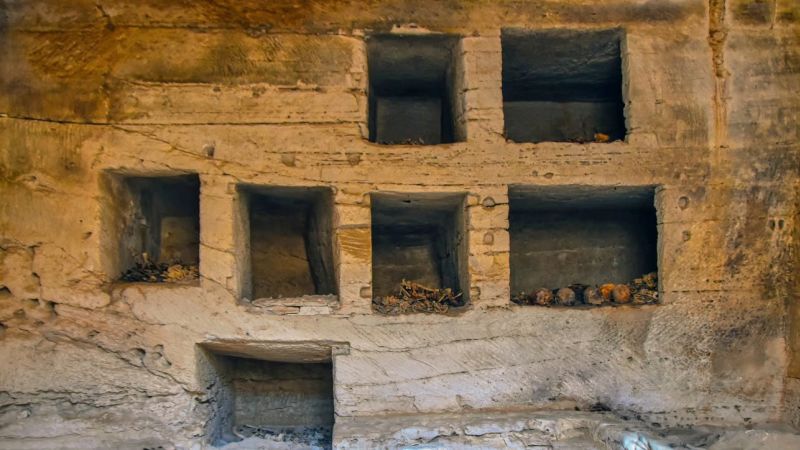
The latest findings at Marina el-Alamein include 11 rock-cut tombs, averaging 8 meters in depth, and seven surface-built limestone tombs. This brings the total number of tombs discovered in the area to 48, a significant addition to the site’s historical record. Archaeologists have also recovered pottery vessels, amphorae, lamps, plates, altars, and limestone basins, which offer clues about the burial practices and religious customs of the time.
“One of the most striking finds was a 2.5-meter-long granite sarcophagus containing skeletal remains,” said Eman Abdel-Khaliq, head of the archaeological mission. “We are currently analyzing these remains to understand more about the lives of those who lived here.”
Notably, near the sarcophagus, researchers uncovered the remnants of a plaster sphinx statue, a symbol of ancient Egyptian mythology. The statue, likely a funerary artifact, adds to the site’s cultural richness. Another fascinating element is the presence of four gold pieces placed in the mouths of deceased individuals—a practice known as “the golden tongue.” This ritual, believed to ensure the deceased could speak in the afterlife, reflects the spiritual beliefs of the era.
Diaa Zahran, head of the Islamic, Coptic, and Jewish Antiquities department, emphasized the importance of the pottery fragments discovered at the Dakhla Oasis. These octraca, or writing fragments, include inscriptions detailing commercial transactions, correspondence, and other aspects of daily life. Such materials are crucial for reconstructing the economic and social fabric of the Byzantine community. The preservation of these items highlights the ingenuity of the people who once inhabited the region.
Tourism Recovery and Cultural Significance
These discoveries come at a pivotal moment for Egypt’s tourism sector, which has been on the mend after years of political instability and the impact of the coronavirus pandemic. Following the 2011 uprising, the country faced challenges in attracting visitors, but recent efforts have seen a notable rebound. In 2025, Egypt welcomed a record 19 million tourists, a 21% increase from the previous year. The first four months of 2026 alone recorded 6.1 million visitors, surpassing the 5.7 million seen in the same period of 2025.
With the Suez Canal serving as a strategic asset, tourism remains a critical economic driver for Egypt. The government has been actively promoting the country’s rich archaeological heritage, including sites like Dakhla Oasis and Marina el-Alamein, as key attractions. The UNESCO Tentative List designation for Dakhla Oasis further underscores its potential to become a globally recognized heritage site, drawing international interest and investment.
Experts believe that the combination of these findings will enhance Egypt’s appeal as a
