
Inside a grass scientist’s 6-year quest to grow World Cup stadium turf
Inside a Grass Scientist’s 6-Year Quest to Grow World Cup Stadium Turf
Inside a grass scientist s 6 year – The FIFA World Cup, set to begin on June 11, 2026, will bring global attention to the 16 venues across North America. Yet, while the spotlight will be on the players and the matches, one individual will be monitoring the grass beneath their feet with unwavering focus: John Trey Rogers. As a turfgrass research professor at Michigan State University, Rogers is the key figure behind the meticulous selection and cultivation of natural turfgrass for the tournament’s pitches. His work ensures that every field meets professional-grade standards, a challenge that has required six years of preparation and innovation.
The Science of Perfect Grass
Rogers’ role is far from conventional. “I’m more of a grass guy than a soccer guy,” he said, explaining how his expertise in turfgrass science is critical to the success of the World Cup. The tournament features a mix of natural and artificial turf, but Rogers and his team have prioritized creating the ideal grass surface for every venue. This task is complicated by the varied climates in which the stadiums are located, from the sweltering heat of southern U.S. cities to the cooler temperatures of northern regions.
Each stadium must undergo a complete overhaul to ensure the grass is suitable for the intense demands of international soccer. For instance, eight of the 16 venues originally had artificial turf, requiring the removal of existing surfaces and the installation of new natural grass. This process is further challenged by domed stadiums, which limit sunlight exposure. Rogers noted that in these locations, “sunshine is not going to help you at all,” necessitating creative solutions like artificial grow lights to mimic natural conditions.
A Six-Year Journey of Precision
The project began in late 2020, with Rogers and his colleague John Sorochan, now a distinguished professor at the University of Tennessee, working closely to develop a tailored approach for each venue. “FIFA wants the top games to be played on natural turf,” Rogers emphasized. “Because the world’s best players will have the most control and most comfort on a natural turf surface, which they’ve been playing on their whole life.” This goal required balancing the needs of different environments and ensuring uniform quality across all 16 sites.
Rogers and his team employed specialized equipment to simulate the wear and tear of cleated shoes and measure how the grass interacts with the ball. This testing allowed them to determine the optimal grass species for each location. For example, cooler climates like Toronto, Philadelphia, and Mexico City—despite being in southern regions—were suited for a mix of Kentucky bluegrass and perennial ryegrass. In contrast, warmer areas such as Miami, Guadalajara, and Monterrey, Mexico, required Bermuda grass for its resilience in high temperatures.
However, the domed venues presented an additional layer of complexity. Stadiums in Houston, Dallas, and Atlanta, which are typically associated with warm-season grasses, had to adapt to indoor conditions. Rogers explained that “the grass will be indoors with less sunshine and under air-conditioning,” making cool-season grass blends a better choice. To sustain this, the team deployed advanced irrigation systems and artificial grow lights, which they described as “big birds that get wheeled out and put on the turf.” These lights provide a specific daily regimen to mimic sunlight, a breakthrough in turf science.
The Human Element Behind the Turf
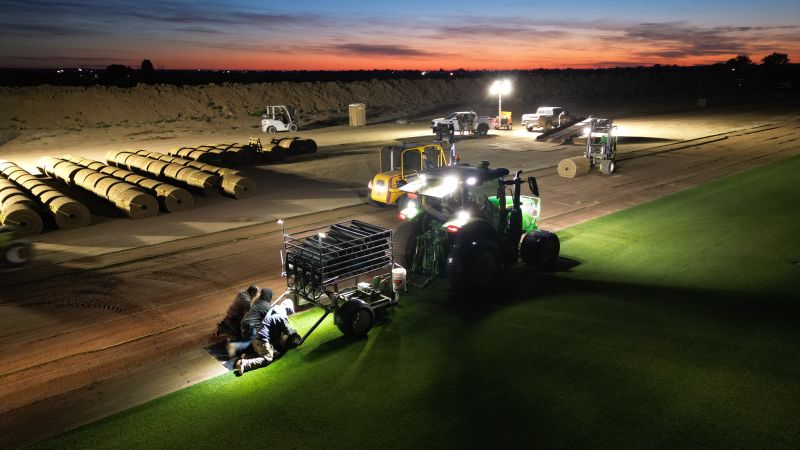
While the science is precise, the human effort behind the process is equally vital. Sod farmer Joe Wilkins III, general manager and owner of Green Valley Turf Co. in Platteville, Colorado, has played a crucial role in supplying grass for the Atlanta, Houston, and Dallas venues. Wilkins’ expertise in cultivating high-quality turf ensures that the fields are not only visually appealing but also resilient enough to withstand six weeks of intense use.
Rogers and his collaborators visited these sites monthly to monitor progress and make adjustments. “It seems a little strange that the grass is coming all the way from Colorado,” Wilkins admitted, highlighting the logistical challenges of transporting turf to distant locations. Yet, the effort is justified by the need for consistency across all venues. Rogers noted that “most of the world is soccer crazy,” but the U.S. has been an exception, with stadiums traditionally designed for American football rather than soccer. This difference necessitated redesigning fields to meet soccer-specific standards, including expanding the playing surface in some cases.
For example, the Kansas City stadium required removing 10 rows of seats to create a field surface large enough for World Cup requirements. This adjustment underscores the scale of the project, as it involves not only selecting the right grass but also modifying infrastructure to accommodate it. The goal is to ensure that players can perform at their peak, with the turf providing the right balance of firmness, cushioning, and drainage.
Challenges and Innovations
Rogers acknowledged that the endeavor is daunting, particularly given the lack of prior experience with World Cup games in multiple domed stadiums over extended periods. “We’ve not had World Cup games in multiple domed stadiums over multiple-day periods before,” he said, emphasizing the novelty of this setup. The team had to experiment with light cycles, temperature controls, and nutrient management to maintain optimal grass health in these enclosed environments.
The collaboration between scientists and agronomists has been instrumental in overcoming these challenges. By combining their knowledge of turf biology with engineering solutions, they’ve created a system that supports grass growth in conditions previously deemed unsuitable. This approach has set new benchmarks in sports turf management, blending traditional farming techniques with cutting-edge technology.
The World Cup’s success hinges on the seamless integration of these efforts. From the initial research in 2020 to the final touches in 2026, the work of Rogers, Sorochan, and their team has ensured that the grass is not just a backdrop but a vital component of the tournament. As the matches unfold, the turf will play a silent but essential role in shaping the game’s dynamics and the players’ performance. The culmination of six years of planning and experimentation is a testament to the intersection of science, sports, and global collaboration.
“We have to have a specific recipe for how many hours of light per day on the plant to have, and we’re crossing some new ground in a lot of this,” Rogers said. His team’s innovative methods have made it possible to maintain natural turfgrass in environments where it once seemed impossible.
Rogers’ work highlights the often-overlooked importance of turf in sports. While fans may not notice the grass, its impact on the game is profound. The right mix of species, careful maintenance, and advanced technology ensure that the pitches are both safe and competitive. This six-year quest has not only transformed the World Cup’s stadiums but also redefined the standards for natural turfgrass in the sport.
