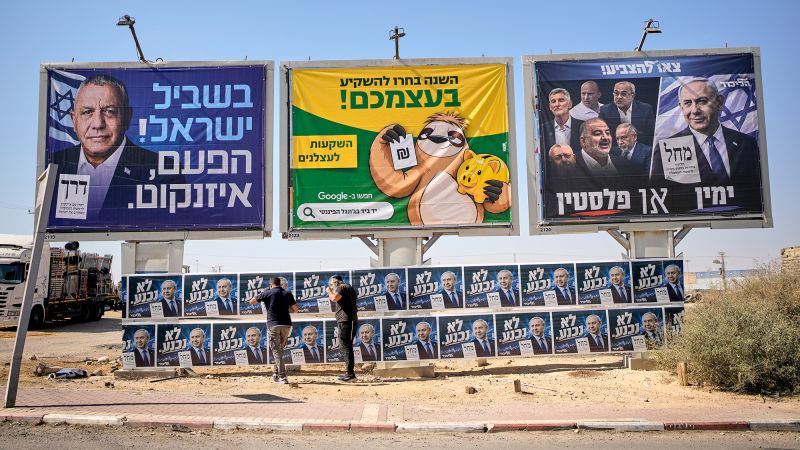
Israel is holding its most important election in years. Here’s what’s at stake

Daftar Isi
Israel’s 2026 Election: What Is at Stake for Voters
Earthguardiansonline.com – Israel is holding its most consequential election in years on October 27, with voters deciding whether Benjamin Netanyahu should remain prime minister after a period defined by war, political upheaval and deep social division.
The vote is the first nationwide election since the Hamas-led attacks of October 7, 2023, and the conflicts that followed in Gaza, Lebanon and Iran. For many Israelis, it is a chance to assess the government’s handling of security failures, military operations and the country’s future direction.
Netanyahu, Israel’s longest-serving leader, again stands at the center of the campaign. But the result will affect far more than one political career: it could determine the shape of the next coalition and Israel’s approach to security, religion, the judiciary and relations abroad.
War, security and responsibility dominate the campaign
Israel is holding its most important vote since the October 7 attacks, which were widely seen as the country’s gravest security breakdown. Questions over accountability, military service and the government’s strategy in the conflicts that followed remain prominent for voters.
The outgoing coalition completed a full four-year term, an uncommon outcome in Israeli politics. It was built around Netanyahu’s Likud party, far-right parties and ultra-Orthodox partners, advancing a more nationalist and religious agenda.
Its term also included fierce arguments over proposed judicial changes. Netanyahu became the first serving Israeli prime minister to face trial on corruption charges, while his government’s judicial overhaul plans prompted major demonstrations across the country in 2023.
How the Israeli election and coalition system work
Voters elect party lists to the 120-seat Knesset rather than choosing a prime minister directly. Israel uses proportional representation, allowing smaller parties to win representation but making coalition negotiations essential.
Thirty-seven lists are registered for the election. A party must receive at least 3.25% of the vote to enter the Knesset, and polls suggest that roughly 11 to 13 parties could pass that threshold.
Winning the largest number of seats does not guarantee control of the government. A prospective prime minister needs support from at least 61 lawmakers, and no party has ever won that number alone. Coalition talks can therefore last days, weeks or months.
Netanyahu and Eisenkot face an uncertain contest
The largest parties are expected to be Likud and Yashar, a new centrist party led by former Israeli military chief of staff Gadi Eisenkot. Eisenkot has emerged as Netanyahu’s principal challenger.
Polls have produced sharply different projections. A Channel 12 survey gave Yashar 23 seats and Likud 21, while a Channel 14 poll put Likud at 30 seats and Eisenkot’s party at about 20. Eisenkot has held an advantage over Netanyahu in surveys asking who is more suitable to be prime minister, though personal popularity alone cannot form a coalition.
Most polls put Netanyahu’s potential bloc between 49 and 55 seats. It includes Likud, the far-right parties led by Bezalel Smotrich and Itamar Ben-Gvir, and two ultra-Orthodox parties. That remains below the 61-seat threshold.
Israel is holding its most closely watched election because the opposition is not a single unified camp. Eisenkot faces competition from former Prime Minister Naftali Bennett and former Defense Minister Avigdor Liberman, while Yair Golan leads the Democrats party on the left. Their differing ambitions and priorities could make a post-election agreement difficult.
FAQ: Israel’s 2026 election
When do Israelis vote?
Israelis are scheduled to vote on October 27.
Do voters directly elect the prime minister?
No. Voters choose Knesset party lists. The candidate able to assemble support from at least 61 of the 120 lawmakers can form a government.
Why does this election matter?
Israel is holding its most significant electoral test in years amid continuing security pressures, disputes over the October 7 failures, debate over the judiciary and uncertainty about the country’s political future.